Clint Dempsey´s gol de barriga against Portugal sent me into fits of belly slapping. It may be the most famous goal of its kind since Renato Gaucho´s 1995 tally that won the Campeonato Carioca for Fluminense. As I was pounding out a batucada on my stomach it came to me that the bacchanal of the Copa is all about the gol de barriga.
Mysterious circumstances landed me in one of the hospitality suites for the Belgium x Russia match. In order to get there I had to pass through four levels of Military Police, two levels of ticket checkers, one turnstile, and then a credentialing center where I was given a multi-colored wristband that identified my place in the consumption circus.
Once the three business-attired, very thin, very attractive multi-lingual Brazilian women had kitted me out and opened the door to the consumption zone, I was met by the leveled gaze of three very dark, very plump, very unhealthy looking women who were standing in the foyer to the handicapped bathroom. Their dark crimson uniforms said more than they ever would about their position in the hierarchy. Between them and me was a table heaped with salads and deserts. The open bar offered champers, wine, gin and tonic, beer, whisky, vodka, capirinhas. Russians, Belgians, Brazilians were going back and forth to the buffet as the noise of the crowd built outside.
The hospitality sector of the Xaracanã was not close to full when the game started, nor would it be for the match as a whole. Yet the official attendance figures tell a different story. The emptiness of the stands is a reflection of the corporatization of the event as a whole. Mutli-nationals buy up these packages through MATCH and then give tickets as gifts to clients or friends. The major purchasers of these packages in Brazil are the civil construction firms that have made billions through over-priced stadiums and infrastructure for the World Cup.
Here´s the flow: Civil construction firms finance election campaigns. The World Cup projects are hastily proposed in back room agreements between government officials and the civil construction firms. Brazilian taxpayers finance multi-billion real projects that are contracted to the civil construction firms. These firms then spend millions on MATCH hospitality packages. Employees go to the hospitality suites to fill their bellies in the same way that their companies have filled their coffers with public money. Cheap labor increases MATCH´s profits in the same way that slave labor enriches Odebrecht in Angola. Belly size increases while the poor stare hungrily at the banquet table.
This is why it is so easy to score a gol de barriga in Brazil.
Showing posts with label Odebrecht. Show all posts
Showing posts with label Odebrecht. Show all posts
24 June 2014


19 January 2011
The March of the White Elephants
And I’m back...
 |
| Santa Cruz |
Some background. Recife already has three stadiums, one each for the city’s principal teams - Sport, Náutico, and Santa Cruz (see photos). None of these were considered for renovation or modification for the Copa. The current project is being developed on a Greenfield site in the suburbs, has an initial budget of R$ 532 million (US$ 302 million), a capacity for 46,000 spectators and parking for 6,000 cars. The Arena Pernambucana is going to cover a massive area (218 hectares – a donation from the state) and will include the building of nine thousand apartments. The entire project is being directed by Odebrecht which is operating under a public-private-partnership. It is unclear how much money Odebrecht had to put up front, but the Pernambuco State Secretary for the World Cup told OGlobo that the apartments should generate R$33 milllion for ‘private investors’. Odebrecht has contracted the USA-based entertainment giant AEG Facilities and ISG (International Stadia Group) to run the show for the next thirty years. OGlobo happily reports that AEG is responsible for bringing Paul McCartney, the Black Eyed Peas, and Bon Jovi to Brazil! Wow! The president of the State Copa Secretariat was also quick to point out that Ajax ArenA hosted a royal wedding and that the Arena Pernumbucano could, what, host Lula’s traveling circus act? Fala sério meu irmão.
 |
| Nautico |
 |
| Sport |
The plan, therefore, is to have all three of Recife’s teams play their games in the new Arena. None of these teams are currently in the first Brazilian division. Of course, if the teams decide to play in the stadiums they already have, the plan to have an “economically sustainable” [sic] stadium will be shot. In which case, the state government will be obliged to pay Odebrecht around R$ 5 million a year. Public risk, private profit. The president of the Odebrecht Consórico said that the local teams “shouldn’t bother with the management of their stadiums whose maintenance costs are not compatible with their financial situations.” What?
Because these teams can no longer afford the maintenance costs of their stadiums (which is likely not true), they should abandon them? Náutico averaged 15,954 and Sport 15,667 fans in 2009 while in the 1st division, Santa Cruz averaged 38,249 while in the 4th division. These are far from pathetic numbers, did anyone ask the teams if they had trouble maintaining their stadia? The president of the state football federation said, “The problem is that fans here have the culture of watching their teams play at home. It’s not easy to move this idea in their heads.” No kidding. It’s also difficult to imagine an arena that is 19km from the city center being a site of convergence for the tens of thousands of people that will have to consume there on a weekly basis to make the project anything but a drain on public coffers.
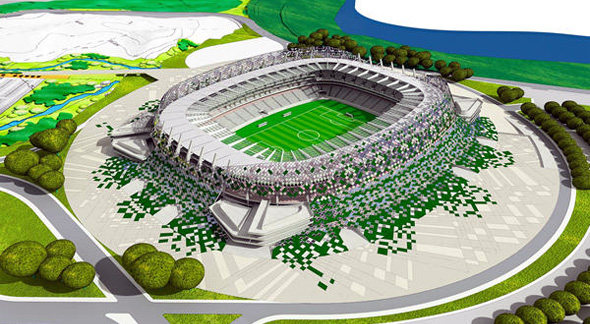 |
| Arena Pernambucana. The raw beauty of contextualized urbanism. |
It appears that the plan for Recife is for the public to invest massively in a stadium project, hand it over to a private firm, and if the stadium turns out not to be economically viable the state will have to subsidize the loss while the private entity makes out like bandits on the real-estate development project. In addition to this and perhaps more insidious is the R$3 billion, yes billion, that will be invested in transportation infrastructure. As we saw in Johannesburg and are witnessing in Rio, these transportation projects do not necessarily attend to the real needs of the city. Hopefully there will be some more information forthcoming about the nature of these transportation projects. The degree of improvisation that is happening in most sectors of “planning” for the world cup was revealed in the final paragraphs of the article. The State Secretary for the Cup Ricardo Leitão said that a potential shortage of hotel rooms was not really a concern because many tourists were probably going to sleep aboard their trans-Atlantic ocean liners during the Cup and that the secretary of tourism was going to start registering residents who want to put people up in their homes. Actually, this last idea is very good, but probably not the first or most readily available option for nervous international tourists coming to Brazil for the first time.
The march of the white elephants continues.
12 August 2010
And the winner of the Maraca project is...
The biggest civil engineering firms in Brazil!
The Rio State Government awarded the Maracanã construction contract to Consórico Brasil 2014, a consortium composed of the massive civil construction firms Andrade Gutierrez, Delta and Odebrecht. The stated reason for the victory - they came in with the lowest bid, R$712,000,000 a whopping 2.4% below the allocated budget.
This rationale for selecting a construction company is nullified by a tidy exception in the law when dealing with architectural reform projects. Because the Maracanã is undergoing “renovation” the law permits contractual readjustments up to 50% of the contracted value. Therefore, the legal limit for the Novo Maracanã project will be R$1,068,000,000 (R$1.068 billion). Why not spend it? When added to the R$ 430 million spent between 2005-2007 on reforms for the Pan American Games…R$ 1,498,000,000. This number reflects the best case scenario.
To reiterate: the federal and state governments are spending at least one point five billion Reales (US$ 881 million) on a stadium in a city where less than 20% of public schools have recreational areas for students. This is yet another example of the prioritization of contracts with international sporting agencies taking precedence over the social contract of a democracy.
There is a meeting being held today between the State Secretary of Sport and Leisure, the Company for Public Works (EMOP) and a representative of Consórico Brasil 2014 to determine when the project will actually begin. The longer they wait, the more money there is to be sucked out of the public coffers.
Does anyone remember, way back when Brazil was first going about organizing the World Cup, that the Minister of Sport said, “The government is not planning to use public money for the construction or remodeling of stadiums.” (Folha do SP 31.11.07). The private sectors is not jumping in BECAUSE IT IS A BAD INVESTMENT.
FIFA’s deadline of December 31, 2012 is driving the entire process. FIFA’s absurd demands informed the architectural project, the cost, the way that urban space around the stadium will reshaped and exploited for private profit. The public interest is the last item on the agenda. All that matters now is that the state and federal governments get the check book ready so the city, state and federal governments can pay Brazil 2014 to deliver on a promise made to organized criminals.
But don't despair, Brazilian taxpayers, there is still hope that the process can be delayed even further because the losing bidders have the chance to suspend the contract process through legal means. The underhanded dealings of the licitação are reflective of the total lack of transparency in general. All of the candidates were informed (via fax) after business hours on Monday night that the winning bid would be announced on Tuesday morning. In reading between the lines of OGlobo’s characteristically Prozac-influenced reporting, the faxed messages included information telling companies that they were disqualified because their bids were outside of the required parameters. The eleventh-hour notification was not accidental. This is a game played with marked cards.
I will get used to this opacity, eventually, but it really does seem to be much more work to hide everything than to negotiate in the light of day. One of the terrible beauties of Brazilian bureaucracy is that there are so many forms and agencies and permissions and confusions, that there is inevitably something wrong with everything, which always provides an excuse to eliminate a company from the competition. Will there be collusion between Brasil 2014 and the losing bids in order to delay the process for another six months so that the budget for the project will increase as FIFA’s version of the Mayan Calendar comes to a close?
The news from Manaus is no better. The Tribunal de Contas da União (TCU, the federal auditor) and the Ministério Público Federal (MPF, the federal judiciary) are investigating a supposed budgetary overrun of R$749 million. This money is related to the construction of the Arena Manaus and a monorail, two things that Manaus could desperately live without. Of the R$1.3 billion destined for the monorail, R$686 million are in question. Brincadeira. Of the R$ 591 million intended for the stadium (in a city that does not have a team in any of the top three Brazilian divisions), R$63 million are in question. Various federal investigative agencies are wading through the mess, which so far only involves the contracting stage. Imagine once the project actually gets moving! Multiple the situation in Manaus x 12 and you get the general picture for the 2014 World Cup.
14 May 2010
2014 + 2016 = Brasil 4030 (milhões de reais)
Recife announced that the Brasilian construction giant Odebrect has won the licencing contest to build its World Cup stadium at a cost of R$532.6 million. This is 77.5% over the projected cost in May 2009. Of course, no construction has begun, so we can expect this number to increase by at least a third before this suburban stadium turns into a white elephant.
Last week, Lula announced a financing package of R$12.8 billion for the World Cup, but included an "anti-Pan" clause, requiring that cities and states somehow gaurantee that budgets be kept in check. R$ 8 billion of this money is intended for infrastructure improvements (this in addition to the R$5 billion in freemoney given out by the national development bank to subsidize stadium construction). The anti-Pan clause should have required that anyone involved in the bungled mess of the Pan American games be prevented from participating in the World Cup or Olympics. Sadly, all of the same people are in charge and we can expect the same black box to produce the same red recepits.
The almost total absence of private sector investments in Brazil 4030 is a VERY GOOD INDICATION that mega-events ARE NOT A GOOD INVESTMENT. Does anyone in Greece yearn for the halcion days of freely spending on toursit, transportation, and sporting infrastructure, or would they like their pensions back? Brasil's economy has been doing well of late, but the federal government is spending it like they're Sarah Palin on 5th Avenue.
The absurdities never cease in relation to FIFA and IOC. The news coming out of South Africa is terrible. Residents are claiming that the World Cup Regime is worse than Apartheid. The same thing will happen here, despite the government's attempts to green and white wash the real issues driving urban and social divides.
The 13 airport projects for the 2014 World Cup are already delayed. Everyone has fortunately forgotten about the bullet train idea. And only seven stadium projects have been approved by FIFA (which is a good thing - something I'll be writing about soon).
After attending the 1st Symposium on Football Studies at the Football Museum @ São Paulo's Pacaembu stadium, I'm convinced that the Morumbi in São Paulo should be excluded from the World Cup. The city doesn't need the headache and has no functional tourist infrastructure.
Public spending for public goods that are well and truly public, yes. Public spending for FIFA and the IOC to party for 7 weeks, transforming cities for the next generations and leaving us with insurmountable debt and elaborate infrastructure that doesn't pay for itself, not so much.
Last week, Lula announced a financing package of R$12.8 billion for the World Cup, but included an "anti-Pan" clause, requiring that cities and states somehow gaurantee that budgets be kept in check. R$ 8 billion of this money is intended for infrastructure improvements (this in addition to the R$5 billion in freemoney given out by the national development bank to subsidize stadium construction). The anti-Pan clause should have required that anyone involved in the bungled mess of the Pan American games be prevented from participating in the World Cup or Olympics. Sadly, all of the same people are in charge and we can expect the same black box to produce the same red recepits.
The almost total absence of private sector investments in Brazil 4030 is a VERY GOOD INDICATION that mega-events ARE NOT A GOOD INVESTMENT. Does anyone in Greece yearn for the halcion days of freely spending on toursit, transportation, and sporting infrastructure, or would they like their pensions back? Brasil's economy has been doing well of late, but the federal government is spending it like they're Sarah Palin on 5th Avenue.
The absurdities never cease in relation to FIFA and IOC. The news coming out of South Africa is terrible. Residents are claiming that the World Cup Regime is worse than Apartheid. The same thing will happen here, despite the government's attempts to green and white wash the real issues driving urban and social divides.
The 13 airport projects for the 2014 World Cup are already delayed. Everyone has fortunately forgotten about the bullet train idea. And only seven stadium projects have been approved by FIFA (which is a good thing - something I'll be writing about soon).
After attending the 1st Symposium on Football Studies at the Football Museum @ São Paulo's Pacaembu stadium, I'm convinced that the Morumbi in São Paulo should be excluded from the World Cup. The city doesn't need the headache and has no functional tourist infrastructure.
Public spending for public goods that are well and truly public, yes. Public spending for FIFA and the IOC to party for 7 weeks, transforming cities for the next generations and leaving us with insurmountable debt and elaborate infrastructure that doesn't pay for itself, not so much.
Subscribe to:
Posts (Atom)
