Showing posts with label Soccerex. Show all posts

01 December 2011

Mega-events don’t exist

Mega-events don’t exist.

There is no point in using the term “mega-event” except as a convenient placeholder for the impossibly complex, intersecting, mutually dependent and independently functioning elements that come together to produce whatever the “mega-event” is.

Deconstructing the World Cup and Olympics and organizing them into intelligible, digestible bits that can be understood is, perhaps, within the realm of possibility. Understanding the hundreds of millions of moving parts and how they come together to give us something like the 2014 FIFA World Cup is impossible. Pulling on a loose thread may begin to unravel the general structure, but without understanding the whole at the end of the day you’re left with a pile of micro-fibers.

So, let’s stop talking about mega-events and start talking about “accelerated process of socio-spatial transformation punctuated by signature global events”. Not very catchy, I know. How about “vicious circles of creative destruction marked by overlapping sovereignties, deliberately vague responsibility frontiers, and the imposition of homogeneous and globalized consumer cultures”. Perhaps something more pithy? Hmmm…”the normalization of a condition of political exception that generates the compulsory acceptance of a consumptive ritual decoupled from its ontological moorings.” Hard to put an acronym on that.  Oh well. Perhaps my degree in philosophy will come in handy while discussing the non-existent.

It must be because the mega-event doesn’t exist that no one can take ultimate responsibility for the processes it unleashes and the impacts it generates. FIFA can’t be blamed for the transportation infrastructures that cities choose to install. The cities can’t be blamed for wanting to host the World Cup. The state can’t take responsibility for the way that FIFA goes about its business, though they could refuse to get on their knees to bring the event. Sponsors can’t be blamed for the human rights violations that pave the way for their profits.  The security demands of the event attend to the real and perceived risks that the event itself generates. No event, no risk? Or is the risk in not having the event?

I am not trying to hedge my bets here, but trying to make sense of the arguments, displays, discussions and presentations from Soccerex over the last three days. There are billions of dollars of public funds in play. This money, although also fictitious and conceptual, has very real effects and could be put to uses other than hosting a month long soccer tournament. Because no one has ultimate responsibility over the way in which this money is spent and the effect it has, before smashing the Cup on the ground to see what it’s made of we’ve got to continually step back to look at the Cup as an object: an object of desire, a goal in and of itself, a process, a social construction, a symbol, a moment, and a means to various, valorous and nefarious ends. In Brazil, this Cup runneth over with problems, contradictions, intransient bureaucracy, narrow political agendas, nepotism, corruption, graft, conflicting interests, ill-conceived projects, forced removals, rule by decree, a lack of effective urban planning and the funneling of public money to private hands in one of the most unequal societies in the world -  quite a lot for something that doesn’t exist. 

01 December 2010

The Stadium as Disciplinary Space

Facial identification of fans to be installed at the Engenhão stadium in Rio

One of the terrifying elements of going to events like Soccerex and Expoestádio is that I get to see all of the new technologies being developed in order to control fans. As I wrote with Gilmar Mascharenas some time ago, stadiums are places of discipline, where everyone is watched, measured, evaluated, judged, reformed, controlled. The players suffer the greatest scrutiny, followed by the referee, the coaching staff, the fans. Going to stadiums is a contradictory practice. We go to public space to lose ourselves in the crowd, but at the same time we are controlled, shunted, forced, and watched over like never before. The seating arrangements determine our behavior to some degree, the way that space is structured in and around the stadium directs our movement, the police lord over the crowd, the advertisers target us, and we watch each other – 80,000 cell phone cameras record everything.  

With the arrival of the World Cup in Brazil, and given the recent events in Rio, all people want to talk about is “security”. The concept of security as it is used in the media and by football officials is woefully narrow, focusing solely on the physical integrity of the fan. The security to come and go from the stadium without suffering robbery, attack, or threat is a fundamental one but surely security pertains to much more than what should be a fundamental condition of citizenship. In Brazil, the Law of the Fan is basically a penal code that creates extraordinary statutes for violent acts that occur in and around stadia. The “rights” of the fan to be “secure” do not extend past the limited conception of physical integrity. We could also consider security to pertain to culture and social well-being:

Are we secure in the knowledge that our rights as citizens will be protected? How will the information gathered about fans be used? Is there security of information? Do we have guarantees that public money being spent on stadia is meeting social needs, or is the huge expenditure going to decrease social welfare?  What are the opportunity costs of hosting mega-events and do they contribute to social security other than an increase in policing (which is not, in Rio de Janeiro, synonymous with security)?

With all this in mind I was perturbed to read a press release from Axis communications expressing in very press-release terms that soccerex would host the launching of a new camera that would identify football fans’ facial features as they go through the turnstiles:

 “the prototype, developed in Brazil, will be presented a the BWA stand, a business that offers complete solutions for the control of access to events…as the fans approaches the ticket reader (electronic, with specific seat), they will have their image registered in high definition and stored in a data bank. In the case that something happens in a determined seat, it will be possible to immediately identify the face and the data of the fan that occupied that place…after Soccerex, the camera will be tested in various stadiums that will host the World Cup.”

Because none of the stadiums that will host the World Cup will be ready until 2013, the test is going to take place at Rio's Engenhão (Fechadão, Stadium Rio, Estádio Olímpico J.H.). It might be tested this Sunday as the stadium will be full to see Fluminense grab their first Brasileirão title in 26 years.

This new camera, combined with microphones that can pick up a conversation from 500 meters between two people in a crowd and the multi-billion real investment in security apparatuses for the mega-event city are all part of a larger disciplinary scheme that is making Rio de Janeiro and its stadiums, and its stadium cultures, ever more docile, ever more ready to facilitate the free flow of capital. The new model of fandom is well known in other parts of the world. Buy your ticket, pay to park, walk quietly to the stadium, buy some things at the shop, sit down, buy some food, applaud, control yourself (or others will), consume, get out, come back. Repeat.

In summary: Brazil 2014 is making the world safe for capital accumulation, one high-tech security apparatus at a time. 

Soccerex and the 2014 World Cup

This is a link to an article published today in TheShinGuardian about soccerex and the 2014 World Cup.


Brazil 2014: Soccerex & BBC Response

Professor Christopher Gaffney checks in again from Brazil…
The Soccerex Global Convention was held last week in the Copacabana Fort, attached to the Sofitel in Rio de Janeiro. The title of the convention, Uniting the Football World, made as much sense as FIFA’s slogan, For the Good of the Game. The world of football is huge, as big as the world itself, but we know what they meant: Bringing together people who are in the business of football.
Soccerex is the biggest football business event of the year, dwarfing Expo Estádio, which has also been held in Rio the past two years. The entry fee to Soccerex was a tidy ₤800. It will be held in Rio every November through 2013.
I’m writing about Soccerex because it gives deep insight into the precarious and bordering-on corrupt state of Brazilian football, the preparedness of Rio for mega-events, and the general absurdities that are pertaining in the run up to 2014.
Let’s begin with the World Cup.
Only five of the twelve host cities were represented at Soccerex: Rio de Janiero, Belo Horizonte. São Paulo, Porto Alegre, and Salvador da Bahia. Of the five, only Belo Horizonte had a thoroughly professional team in place to answer questions about the Minerão stadium project. (A project that, surprisingly, is not being financed by the city government but rather by a Public-Private-Partnership).
The Minerão project is not without its problems, but the team they sent to attend media inquiries were willing and able to respond to some difficult questions and have sent alonginformation regarding the project.
São Paulo’s booth was lovely, but as we know, there is currently no stadium project underway for Brazil’s biggest city and main point of entry.
Let me repeat that. São Paulo, Brazil’s biggest city, does not have a stadium project for 2014….yet.
The idea is that Corinthians are going to build a new stadium, but ground is closer to exploding than breaking, literally.
Well, there is a Petrobras gas pipeline that runs through the site. Surely São Paulo will have a stadium for the World Cup. Raquel Rolink, a well-known Brazilian urbanist and UN delegate, has suggested that São Paulo’s Morumbi project was not sufficiently expensive to allow for FIFA to gain monies from and thus was dropped from consideration.
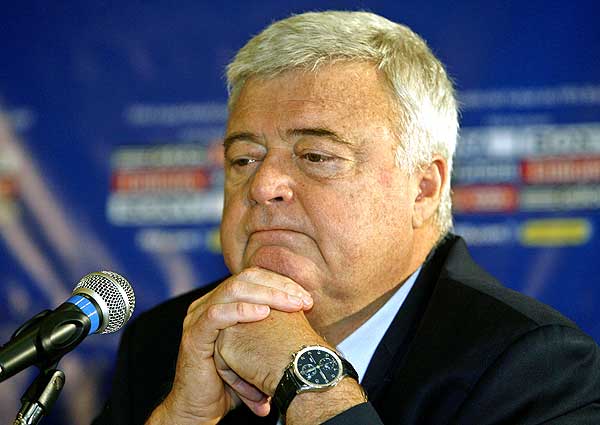
There is also the likelihood that Ricardo Teixeira, head of the Brazilian Football Confederation is working with his longtime confidante Andre Sanchez, president of Corinthans, who is assumed to be next in line for the CBf presidency should Teixeira head for Switzerland and FIFA House to escape the recent corruption claims.
Salvador had a touching video of the Novo Fonte Nova, some Bahianas dressed up in traditional garb, but nothing concrete to offer.
Porto Alegre had set up a small room that looked like place to open a bank account: not very inviting and clearly targeting a limited audience. The Beira-Rio project is one of the few that is being financed by a private entity (Internacional F.C.) and as a result is the stadium project with the lowest cost and perhaps greatest post-Cup use value.
The big show, of course, was reserved for Rio and the Novo Maracanã project. The show was led by the mono-lingual state secretary for tourism and leisure, Marcia Lins, who stood proudly over the stadium model showing the unquestioning media all of the “improvements” that would be made to the no-longer-so-colossal stadium.
Let’s remember that the Maracanã underwent hundreds of millions of dollars of reforms from 2005-2007 to “prepare” it for the Pan American games. All of those reforms have just been blasted through to get started on the “facelift” the 60-year-old ground will get for 2014. It’s an expensive lift. A project that was projected to cost R$500 million in May of 2009, jumped to R$709 million one year later – without actually doing any work!
Imagine how much it is going to cost by the time 2013 and the Confederation Cup rolls around. There is no justification for this kind of expenditure of public money on stadiums that will be handed over to FIFA and the IOC for private profit.
Soccerex was a relatively small event in a small space. That doesn’t explain why there was almost no information about what was happening on a daily basis. The only way to get a schedule of events and talks was to download it to an ipad or iphone. There was nothing available in paper on the day of the event. Speakers changed rooms and times without warning. The press conference rooms were small and ill-prepared. The bathrooms were port-a-potties with no paper towels. Sure it’s a fort, but come on! For 800 pounds I would have expected more.
As I commented in my previous article, the 2014 Local Organizing Committee is headed by five people.
Ricardo Teixeira and the head and the other departments (as I was informed by the LOC press secretary) are: Strategic Planning and Operations Support (Joana Havelange), Operations (Ricardo Trade) and Communications (Rodrigo Paiva). What are the qualifications of these people to do what they do? Ms. Havelange is 33 years old. She willonly report to her father. Let’s talk about him.
Ricardo Teixeira: Questionable
Ricardo Teixeira was named in the Andrew Jenning’s BBC report as a recipient of bribes paid out during the long running ISL – FIFA scandal.
The media in Brazil did some much-delayed back flips when it was revealed last week that it will be possible for Teixeira to direct all of the profits of the 2014 LOC to himself.
How? In order to register as a corporation, the 2014 LOC needed to have a real person as a partner (apparently). Teixeira was made a .01% owner of the World Cup yet was given the power to direct profits where he sees fit. This is already the first time that the head of the national football federation will be heading up the LOC. Now the head of both of those organizations has been accused (and not for the first time) of being on the happy end of bribery schemes and has put himself in a position to make hundreds of millions off of the World Cup that is being constructed and financed with pubic money.
The stadium projects will forcibly dislocate people from their homes. They will all be way over budget. The majority will be mono-functional structures that have no articulation with their urban environments. Transportation infrastructures will not attend to the demands and needs of the local context but will ram through neighborhoods to link the stadiums to tourist areas. Everything associated with the World Cup will be exempt from taxation, visas procedures, and regular fiscalization by any level of government. The documents and legal exemptions that Andrew Jennings highlights in his videos are already reality in Brazil.
free counters

Labels

2014 World Cup Rio de Janeiro Maracanã FIFA 2016 Olympics 2016 Summer Olympics Eduardo Paes CBF Copa do Mundo 2014 Rio de Janeiro Olympics Ricardo Texeira World Cup 2014 Vasco da Gama 2010 World Cup White Elephants mega-events APO UPP BRT Brazil football Flamengo Lula Orlando Silva violence ANT Aldeia Maracana Carlos Nuzman Dilma Eike Batista Rio 2016 Sergio Cabral 2007 Pan American Games Campeonato Carioca Corruption IOC Jerome Valcke Novo Maracanã stadiums BOPE BRASIL 2016 Brasil 2014 Engenhao Joao Havelange Maracana Policia Militar Vila Autódromo Aldo Rebelo Botafogo Henrique Meirelles Medida Provisoria Metro Revolta do Vinagre Sao Paulo Sepp Blatter World Cup 2010 forced removal Carnaval Elefantes Brancos Fechadao Marcia Lins Minerao Morumbi Odebrecht Porto Maravilha Rio+20 Romario Security Walls South Africa South Africa 2010 TCU Transoeste protests public money public transportation slavery transparency x-Maracana Andrew Jennings Argentina Audiencia Publica Barcelona Brazil Carvalho Hosken Comitê Popular Confederatons Cup Copa do Brasil 2010 Cost overruns Crisis of Capital Accumulation EMOP FERJ Favela do Metro Fluminense Fluminese Fonte Novo IMX Jose Marin Leonel Messi London 2012 Marcelo Freixo Maré Museu do Indio Olympic Delivery Authority Perimetral Rocinha Soccerex Transcarioca bicycles consumer society debt idiocy militarization transportation 1995 Rugby World Cup 2004 Olympics 2015 Copa America Banco Imobiliario Barcas SA Belo Horizonte Bom Senso F.C. Brasilerao CDURP CONMEBOL Champions League. Mourinho Complexo do Alemão Copa Libertadores Cupula dos Povos ESPN England FiFA Fan Fest Istanbul 2020 Jogos Militares John Carioca Kaka Manaus McDonald's Obama Olympic Village PPP Paralympics Providencia Recife Russia Salvador Soccer City Taksim Square Tatu-bola Urban Social Forum Vidigal Vila Olimpica War World Cup Xaracana attendance figures cities corrupcao drugs estadios football frangueiro futebol mafia planejamento urbano police repression porn privitization reforms shock doctrine taxes 201 2010 Elections 2010 Vancouver Olypmics 2013 2018 World Cup 2030 Argentina / Uruguay ABRAJI AGENCO ANPUR ANT-SP Amazonia Ancelmo Gois Andrade Gutierrez Anthony Garotinho Arena Amazonia Arena Pernambucana Athens Atlético Paranaense Avenida das Americas BID Barra de Tijuca Blatter Brasil x Cote d'Iviore Brasileirão 2013 Brasilia Brasilierao Bruno Souza Bus fares COB COI COMLURB CPI CPO Cabral Caixa Economica Canal do Anil Cantagalo Celio de Barros Cesar Maia Chapeu Mangueira Chile 2015 Choque do Ordem Cidade da Copa Class One Powerboat Racing Clint Dempsey Comite Companhia das Docas Copa do Brasil Corinthians Cuiabá Curitiba Dave Zrin David Harvey Der Spiegel Eastwood Edge of Sports Escola Friendenrich Expo Estadio Expo Urbano FGV Fonte Nova Gamboa Garotinho Geostadia Ghana Globo Greek Debt Crisis Greek Olympics HBO Hipoptopoma IMG IPHAN ISL Iniesta Internatinal Football Arena Invictus Istanbul Itaquerao Jacque Rogge Jefferson John Coates Jose Beltrame Julio Grondona Julio Lopes Julio de Lamare Knights Templar Korea Lei Geral da Copa MAR MEX Manchester United Mangabeira Unger Maracanã. Soccerex Marina da Gloria Mexico Milton Santos Molotov Cocktail Mr.Balls Neymar Nicholas Leoz Nilton Santos Olympic Flag Olympic Park Project Oscar Niemeyer Pacaembu Pan American Games Parque Olimpico Pernambuco Plano Popular Plano Popular do Maracana Plano Popular do Maracanã Play the Game Pope Porto Alegre Porto Olimpico Porto Seguro Portuguesa Praca Tiradentes Preview Projeto Morrinho Putin Qatar Quatar 2022 RSA Realengo Regis Fichtner Roberto Dinamite Russia 2018 SETRANS SMH Santa Teresa Santos Sao Raimundo Sargento Pepper Security Cameras Smart City Sochi 2014 South Korea Stormtroopers São Januário São Paulo Teargas Templars Tokyo 2020 Tropa do Elite II Turkey UFRJ/IPPUR URU USA USA! Unidos da Tijuca United States government Urban Age Conference VVIP Via Binário Victory Team Vila Autodromo Vila Cruzeiro Vila do Pan Vilvadao Vivaldao Volta Alice Wasteland Workers' Party World Cup 2018 Xavi Zurich apartments atrazos barrier beer bio-fuels bonde capacities civil society comite popular copa sudamericana crack crime dengue dictatorship estádios favelalógica feira livre fiador flooding freedom of information furos geral graffiti guarda municipal host city agreement identity infrastructure ipanema istoe labor rape riots schedule school shooting security segregation social movements stadium state of exception supervia tear gas ticket prices torcidas organizadas tourism traffic tragedy trash trem-bala velodromo wikileaks xingar