28 February 2011

Photos: Corinthians (3) x Santos (1)

These are some photos from a trip to one of the Paulista clássicos with the people from ANT-SP. Most of these are self-explainatory. My ticket, bought from a cambista, was R$50 (face value R$30, probably purchased for R$15). He initally wanted R$70. It's not cheap to go to the stadium in Brazil.

Plaza Charles Miller and the walk to the entrance
Bandeira in waiting

Main entrance, Pacaembu. Opened in 1939. 

big, but not uncommon

Playing on Corinthians' nickname of "Black Chickens", the Santos fans circle the stadium with corn feed the night before the game.

Integrantes, ANT-SP


one of millions
under the bandeira

cold rain, getting ready to fall


A nation of more than 30 million crazies. Santos fans stuck in the far corner of the stadium. 

Under the narrow roof, six rows back. I missed the third Corinthians goal.

"Fans: sit in the right place"

Galinha nova, galinha grande

22 February 2011

Oh no, more APO...

Today, the Brazilian lower house is taking up the possibility of reforming Provisional Measure 503/2010 (MP 503/2010) that may or may not create a new state agency to run the 2016 Olympic Games. Rio's mayor, Eduardo Paes, has been expressing his dissatisfaction with the measure which will take much of the power over Olympic construction out of his hands and put more powerful and qualified people than him in positions of power. According to today's small column in OGlobo, there does not appear to be much chance of changing MP 503/2010 as it has to be voted on before March 1. If the vote is delayed, the MP will die and Rio's Olympic project will be delayed for another few months (not necessarily a bad thing).

Apparently Dilma, Paes, and Rio state govenor Sergio Cabral are willing to let the measure die rather than create the new state agency. The creation of the Public Olympic Authority and the Brasil Sport Legacy [sic] Company (or BRASIL 2016), was a fundamental piece of Rio 2016's bid. It has been nearly a year and a half since Rio won the Olympic auction. While I agree that MP 503/2010 needs to be radically reformed, there has been no public discussion of the MP in Rio and there will be no mechanisms for civil society to participate in the decisions taken regarding the city's future. There are R$30 billion hidden agendas in this process, but if MP 503/2010 does not get voted upon, it may be just the opporutnity that Rio's social movements and public defenders need to get insert themselves into the hurricane of creative destruction that is making its way to South America.

The TCU report from last week didn't have any immediate or noticable effect on the CBF or the organization of the World Cup. Today I published a o a slightly revised version of last week's article regarding the TCU's findings about Brazil's 2014 World Cup preparations at The Shin Guardian, one of the leading footy websites in the USA:
http://theshinguardian.com/2011/02/22/brazil-stadiums-budgets-that-border-on-complete-fiction/

Coming soon: photos from a Paulista clássico, Santos (1) x Corinthians (3)

11 February 2011

World Cup FAIL

What is it about Rio de Janeiro that makes everything just a little more complicated than it has to be?  Is it possible that Jared Diamond’s environmental determinism has some merit? Why aren’t the football fans in this city totally revolted by what is going on?

O Maraca já era. Foto Raul Melo Neto.
The BIG NEWS coming out of the TCU (Federal Accounting Authority) is that the Novo Maracanã project is being carried off in R$1.5 billion illegal and opaque ways. There’s no surprise but to hear the same thing that I have been saying come from the very government that is financing the project is both refreshing and sad, as there is basically nothing that can be done about it. Why? Because the TCU has no power to initiate legal proceedings. Those must be taken up by the Ministério Público (Public Prosecutor). There, a very ambitious, brave, or stupid lawyer would have to get permission from her higher ups to initiate legal proceedings against the government officials in charge of the project. There is simply never going to be enough political cover for a lawsuit to be brought to bear, so while the TCU can make recommendations and use strong language, it’s very unlikely that the jeitinho is going to change. 

Let’s look at some of the details of the TCU’s report culled from a dozen different news sources (I have not yet been able to find Valmir Campelo’s relatório on the Byzantine TCU webpage, any help appreciated).
The report was firm in declaring that the Maracanã  contract process was completely opaque and that the budget “borders on complete fiction”. The TCU highlighted the fact that while the Minerão project in Belo Horizonte presented 1309 architectural drawings and the Verdão project in Cuiabá presented 702, the Maracanã presented 37. Thirty-seven drawings for a R$709 million project!?#!@$%!?  Fala sério. In the budget for the Maracanã, “multiple items are included multiple times, there are innumerable opportunities for inflationary costs to be written in, and items included in the engineering budget have nothing to do with engineering.” Pah! Ha ha ha! Tão de brincadeira?

This is what one gets when you take the same people that managed a 1000% cost overrun for the Pan American Games, give them more power, more money, less public accountability, and fewer transparency mechanisms. The TCU, which condemned Ricardo Leyser (head of the Pan construction projects and now head of the Empresa Brasil 2016, responsible for using R$30 billion [the initial Olympic budget, sure to double] to transform Rio de Janeiro forever), noted in their report that there is a risk of “added contractual costs, over-charging, un-necessary projects, and emergency contracting procedures that will follow in the pattern of the Pan 2007.” The report cites the case of the Nova Fonte Nova in Salvador, whose price went from R$ 400 million in 2009, to R$ 591 million in 2010, to an estimated R$ 1.6 billion in 2011. Tão de sacanagem, sim.

The TCU also confirms my suspicions about Orlando Silva’s renewed position within the Ministry of Sport saying,  “there are indications of a possible lack of accompaniment on the part of the Minister, a characteristic that will make controlling the projects more difficult.” Initially, Silva was nominated as a potential head for the APO (Public Olympic Authority, which will employ Leyser’s BRASIL 2016) but after some negotiation he remained in his post as MoS because the powers behind the powers know they can count on him to turn a blind eye to the proceedings.  

What the TCU report does, in addition to bringing to light what everyone has known all along, is warn the cities that they may actually be held accountable for what they are or are not doing. The very same TCU minister that produced this most recent report warned that Fortaleza is in serious danger of having their World Cup Host status revoked. The main issue cited is the forced removal of communities that are “in the way” of transportation lines designed to bring tourists from the beach to the stadium. As I have mentioned in other posts, the Fortaleza project is more about massive real-estate projects than anything else, as a massive residential complex is in the works right next to the suburban stadium. FIFA only ever asked for 8-10 cities, so there is a real possibility that one or two cities are going to fall off the World Cup map.

So what is going to happen now? The TCU has asked that BNDES, the Brazilian National Development Bank, suspend 80% of the financing for the Maracanã until SEMOP (Municipal Works Secretary), SUDERJ (State Sports Secretary), and Rio 2014 (the consortium of Rio’s big boy construction firms) can find a way to make their jogo-do-bicho a little more palatable to government authorities. BNDES has opened R$ 400 million in financing for all of the World Cup cities, a massive stimulus for the funneling of public money to private interests.

In the meantime, nearly all of the games of the Campeonato Carioca are being played at the Engenhão. Indeed, all of Rio’s teams are going to be playing their big matches in Engenho de Dentro until 2016. Once the Novo Maracanã  is finished, sometime towards the end of 2013, it will be used sporadically for clássicos in order to test new security systems and general functioning in the months leading up to the World Cup. After the World Cup, the stadium will undoubtedly suffer more investments in preparation for the 2015 Copa América and 2016 Olympics. Then, when Rio’s real-estate bubble bursts and the only people who can afford tickets to the Novo Maracanã are jumping off of their coberturas, who will go to the games? Not that the teams really want fans to go anyway as only 8% of their income results from ticket sales. (Last year, Flamengo offered tickets for R$10, filling the Fechadão and recording their highest receipts of the year, yet the club said that this was not a viable economic model because, “it’s complicated”) .

In other fun news that I culled from the TCU webpage, two of the major infrastructure works being planned for the World Cup have been paralyzed for lack of transparency in theitr contracting process. Rio Metrô has had their Linha 3 project stopped and São Paulo’s Garulhos (international) Airport has been halted. Here are the links: https://contas.tcu.gov.br/pls/apex/f?p=2207:4:4926169036331711::NO::P4_COD_OBRA:611

09 February 2011

Que transparência é essa?

I have been keeping track of the rediculous website transparenciaolimpica.com.br for more than a year now and there is still nothing on it to suggest that the public at large will be able to follow the disappearance of R$30 billion in the coming years. For example, if you want to "monitor" the Trans-carioca BRT line with a budget of R$480 million, follow this link. There's simply no information.
London 2012 is only slightly better. Follow this link to the final transparency report for December 2010. It will take a dedicated Scotsman to sort through this mess, but at least there is something to go on. So even though we can criticize all levels of Brazilian government for sailing the seas of cheese in relation to Olympic spending and accountability, it's the same wherever the Olympics go.
The Olympics are a horror show. Boycot now. Do not go to London for the Games, do not come to Rio. did you know that Sochi, host of the 2014 Winter Games, is Putin's old stomping ground? Do not watch on tv, do not buy the products of their sponsors. Give the finger to the Olympic flag. The IOC is a conduit for money from your wallet to those who are already way richer than you could ever imagine. This is organized crime on a global scale and by suggesting that the Olympics (or World Cup) could be carried off "sustainably" is to have already lost the battle. To see how this went down in Vancouver check out the recent issue of the New Left Review.

07 February 2011

Ocupações, demolições, e concentrações, oh my!

Sunday in Rio started off with the occupation of seven favelas in the center of the city. The expansion of the Rio State Government’s UPP project continues to successfully remove armed drug traffic from select favelas in the city. The popular consensus is that the UPPs are making the city a safer place but some lingering questions remain. The city government continues to remove favelas in the paths of the ill-conceived BRT lines and are meeting with some stiff resistance from residents. This is in complete concordance with the Olympic Plans for the city. And to complete the rational for the title of this article, the UPPs are concentrating drug traffickers and drug trafficking in other parts of the city and state.

OGlobo’s mission is not to report fully the story but to spin what the government is doing in such a way as to make it more palatable to the middle and upper middle classes. This is why OGlobo continually refers to the occupation of favelas via the installation of UPPs as “The War of Rio”. It’s not a war, porra! These are military actions to gain control of strategic areas of the city. The general hope is that once the presence of the state is installed through violence (or the threat of), that other state functions such as education, sanitation, water provision, and health care will begin to appear. So far, these programs have been limited to massively centralized, top-down projects. It will take years to evaluate the effectiveness of these new projects. The concentration of military force and urbanization projects in the Olympic Zones of Rio is compounding the already grossly unequal urban, social, and economic geographies of Rio.

The economic and geographic logics for the occupations are clear. UPPs function to install the state in the areas within the so-called Olympic Rings of Rio traffickers so that:
 1) New consumers can be added to the market. Form Ancelmo Gois today, “Mintues after BOPE occupied the São Carols yesterday, an elite troop of Sky salespeople (a cable provider) disembarked in the carioca favela. They set up headquarters on top of the hill…to take advantage of the presence of the law in the community that will put an end to the pirating of cable services.” Nossa senhora. So now, when BOPE goes into a favela they have embedded commercial interests? This is not the first instance of this trend. Light, the electricity provider, is giving away free refrigerators in the Complexo do Alemão, as long as the new consumers legalize their electricity service.  By pacifying the favelas, the state opens up new markets for service providers. That they act in such a concerted manner is reflective of the general logics of capital accumulation (insert your favorite David Harvey quote here:).

 2) Real estate values can be unlocked. The mere mention of the installation of a new UPP increases real-estate prices in the targeted favelas and their surrounding neighborhoods. (insert favorite Raquel Rolink quote here).

3) The new security regime of Rio can be broadcast to the world announcing that the city is safe for accelerated capital accumulation. While I don’t think that UPPs are only a Potemkin exercise, the ostentatious displays of power are not only for local audiences. What is not reported in the national media is that while the international showpiece city of Rio de Janeiro is becoming safer, the entire northeast of Brazil is exploding in violence. The cities of Salvador, Natal, Recife and Fortaleza will all receive World Cup projects and all have seen dramatic increases in violent crime in recent years. The massive investments in the South-east of the country not only increase geographic and social inequalities within the cities themselves, but extend this inequality to other parts of the country. This is one of the issues that we’ll be taking up in the Mega-events observation project.

4) Armed drug trafficking will become increasingly concentrated in other parts of the city and state so that the police will be able to more easily eliminate it. From p.12 of today’s paper: “Traffickers from the Complexo de São Carols and the favelas of Santa Teresa, knowing that the occupation was coming, fled to Rocinha, Costa Barros, the favelas in Caju, and communities in Enenho da Rainha…Residents of Santa Teresa were adamant in saying that traffickers had fled once the governor announced that the favelas would be occupied.” Ok, fine, they’ve left for other communities. But is that the end of the story? What is happening in the places where the traffickers go to? Are these places becoming more violent? I assume that a higher concentration of violent people with more weapons would make for a more hostile place to live. The map below would suggest the same. Is the government working to identify how the dislocations of armed and violent drug traffic to other parts of the city and state are negatively affecting hundreds of thousands of people in the same way that OGlobo crows about the numbers of people “benefitted” by the UPPs? Given that the demand for drugs is never, ever going to diminish, how will the government “regulate” it? Are they trying to move the sale of marijuana to the middle class kids of the Zona Sul? Why is “Toke” the sponsor on the jerseys of the referees in the Campeonato Carioca? (para os Brasileiros, em inglês, “Toke” quer dizer dar uma tapinha num baseado). Perhaps this explains some of their bizarre decisions.

5) To demonstrate that the city, state and national governments are inveting massively in public works that work for the public. However, the total investments in urbanization of favelas and the occupation of communities in Rio will probably only total around R$2-3 billion, while the spending just for the Maracanã reforms will be around R$1.5 billion and the proposed budget for the Olympics is R$ 30 billion. So while it is laudable that the government is finally putting some money where its mouth is, they are talking more to FIFA and the IOC than to the people, communities, and entities with whom they have a longer standing and more substantial contract.

The movement of drug trafficking and drug traffickers within Rio de Janeiro is making the coming Battle of Rocinha and the Battle of Vidigal even more complex than they were. These battles will happen either this year or next. Maybe before the Jogos Militares in July? (Will someone please correct their English on this site? Nossa. “Meet the history of Santa Cruz air base”.  I offered to help, but received no reply).  

In happier news, Vasco da Gama finally won, giving them 4 points after 6 games.


03 February 2011

Pan American Village apartments auctioned off, again

The sad legacy of the 2007 Pan American Games continued this week with the auctioning off of 129 apartments.  According to Valor Economico (see full text at the end of this article), the apartments were to have a minimum value of R$148k and a maximum value of R$486k, putting them above the market value per square meter in the region. Despite selling 95% of the 1480 apartments of the Vila do Pan after the closing of the 2007 Pan American Games, many owners refused to take possession of their new flats, filing lawsuits against AGENCO and Carvalho Hosken for the incompleteness of the project, the poor state of the apartments, and the various problems that occur when one builds thirty story buildings in a swamp (please see video until the 50 second mark).


Oddly, there was also an auuction scheduled for last April as reported by OGlobo. The information about the auction (concorrencia public 00013/2010) can be found here, and it's a bit complicated, but you could, for example find an apartment of 40 square meters for R$134,540. That's a tiny place for that money and given that the Vila is only accessible by car, is in the middle of a swamp, has no supermarkets or shops, and feels like a strange modernist off-world, it's not surprising that not many people rushed in to buy these places when they could get a brand new condo for the same price. In the April auction, 58 apartments were on offer, in this week's auction, 129. Things are not improving in the Vila do Pan.

I visited the Vila do Pan in 2009 and checked out some of the apartments there. They were spartan in the extreme, looking like they had been constructed in order to host athletes for a short time and then be destroyed. The apartment complex was not without social costs as many residents of the Canal do Anil favela were either forcibly removed by the city government or residents were bought off by Carvalho Hosken or intimidated into moving by the Municipal Secretary of Housing (SMH), which has the nasty habit of going through communities and marking the houses to be destroyed with spraypaint. Some of the Canal do Anil houses can still be seen from the Vila do Pan.

Nearly everything resulting from the 2007 Pan American Games is a small encapsulation of what is wrong with mega-events. The struggle for housing meets with billionaire plans for erecting Olympic Villages. The need for public places of sport and leisure conflicts with the erection of temporary gilttering palaces that quickly fall into disuse or are poorly located and constructed spaceships that actually reduce urban functionality, the need for cheap and efficient transportation is buried under the viagra-vodka-driven desire to tie these poorly planned projects together. But behind it all is real estate value. Big money for big-time constructors.

Carvalho Hosken, winner of the pin-the-tail-on-the-donkey bid to build the Vila Olímpica has promised that their Olympic project will be different than the Vila do Pan. Why? "One, becuase C.H. will sell the apartments slowly. Two, because the Vila Olímpica will be near the Rock in Rio park and the football museum" (Um, can you say noise pollution? and how many times can one go to the same museum?). But wait here...the land upon which the Vila Olimpica is being built is owned by Carvalho Hosken and values at between R$6 and $700 million. The budget for the Vila Olimpica is R$2.5 billion of public money!!!! Vancouver's got nothing on Rio.


the naturalization of space


bladerunner meets monty python

full text from Valor Economico:
 Paola Moura, 02/fev


Legado do Pan-Americano de 2007 para a cidade do Rio de  Janeiro e exemplo do que a cidade não quer que se repita nas Olimpíadas de 2016, a Vila do Pan terá 129 apartamentos leiloados hoje. Os imóveis, que têm entre 60 e 100 metros quadrados e de um a quatro quartos, foram devolvidos pelos seus compradores. Atualmente, 1.480 apartamentos, construídos em 17 prédios, menos de 50% estão habitados.Quando foi lançado, em 2005, o condomínio fora considerado um recorde no mercado imobiliário nacional: na ocasião, 95% de seus 1.480 apartamentos foram vendidos em poucas horas. No entanto, até hoje, a Agenco - responsável pela obras - e a Caixa Econômica Federal enfrentam uma série de processos de donos dos imóveis da Vila do Pan por problemas na finalização da obra. O portal e um shopping center prometido na entrada do condomínio nunca foram  construídos e parte do terreno chegou a afundar por se tratar de área arenosa, mas danificando apenas a área útil. Cerca de 500 mutuários se negaram a receber as chaves e entraram na Justiça para tentar reaver a entrada já paga porque levaram um susto ao conhecer o saldo devedor na hora de ocupar seus imóveis. Entre eles o ex-jogador Romário que adquiriu 11 apartamentos no empreendimento.Os imóveis estão sendo leiloados com preços mínimos entre R$ 148 mil e R$ 486 mil. Segundo o leiloeiro João Emília, os preços estão até 50% mais baratos que o mercado. No entanto, numa rápida pesquisa nos sites de vendas de imóveis, há apartamentos com a mesma metragem, numa área próxima, Avenida Abelardo Bueno, onde está o Rio2, com preços inferiores ao do leilão.A Carvalho Hosken, empresa responsável pela construção dos 44 prédios, com 2.800 apartamentos, da Vila Olímpica promete não repetir o exemplo do Pan. "Nós já construímos dois 
 bairros dentro da Barra da Tijuca, temos experiência", afirma o assessor da presidência da empresa, Henrique Caban. Os dois bairros são o Rio 2 e a Península. O último, ainda em expansão mas que vai chegar a ter 64 edifícios com imóveis de nível médio e alto luxo, é considerado um sucesso de vendas na cidade."Ainda estamos montando a estratégia. Mas não vamos vender tudo de uma vez, para não depreciar o mercado", conta Caban. Como a entrega tem de ser feita até o início de 2016, a Carvalho Hosken planeja colocar os apartamentos à venda aos poucos, como vem fazendo na própria Península.Para Caban, diferentemente da Vila do Pan, que fica em uma área degradada e sem atrativos, a área da Vila Olímpica será valorizada porque lá serão construídos o Parque Olímpico Rock in Rio, que será permanente, e o Museu do Futebol, entre outros equipamentos e onde haverá a expansão do Riocentro. Do cerca de um milhão de metros quadrados da  Vila, apenas 400 mil metros terão edificações. O valor total do empreendimento está orçado em R$ 2,5 bilhões e o terreno, de propriedade da Carvalho Hosken, está avaliado entre R$ 600 milhões e 700 milhões. 

02 February 2011

Head of Autoridade Publico Olimpico announced; Nova Fonte Nova underway

In all of the shuffling of positions that occured with the change of government in Brazil, the ever-confused Minister of Sport Orlando Silva couldn't quite figure out where he was going. The CBF wanted him to stay in his current position as did the Communist Party of Brazil (PCdoB). If you find it shocking that Brazil has a cabinet position filled by a nominal communist, don't be, Mr. Silva is as red as an international finance manager.

The Dilma government decided to maintain Silva in his post at the MoS and has indicated Henruque Meirelles to occupy the top position in the APO. As president Mirelles will make R$22,000 a month and direct a budget of R$30 billion. His qualifications? For the past eight years Meirelles has directed Brazil's Central Bank, winning IstoE's 'Brazilian of the Year' award in 2009. As with nearly all Latin American central bank directors since the Chilean coup in 1973, Meirelles has passed through a conservative USAmerican institution (Harvard) and was the president and c.o.o. of Bank Boston.

There are some conflicts ahead for Mr. Meirelles. The APO is comprised of representaives from three spheres of government, federal, state, and city. The state governor of Rio appears to be on board but the mayor, Eduardo Paes has openly resisted the scope of power of the APO to direct the Olympic building projects. Yesterday he said that he wants "someone smaller" in the position, ostensibly so that Paes himself can have more control over what is going on. This will be an intersting clash of egos. It's unclear to everyone how the APO is going to function, where they will set up shop, who is going to fill the 400 odd positions, and the amount of authority they will wield over urban planning in Rio. We can bet that there will not be much in the way of transparency mechanisms as nearly a year and a half after the seletion of Rio as host of the 2016 Olympics, the website dedicated to Olympic transparency www.transparenciaolimpica.com.br has NO USEFUL INFORMATION.

In my other attempts to gain access to information about the organization of the World Cup and in particular the Maracanã project, I have been met with a vast and stunning silence. I will attempt in the near future to bang on the doors of the SUDERJ archives while continuing to call and email in order to get access to someone or something that will shed light on the inner workings of the World Cup project. The SUDERJ website is good for a laugh.

Which brings me to the World Cup. Four years after the selection of Brazil to host the 2014 tournament there is no didicated website. The CBF website (which only recently has started to work in any browser other than Explorer) has a link that takes one to the FIFA website. On the FIFA site, there are pictures of flaccid, pale middle aged men shaking hands and smiling. There is no public transparency mechanism for the World Cup, and it is increasingly difficult to figure out where money is coming from, where it is going, what the associated infrastructure projects are and who is in charge of anything. The media are as complicit in this obfuscation as as anyone, as I pointed out in my damning critique of IstoE last week.

Another example of the faux-journalism related to these projects came in yesterday's OGlobo. Buried in the middle of the sports section was a full page treatment of the Nova Fonte Nova in Salvador. The stadium was demolished last year over the protests of several residents' groups. There's an excellent article about why it was wrong to demolish the stadium, highlighting its historical function in the city, its multi-purpose utility, and the false and flawed logic employed by the government in order to build something to attend to the sick desires of the FIFA-mafia. Oh well.

The OGlobo piece talks about the public-private-partnership between two of Brazil's largest civil construction firms, OAS and Odebrect, the amount of public financing (R$300 million), the money spent on demolition (R$67 million), but does not mention how much private capital has gone into the project. The stadium will, you will be plesed to hear, "have 31 quiosks, 11 elevators, a panoramic restaurant, a football museum, and space for lectures, shows and business meetings." They might even have a football team play there, though nothing is confirmed. And of course, all of this destruction and construction is actually good for the environment as it will "utilze natural [sic] wind, recycle rain water and sewage, and will (somehow) preserve the environment around the stadium."

The second section of the report was not so glowing as the majority of the urban infrastructure projects planned for Salvador have not lept off the paper and into the lives of residents. The shocking thing about this article was the official statement that Salvador is expecting 70,000 tourists for the World Cup. That's it? 70,000? Surely they get more than that for Carnaval...The planned investments in urban infrastructure, which are needed, amount to R$750 million. But who is directing these projects? Will these projects only attend to the needs of the 70,000 visitors, or to the city at large, creating a more integrated urban transport system? How much will these (so far) phantom projects cost? As a demonstration of the logics behind the projects, the coordenator of the Salvador World Cup said, "It's no good to talk about exact values because the projects will be distributed between various municipal departments and some projects are only related to urban dynamics, and won't be considered part of the World Cup costs?"

Indeed, it is no good to talk about exact values, because these values are going to be hidden from public view. According to the vast majority of press reports, the World Cup and Olympics are responsible for EVERYTHING that will happen in Brazil through 2016. However, when it comes time to talk about the ways in which this will happen logistically or where the money will come from or how those money trails will be followed and accounted for or who will be responsible for delivering the finished product and ensuring that public money is spent in the interest of the public, the answer is always "não dá".

31 January 2011

Vasco da Gama (1) x Flamengo (2), Campeonato Carioca 2011

With all of the writing about mega-events I rarely take the opportunity to write about football, which is more than a passing interest.

Contrary to produced and received wisdom, the biggest fixture of the Rio football calendar is not Flamengo x Fluminense (Fla x Flu) but rather Vasco da Gama x Flamengo. Known as the “Classico das milhões” (the derby of millions) Vasco x Fla happens four times a year and in the ‘classic  years’ of Rio’s football drew eight of the twenty largest crowds in Brazilian history. 

Vasco entered yesterday’s game having lost their first three games of the Campeonato Carioca. Flamengo had won all of theirs. Two teams going in opposite directions.  Vasco fired its coach who had been sabotaged by the two star players, Carlos Alberto and Felipe. This sabotage took the form of intentionally losing games, which is a pretty sinister thing. There is also speculation that the players are trying to end the presidency of Roberto Dinamite, who scored 700 goals for Vasco as a player. Are Dinamite’s political rivals paying players to lose games so that he is weakened come election time? Whatever is going on, Vasco is totally lost at sea and entered the day at the bottom of the table with no coach, no captain, no confidence, one goal and zero points from three games. Uma situação cumplicada.

Flamengo just signed Ronaldinho Gaúcho and appears to be rolling in cash. Even though they just escaped relegation in 2010 after winning the league in 2009, they looked comfortable in their first three games. In the lead up to the game the platitudes and clichés were flying, as usual – “Vasco sempre é um rival cumplicado” “Clássico é Classico, não dá para prever”, etc.

It’s high summer in Rio. Game time temperature at the stadium was 38°C, and probably much, much hotter on the field. Contrary to the ‘classic’ years, there were only 15,000 people in attendance. The reasons for the radical drop in attendance are too complicated to explain succinctly.  The broadcast team for PFC2 (owned of course by OGlobo) continually referred to the Fechadão by its original name, Estádio Olímpico João Havelange. That’s not the name anymore. It was changed to Stadium Rio last year in an empty appeal to internationalize this sad spaceship of a sporting venue.

The expectation was that Vasco were going to lose, badly. When David hit the first goal, there was no surprise, almost a relief that the anticipated had arrived. When Thiago Neves took advantage of a lovely through ball aided by some lazy defending and chipped over Fernando Prass just before half-time, it was basically over.
Contrary to expectations, Vasco did not lie down and die in the second half, but upped the intensity of the game once substitutions were made. One of the problems I have with following Brazilian football really closely is that the players are never around for long enough to become familiar with them. I would like to be able to report about how the insertion of Misael for Allan and Márcio Careca for Ramon changed things for Vasco, but I can only say that they did, and from the 20th minute of the second half on, Vasco were the better team.

One of the delightful things about watching games in Brazil is also one of the most frustrating. The commentators don’t tend to provide much depth to the game, but come up with some gems once in a while. They are also biased. For instance, instead of saying that Vasco had improved and were stringing passes together and looking good, the commentator (whose name I forget) said: Flamengo perdeu o meiocampo. Flamengo lost the midfield. Porra! Porque não poderia ter dito que Vasco melhorou? A small thing, but important.

The gems were the following:
Regarding one of Vasco's players: Ele é um jogador de pequissimos recursos. He is a player with limited resources. A damning condemnation of a professional footballer.

Regarding the lack of substitutions at half time: Flamengo não mexeu porque não precisa, Vasco porque não tem noção. Flamengo didn’t make any changes because they don’t have to, Vasco because they don’t have a clue.

After melhorando muito seu desempenho em campo, Vasco marcou e quase virou o jogo. A draw would have been lovely and just, but it did not come and Vasco have written a new page in their long history. They have never lost four games to start the Campeonato Carioca. This is the worst start ever. And while it is good and interesting to be living through a historical moment, it’s not exactly a happy time to be a Vascaino in a city where your major rivals have won all of their games.

There were numerous encouraging signs from Vasco in the second half yesterday. They’ve got some talent and were able to cut through Flamengo with some ease as the second half wore on. There are some major defensive lapses, particularly on the wings and there isn’t much hope that Carols Alberto and Felipe are going to rejoin the team after being “afastados” be Roberto Dinamite. Vasco has no coach and whoever decides to take up the task is going to be entering a caldron of political intrigue, a team without cohesion, and a relegation battle to fight. Then comes the Brasilieirão.

Flamengo has booked their place in the semi-final of the Taça Guanabara where they will meet the loser of Fluminense x Botafogo this weekend. 

26 January 2011

Salve Projeto Morrinho! Salve Vic Muniz!

The complexities and contradictions of Rio never cease to amaze me.


A small figure representing traficante lookout. The M signifies
the name of a real person.
Sunday afternoon an anthropologist friend invited me to the Vila Pereira da Silva in Laranjeiras, home to the the Morrinho project. This stunning project is a mind-boggling representation of Rio’s geographic, political, and social worlds. Begun by two brothers who had recently moved to the community, the Morrinho Project has taken on impressive dimensions covering several hundred square meters of a hillside in the Vila. The youth of the community play in the projects within a set of well-defined and enforced rules. They have been able to capture some external funding, have made movies, traveled, do tours, and generally constructed a world through a super-creative geographic representation of Rio. I’m including a few photos, but check out the website for some better ones and for a more complete story. 

Of course, the realities of living in places with parallel systems of government such as drug-traffickers or milícias are not all happy. The morrinho project has plenty of elements to remind visitors that it’s not just a game and that living in a favela is not as romantic as the wave of gringos arriving to buy up real-estate would like to think. The view of the city is spectacular and I don’t know that I’ve ever met friendlier, more welcoming people.

Taking the frequently brutal realities of Rio and turning them into something beautiful is also the project of Vic Muniz in Wasteland. This documentary catalogues Muniz’s photography project in the Jardim Gramacho, Latin America’s biggest landfill where thousands of catadores comb through the collected waste of 13 million people to pull out value. The depth of the project is amazing and demonstrates the ways in which an artistic project can fully transform lives. Muniz himself came from difficult circumstances and though he is now a world famous artist, his ridiculously creative and sensitive art made my head spin. The Jardim Gramacho provides a livelihood for thousands that no-one reading these words would willingly choose for themselves, but Muniz and the filmmakers are able to show the senses of pride and identity that the catadaores have with their work. The film is playing in various parts of the USA and in Rio at Arteplex in Botafogo. This is the film that the Brazilian Film Academy has nominated to represent Brazil at the Oscars ( a rediculous situation in which only one film not of USA or British authorship can be nominated per country. Talk about cultural imperalism! There was much speculation that the crappy Lula film would be nominated. Surely Tropa do Elite II deserves a shot along with Wasteland.)

Both of these projects are strong reminders of how many different worlds exist within Rio de Janeiro and Brazil. This makes it all the more important to talk in greater depth about the flood of investments and new forms of neo-liberal arrangements that are starting to take hold of the city. I have recently heard capitalist gringos lauding the privatization of the Zona Portuaria, saying “so what?” about the intentional creation of real-estate bubbles. The media and the government are walking hand in hand towards a world created in the “world class’ [sic] image of the international tourist class. The real necessities for many millions of people in Rio de Janeiro (and Brazil) are education, sanitation, health care, functional transportation, stronger democratic institutions, transparency, places of recreation, clean water, etc. The false necessities are billion dollar stadium projects, symbolic transportation systems (bullet train), and forcible removal of the poor from their homes in order to make way for upper class condos.

Salve Projeto Morrinho! Salve Vic Muniz!

24 January 2011

Isso é uma desgraça. IstoÉ vergonhosa.

On my way home the other night I picked up a special edition of IstoÈ, one of Brazil`s major news magazines. A few months ago I was interviewed by the very same magazine for what was a fairly balanced piece about the Maracanã reforms. I suppose I should not have had my hopes up for this “Special Copa 2014” edition whose title read: Golaço – How the biggest football tournament in the world is going to help Brazil grow.

I have long commentated about the ways in which OGlobo has zero critical perspective on the World Cup and the Olympics. But I was not expecting IstoÈ to take up the cause of FIFA and the CBF so fully, without uma pergunta séria nenhuma, publishing an entire magazine that had NO journalistic integrity, no examination of the incredibly complex issues surrounding the production of sportive constellations in 12 Brazilian cities, no economic analysis, nothing, nothing, nothing that shed any light at all on what is happening in preparation for the World Cup. Unfortunately, this represents the current state of public discourse in Brazil regarding the World Cup and Olympics.

The principal sections of the magazine referred to:
1)    1)  The “Legacy benefits”, the historical context of the 2014 World Cup in comparison to the 1950 World Cup. This lead with a picture of the Bird’s Nest in Beijing which has recently been turned into a shopping mall because there were no sporting tenants.
2)     2)  The amount of money that the CBF stands to gain from new sponsorship deals.
3)      3) An interview with Mario Zagallo, former coach and player for the seleção
4)      4) An interview with current seleção coach Mano Menezes
5)     5)  A ridiculously shallow profile of the twelve new stadiums suggesting that the “Maracanã is a model that should be followed”. Those familiar with this blog will understand why that is the stupidest, most ignorant headline imaginable
6)     6)  The problem of airports, the reforms underway and multiple guarantees from federal deputies and INFRAERO higher-ups that there will be no problems (even though last month more than 50% of domestic flights were delayed or cancelled).
7)     7)  Arquibancadas em paz. This was perhaps the most sickening of sections as it explained how fans will be surveiled and controlled via legal, technical, technological, social, and military mechanisms. The big joke here is that Flávio Martins, the vice president of the Federação das Toridas Organizadas do Rio de Janeiro is quoted as saying that he wants to have a place to park, a comfortable place to sit, etc. The sad story is that “the final objective is to valorize the fan, treating him like a client”. There is no need to read between the lines  - this is a radical change in Brazilian stadium culture, and the torcidas organizadas have been co-opted so that the spectacle of the arquibancada will be produced so that it can be consumed by wealthier, more comfortable clients. PQP. Oh, and there are plans underway to identify fans through fingerprinting as they enter the stadium:  “The new model proposes a pre-registration of torcidas organizdas and general fans with a collection of personal data and the emission of intelligent [sic] ID cards. The registration will be connected to INFOSEG [National System of Public Security Information]”.
8)     8) To back up the above controls, there is a section detailing the militarization of public space that we can expect, and come to love, for the World Cup and Olypmics. Once installed, why dismantle? Biometric cards for everyone will help control who can come in and out of the new centers of privatized urban governance like the Zona Portuaria. Your card will indicate place of employment and residence, which in Rio says plenty about who you “are” and where you “belong”.
9)     9)  Did you know that all financial expansion and economic development [sic] in Brasil over the next four years can be directly attributed to the World Cup? If you read this section, you will understand that without a mega-event the state would simply cease to function, having no money for the provision of health and sanitation. But wait, “the consolidation of the country in terms of tourism is causing the big hotel developers to dream big.” Meaning, of course, that there might be a hospital or road built somewhere, but the real money is going to be made by those who already have it.
10  10) A sad little section lamenting a loss against Argentina, com golaço de Messi, but lauding the progress of the Seleção under Menezes.
11  11) A little piece justifying the pontos corridos system instead of a playoff system, which many Brazilians prefer. This re-enforcing the position of the CBF. There is no alternative point of view given, even though the continuing success of the state tournaments owes much to the mata-mata playoff system.
1    12)   This unbelievable section features the best picture ever seen of Ricardo Teixeira, the most corrupt person in Brazil. It also lauds the way that Teixeira has “modernized” [sic] the CBF from the “age of paper to five times champion”. Como se fala PROPAGANDA? This is not journalism, it’s a bloody disgrace.
     13)    An exposé on the way that Ney Franco is training the Brazilian junior teams.
1   14)   Interviews with FIFA higher-ups describing the global media coverage of the World Cup and the need for investments in 3D transmission technology in Brazil. There is also an interview with the director of journalism engineering from, you guessed it, OGlobo! What a refreshing change! And to justify all of this, there is an enumeration of the FIFA exigencies for stadiums covering the media booth, radio and tv cabins, tv studios, media center, interview halls, mixed zone, flash interview positions, and parking. FIFA says, Brazil does.
15 15)   Transportation. R$40 billion in investment. This is arguably the most important, most impactful, and certainly the largest investment, yet IstoÈ dedicates the least amount of space to it. As we are seeing in Rio de Janeiro, the installation of transportation lines does not necessarily benefit the city. These need to be investigated on a case by case basis and not just be given some glib treatment that spews out numbers and interviews the people directing the projects.

In short, there is nothing informative in this magazine. It is false journalism and only thinly disguised propaganda for the government, the CBF, and FIFA. This magazine has done a great disservice to the Brazilian public. There are no authorial credits given in the entirety of the magazine, which gets whoever wrote this tripe off the hook for their false prophesies. The photos have no names assigned to them. The information comes from sources that are positioned to make fortunes from public and private investment. There are no alternative realities possible here; only the inexorable march towards a FIFA future that will be cradled within the warmish bosom of a consumer society (and speaking of bosoms, check out this week's cover). The inevitable corruption will be tolerated as long as Brazil wins the World Cup, manages not to screw up the transportation and has enough four and five star hotels for the FIFA boys to get their groove on (read: sexual tourism). It’s sickening and sad and pathetic, especially for a publication that claims to be "the most combative magazine in the country."  

20 January 2011

Closing out 2010

Catching up on a few things left hanging around my desk from last year…

Way back in 2010, the London Organizing Committee announced a 25% cut in the security budget, with assurances that security would not be compromised. This should be a clear indictment of the huge and unnecessary spending for the Olympic Games. If the security won’t be compromised by spending less, then why were they going to spend so much in the first place?

Jumping to 2022, it was uncommented here, but the Führer Sepp Blatter suggested that gays avoid having sex if they were so bold as to visit Qatar for the 2022 World Cup. This is old news by now, and the little corrupt tyrant has since apologized, sort of. Qatar is a country of 1.9 million people. Homosexuality is illegal. The World Cup is a joke. Why bother getting upset about it anymore?

One can’t help but get upset after reading books like The Fix: soccer and organized crime by Declan Hill. It’s common knowledge by now (or should be) that FIFA is a global mafia that throws bones here and there to ‘developing’ countries to put some developmentalist spin on their otherwise nefarious dealings. But in The Fix, Declan Hill dives into the underworld of the people that are paying to have World Cup games rigged. His exposé, of course, had no real effect on the way that soccer is run, principally because it makes so much damn money for those who are fixing it, in all senses of the word. Some of you out there probably remember South Korea’s unlikely run to the semi-finals of the 2002 World Cup, sweeping aside Spain and Italy. Well, there was widespread conjecture that those two games were fixed and if you give a look at the replays, there is plenty of evidence to suggest that the referees in both matches were doing very strange things. One of the referees, an Ecuadorian, was arrested in 2010 as he was entering the USA as he had bags of heroin strapped to the insides of his legs. If that’s not a corruptible (and idiotic) person I don’t know what is. After reading Hill’s book, I became even more convinced that the Brazil x Holland quarter-final match in the 2010 World Cup was sold by the Brazilians. Hill says of one of his major informants and global game fixer that, “when he arranged fixes he would often get the team to play well in the first half and then have a bad second half’ (249). There is no doubt in my mind that the Brazil team that played so brilliantly in the first half and so shoddily in the second, with an uncharacteristic howler by super-goalie Julio César, a summary but far from accidental sending off of Felipe Melo, and a shoddy marking job on a 5 foot 7 attacker in the six yard box when Brazil had defended set pieces very well all tournament…anyway. Would anyone really be that surprised if this were true? Can we still afford to be so naive as to believe that the game, even at the highest level, is clean? Why bother getting upset?

A report on 14.10.10 in the OGlobo sports section outlined the money that the Brazilian Olympic Committee distributes to the various sporting federations. The Brazilian snow sports federation receives R$ 800,000 a year. The Brazilian ice sports federation also receives R$ 800,000 a year. I guess if the Jamaicans can have their bobsled team, the Brazilians can pay for people to live abroad and go skiing. It does beg the question as to why, when the majority of Brazilian public schools have no playgrounds, the national government directs more than a million and half Reales every year to winter sports. A few more interesting numbers – 

Horse jumping: 2,900,000            Table tennis: 2,300,000       Canoeing: 2,300,000                                   Tenis: 1,800,000                          Archery: 1,300,000             Sailing and motor sports: 3,000,000
Modern Pentathlon: 1,300,000     Golf: 500,000                      Rugby: 500,000 
(rugby and golf will be Olympic sports in 2016)

All this money comes from resources from the Piva Law, which directs 2% of all of federal lottery earnings towards sport.

The headline from 15.10.2010: IN 2022 BRAZILIANS WILL BE AS OBESE AS AMERICANS. It seems to me that this is the developmental goal of the PT. Or it will be an inevitable consequence of fashioning Brazil in the image of the big brother to the north. The same edition of OGlobo had more pages dedicated to car sales in the classified section than it did in the newsy bit. In the days following the invasion of the Complexo de Alemão, there was a perceptible increase in the full page ads for closed condominium complexes and gated communities. Now if the Brazilians would only liberate those pesky gun control laws, start using and doing more of the things that white people like (Brazilian version), construct an unnecessarily large army to defend the "homeland" from imaginary threats, invade Angola, treat foreign workers more like criminals, and go into a financial tailspin while slashing public services in homage to the great porcelain throne of neo-liberal autocracy - then they’ll start to get it about right.

19 January 2011

The March of the White Elephants

And I’m back...


The headline of Page 4 of the OGlobo sports section on 18.1.2011 was “Paisagem em Transformação” (Landscape in Transformation). The subheading – ‘On the margens of the BR-408, in São Lourenço da Mata, 19 km from Recife, the task is to hurry up with the construction for the Arena Pernambucano so that it will be ready before the Confederations Cup in 2013’. The picture that accompanied this descriptive and ominous heading was of a dumptruck on top of a large pile of rubble fore-grounded by a flagged stick that marked the eventual midfield dot. The article was a mixture of optimistic projections and grim realities, though the latter have to be read between the lines.

Estádio José do Rego Maciel Stadium (Arruda) in Recife
Santa Cruz
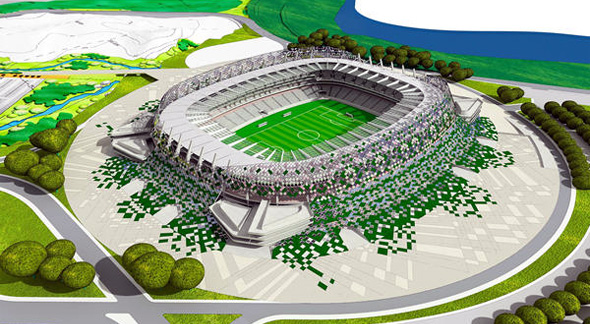
Some background. Recife already has three stadiums, one each for the city’s principal teams - Sport, Náutico, and Santa Cruz (see photos). None of these were considered for renovation or modification for the Copa. The current project is being developed on a Greenfield site in the suburbs, has an initial budget of R$ 532 million (US$ 302 million), a capacity for 46,000 spectators and parking for 6,000 cars. The Arena Pernambucana is going to cover a massive area (218 hectares – a donation from the state) and will include the building of nine thousand apartments. The entire project is being directed by Odebrecht which is operating under a public-private-partnership. It is unclear how much money Odebrecht had to put up front, but the Pernambuco State Secretary for the World Cup told OGlobo that the apartments should generate R$33 milllion for ‘private investors’.  Odebrecht has contracted the USA-based entertainment giant AEG Facilities and ISG (International Stadia Group) to run the show for the next thirty years. OGlobo happily reports that AEG is responsible for bringing Paul McCartney, the Black Eyed Peas, and Bon Jovi to Brazil! Wow! The president of the State Copa Secretariat was also quick to point out that Ajax ArenA hosted a royal wedding and that the Arena Pernumbucano could, what, host Lula’s traveling circus act? Fala sério meu irmão.
Estádio Eládio de Barros Carvalho (Aflitos) in Recife
Nautico

Estádio Ademar da Costa Carvalho (Ilha do Retiro) Stadium in Recife
Sport
The plan, therefore, is to have all three of Recife’s teams play their games in the new Arena. None of these teams are currently in the first Brazilian division. Of course, if the teams decide to play in the stadiums they already have, the plan to have an “economically sustainable” [sic] stadium will be shot. In which case, the state government will be obliged to pay Odebrecht around R$ 5 million a year. Public risk, private profit. The president of the Odebrecht Consórico said that the local teams “shouldn’t bother with the management of their stadiums whose maintenance costs are not compatible with their financial situations.” What?

Because these teams can no longer afford the maintenance costs of their stadiums (which is likely not true), they should abandon them? Náutico averaged 15,954 and Sport 15,667 fans in 2009 while in the 1st division, Santa Cruz averaged 38,249 while in the 4th division. These are far from pathetic numbers, did anyone ask the teams if they had trouble maintaining their stadia? The president of the state football federation said, “The problem is that fans here have the culture of watching their teams play at home. It’s not easy to move this idea in their heads.” No kidding. It’s also difficult to imagine an arena that is 19km from the city center being a site of convergence for the tens of thousands of people that will have to consume there on a weekly basis to make the project anything but a drain on public coffers.

Arena Pernambucana.
The raw beauty of contextualized urbanism. 
It appears that the plan for Recife is for the public to invest massively in a stadium project, hand it over to a private firm, and if the stadium turns out not to be economically viable the state will have to subsidize the loss while the private entity makes out like bandits on the real-estate development project. In addition to this and perhaps more insidious is the R$3 billion, yes billion, that will be invested in transportation infrastructure. As we saw in Johannesburg and are witnessing in Rio, these transportation projects do not necessarily attend to the real needs of the city. Hopefully there will be some more information forthcoming about the nature of these transportation projects. The degree of improvisation that is happening in most sectors of “planning” for the world cup was revealed in the final paragraphs of the article. The State Secretary for the Cup Ricardo Leitão said that a potential shortage of hotel rooms was not really a concern because many tourists were probably going to sleep aboard their trans-Atlantic ocean liners during the Cup and that the secretary of tourism was going to start registering residents who want to put people up in their homes. Actually, this last idea is very good, but probably not the first or most readily available option for nervous international tourists coming to Brazil for the first time.  

The march of the white elephants continues.


free counters

Labels

2014 World Cup Rio de Janeiro Maracanã FIFA 2016 Olympics 2016 Summer Olympics Eduardo Paes CBF Copa do Mundo 2014 Rio de Janeiro Olympics Ricardo Texeira World Cup 2014 Vasco da Gama 2010 World Cup White Elephants mega-events APO UPP BRT Brazil football Flamengo Lula Orlando Silva violence ANT Aldeia Maracana Carlos Nuzman Dilma Eike Batista Rio 2016 Sergio Cabral 2007 Pan American Games Campeonato Carioca Corruption IOC Jerome Valcke Novo Maracanã stadiums BOPE BRASIL 2016 Brasil 2014 Engenhao Joao Havelange Maracana Policia Militar Vila Autódromo Aldo Rebelo Botafogo Henrique Meirelles Medida Provisoria Metro Revolta do Vinagre Sao Paulo Sepp Blatter World Cup 2010 forced removal Carnaval Elefantes Brancos Fechadao Marcia Lins Minerao Morumbi Odebrecht Porto Maravilha Rio+20 Romario Security Walls South Africa South Africa 2010 TCU Transoeste protests public money public transportation slavery transparency x-Maracana Andrew Jennings Argentina Audiencia Publica Barcelona Brazil Carvalho Hosken Comitê Popular Confederatons Cup Copa do Brasil 2010 Cost overruns Crisis of Capital Accumulation EMOP FERJ Favela do Metro Fluminense Fluminese Fonte Novo IMX Jose Marin Leonel Messi London 2012 Marcelo Freixo Maré Museu do Indio Olympic Delivery Authority Perimetral Rocinha Soccerex Transcarioca bicycles consumer society debt idiocy militarization transportation 1995 Rugby World Cup 2004 Olympics 2015 Copa America Banco Imobiliario Barcas SA Belo Horizonte Bom Senso F.C. Brasilerao CDURP CONMEBOL Champions League. Mourinho Complexo do Alemão Copa Libertadores Cupula dos Povos ESPN England FiFA Fan Fest Istanbul 2020 Jogos Militares John Carioca Kaka Manaus McDonald's Obama Olympic Village PPP Paralympics Providencia Recife Russia Salvador Soccer City Taksim Square Tatu-bola Urban Social Forum Vidigal Vila Olimpica War World Cup Xaracana attendance figures cities corrupcao drugs estadios football frangueiro futebol mafia planejamento urbano police repression porn privitization reforms shock doctrine taxes 201 2010 Elections 2010 Vancouver Olypmics 2013 2018 World Cup 2030 Argentina / Uruguay ABRAJI AGENCO ANPUR ANT-SP Amazonia Ancelmo Gois Andrade Gutierrez Anthony Garotinho Arena Amazonia Arena Pernambucana Athens Atlético Paranaense Avenida das Americas BID Barra de Tijuca Blatter Brasil x Cote d'Iviore Brasileirão 2013 Brasilia Brasilierao Bruno Souza Bus fares COB COI COMLURB CPI CPO Cabral Caixa Economica Canal do Anil Cantagalo Celio de Barros Cesar Maia Chapeu Mangueira Chile 2015 Choque do Ordem Cidade da Copa Class One Powerboat Racing Clint Dempsey Comite Companhia das Docas Copa do Brasil Corinthians Cuiabá Curitiba Dave Zrin David Harvey Der Spiegel Eastwood Edge of Sports Escola Friendenrich Expo Estadio Expo Urbano FGV Fonte Nova Gamboa Garotinho Geostadia Ghana Globo Greek Debt Crisis Greek Olympics HBO Hipoptopoma IMG IPHAN ISL Iniesta Internatinal Football Arena Invictus Istanbul Itaquerao Jacque Rogge Jefferson John Coates Jose Beltrame Julio Grondona Julio Lopes Julio de Lamare Knights Templar Korea Lei Geral da Copa MAR MEX Manchester United Mangabeira Unger Maracanã. Soccerex Marina da Gloria Mexico Milton Santos Molotov Cocktail Mr.Balls Neymar Nicholas Leoz Nilton Santos Olympic Flag Olympic Park Project Oscar Niemeyer Pacaembu Pan American Games Parque Olimpico Pernambuco Plano Popular Plano Popular do Maracana Plano Popular do Maracanã Play the Game Pope Porto Alegre Porto Olimpico Porto Seguro Portuguesa Praca Tiradentes Preview Projeto Morrinho Putin Qatar Quatar 2022 RSA Realengo Regis Fichtner Roberto Dinamite Russia 2018 SETRANS SMH Santa Teresa Santos Sao Raimundo Sargento Pepper Security Cameras Smart City Sochi 2014 South Korea Stormtroopers São Januário São Paulo Teargas Templars Tokyo 2020 Tropa do Elite II Turkey UFRJ/IPPUR URU USA USA! Unidos da Tijuca United States government Urban Age Conference VVIP Via Binário Victory Team Vila Autodromo Vila Cruzeiro Vila do Pan Vilvadao Vivaldao Volta Alice Wasteland Workers' Party World Cup 2018 Xavi Zurich apartments atrazos barrier beer bio-fuels bonde capacities civil society comite popular copa sudamericana crack crime dengue dictatorship estádios favelalógica feira livre fiador flooding freedom of information furos geral graffiti guarda municipal host city agreement identity infrastructure ipanema istoe labor rape riots schedule school shooting security segregation social movements stadium state of exception supervia tear gas ticket prices torcidas organizadas tourism traffic tragedy trash trem-bala velodromo wikileaks xingar