27 June 2011

Back in Action

After nearly two weeks away, much has changed in Rio but everything continues along the same trajectory.
A new UPP was installed in the Mangueira favela, closing the “security belt” around the Maracanã . Many communities are clamoring for the installation of UPPs, but some places are more critical than others to mega-event security and those receive military occupation first. Even O Globo can be heard to clamor for more rapid investment in urbanization and social programs to accompany the changing of one form of martial law for another.
Did you understand what our world cup symbol means?
 They're going to steal public money?
Eiii! Whose hand is this without a finger?

The Federal Government is trying to hide the real costs of mega-event construction at the same time that the tight relationships between Rio governor Deputy Dog Cabral, Eike Batista (the richest man in Brazil) and Delta Construction (recipient of more than a billion in tate contracts in the last 3 years) were revealed because of a helicopter crash that killed the girlfriend of Cabral’s son on the way to a private party in Bahia state. Batista gave R$750,000 to Cabral’s re-election campaign in 2010.
Delta is part of nearly all public works projects in Rio de Janeiro. These insider relationships and the closing off of mega-event budgets to public scrutiny because they are considered “state secrets” has not done much to improve public opinion about how, where, why, and how the tens of billions of public R$ are being spent.

On the good side, there is an increasingly coordinated public movement against the autocratic turn in Brazilian politics. On Tuesday (tomorrow) there is a rally in front of the Municipal Government to call for a CPI (Parliamentary Inquisition Commission)  to investigate the forced removal of thousands of homes and the destruction of communities and livelihoods that have been the subject of so much national and international media attention. As ever, Eliomar Coelho is at the front of this movement and is struggling to get a few more city council people to get on board. The majority of the city council is in the pocket of El Principe (mayor Eduardo Paes) and are undoubtedly making tons of money.

The international NGO Witness was in Rio a few weeks ago and produced this video about the removals in the Favela do Metrô, which is being destroyed to make way for a parking lot for the Maracanã. There are a series of videos about other communities in Rio that can be linked to from this youtube clip.

12 June 2011

Festa Juninho (Pernambucano)

Here’s a big post to give everyone something to chew on for a couple of weeks.  I will be giving talks at:  Duke University in Durham, NC on June 22 (@ the Haiti Laboratory, Franklin Humanities Institute, Bay 4 Smith Warehouse, noon), The Brazilian Association of Investigative Journalism in São Paulo on July 2, and Intel in Santa Clara, CA on July 11. Details forthcoming.

Starting from the top down in classic mega-event style:

Leonardo Martins in Jornal do Brasil wrote,  “As UPPs são, antes de tudo, um projeto de poder, de controle de um espaço tradicionalmente submetido à opressão. Os novos Capitães, que comandam as UPPs são os novos “donos do pedaço”, em substituição aos traficantes que ali se encontravam. Autorizam bailes, mandam baixar o som dos moradores, escolhem as músicas que os moradores podem escutar, determinam horário e condutas pessoais, intimam e intimidam àqueles que tem uma opinião mais crítica acerca da função da polícia, como por exemplo o fechamento da rádio comunitária do Andaraí, pela Polícia Federal, sobre o pretexto de rádio pirata e atrapalhar o tráfego aéreo."

“The UPPs are, above all, a projection of Power, for control of a space that has traditionally been oppressed. The new Captains that command the UPPs are the “owners of the land”, substituting the drug traffickers that were there before. They authorize dances, tell the residents to turn their music down, choose the music that the residents can listen to, determine the coming and going and conduct of people, intimate and intimidate those who have a more critical opinion of the police function, as for example the closing of the closing of the community radio station in Andaraí by the Federal Police on the pretext that it was a pirate radio station and it interfered with air traffic.”

I haven’t been back to visit and UPPeed communities in awhile, so I don’t have much more to contribute to the debate than I had a few weeks ago. I hear adolescents around town say “UPP é o caralho” and have seen that succinct and poignant phrase scribbled on walls.

Mayor alert! EP twisted his ankle in a political minefield, but don’t worry, he’s going to be ok. O Principe’s attempts to manipulate the infrastructure of the Olympic machine didn’t sit too well with people more powerful and experienced than he. In trying to limit the powers of the APO, EP threw a few one-liners into the City’s Olympic act that he then had to beg some legislators to erase and pretend to everyone else that he wasn’t trying to maintain as much power for himself as possible. The story is much longer than that, of course, but takes a doctoral thesis to sort though. Fortunately, those are available.

According to sources buried deep within the international press corps, The IOC has had all of their questions answered in regard to forced removals for Rio’s BRT lines. The Trans-Oeste BRT (Blown Right Through) is moving people out of the way faster than a turd in a hot tub. The results are shit.


Picture of housing demolitions carried
out by Rio's Housing Secretary along the Trans-Oeste BRT line, April 2011.
Nelma Gusmão de Oliveira foto.

Last one standing, Zona Oeste
Rio de Janeiro. Nelma Gusmão de Oliveira foto
Mayor alert! O Principe tried to stick the Olympic golf course in a closed condominium complex where the cheapest condo goes for R$2.1 million. Unfortunately, the land that he wanted to put the course on has been stuck in the judicial system. Apparently the news took the condo residents by surprise.  The is the kind of “planning” is happening on a metropolitan level, not just with the Olympic golf course.

According to the Union of Externally Controlled Federal Auditors (AUDITAR), “the new model of contracting banked by the base of Dilma Rousseff’s government in the house of deputies is going to make the public works for the World Cup and Olympics much more expensive.” This is not at all surprising given that the new laws are designed to “flexibilize” normal contracting processes.

Compounding the problem is that those who frequent stadiums end up paying for them three times. Once for construction. Twice for higher ticket prices. Third for world-class maintenance costs.  Even our illustrious Federal Deputy Romário is calling the stadium budgets into question.

The CBF brought their team back to Brazil for the first time in a long time to prepare for the Copa America in Argentina. The ticket prices were staggering and the games were seen as test venue for the CBF to employ private security guards (as will be the case during the World Cup). The Prossegur rent-a-cops did not take kindly to the unfurling of a banner by the ANT-GO crew and gave them some rough treatment for unfurling this lovely banner. Congrats to these brave formigas!!!
Ricardo Ali Baba Teixeira, OUT! For decades Brazilian football has been in the hands of incompetent and corrupt
officials, we demand the democratization of decisions related to Brazilian football with the participation of fans!
Neither FIFA, or the CBF, or Football is of the People!
National Fans Association
Here are the attendances and financial details from those matches:
Game
Paying Public
Gate Receipts
Average Ticket
Free tickets
BRA (0) x HOL (0)
36.449
R$3.120.625
R$85.81
7.000?
BRA (1) x ROM (0)
30.059
R$4.357.705
R$144.90
9.000?

66.508
R$7.478.330
R$112.44
pqp

It’s impossible to tell how many tickets the CBF gave away to itself and to its sponsors. Interestingly and stupidly, the first match in Goiânia, resulted in Ricardo Teixeira (Mr. Jowls) promising a Copa America 2015 match to that city, even though they are not hosting any World Cup matches.  In Rio, tickets for Copa Libertadores matches in 2010-2011 started at R$75. In three hours of football,  the CBF made off with R$7.5 million and scored one goal. How expensive will tickets to the World Cup be? How expensive will the stadiums be?  This is a link to a professor from the Fundação Getúlio Vargas who is criticizing the Maracanã budgeting process. We have seen a 170% increase in construction costs since 2009. This is without multiple labor shifts, without increased raw material and labor costs, without counting the subsidy for imports, without counting the no-bid conracts, without the time crunch, etc.

But, this will give Brazil (and Rio in particular) the MOST MODERN STADIUMS IN THE WORLD!!!!!!

What does it mean to have the most  “modern “ stadium in the world? The continual search for and production of the modern in Brazil has had very mixed urban, social, and environmental results. When the Maracanã was constructed, it was the most modern stadium in the world, was it not? Will not the host of the 2016 European Championships have the most modern football stadiums in the world? Why bother calling it the most modern stadium in the world?  It’s a stupid and completely relative question.

Modern could mean functional but certainly means secure and comfortable and bougie, but in the context of Brazil’s mega-events “modern” has become more associated with overspending on monumental mistakes that are guaranteed to bring diminishing economic returns in an attempt to appear modern for and to foreigners. The stadium, as such, does not have to be submitted exclusively to economic metrics as a measure of its value. In addition to agreeing to build economic black holes, the cultural costs have not been calculated in the production of the twelve stadiums for the World Cup. The Mané Garrincha Stadium in Brasilia had bleachers so well-made that it took three attempts to demolish them with explosives. They are installing an expensive house of cards in his place.

FIFA has chosen Rio de Janeiro as the host of the International Broadcast Center for the World Cup. It will, of course, be in Barra de Tijuca at the Rio Centro complex. This is interesting (though not surprising) for a couple of reasons. One is that it will develop further Barra’s emergent position as the high-tech and media production center of Rio de Janeiro and Brazil. Why? Because in order to install something as sophisticated and grandiose as an IBC millions if not billions of fiber optic cables need to be stuck into the region, creating an information infrastructure that augments already profound structural inequalities within the city.

Secondly, the increasing and repetitive investment in communications infrastructure in Rio de Janeiro (and São Paulo) is consolidating the position of those cities in the hugely unbalanced urban hierarchy of Brazil. The choice of Rio will guarantee that it grows its media and communications industry at the expense of Belo Horizonte, Salvador, Porto Alegre, etc. Of course, wherever this kind of investment happens there are knock on geographic effects. However, the overwhelming Federal investment in Rio de Janeiro (at least R$100 billion between 2010-2016) is going to have long term consequences for a more balanced urban system. The FIFA media release is worth a read.

The Secretary of the Fazenda of Rio de Janeiro is trying to find ways to raise R$4 billion to finance public works for mega-events. His primary obstacle, according to Oh, Globo is the Law of Fiscal Responsibility (LRF), which prevents cities from emitting bonds while they are in debt. O Principe is still waiting for his R$ 2.5 billion loan to come in from the World Bank and until that happens, Rio is prohibited from borrowing more money. The strategy therefore is to wait until Henrique Mirelles (O Neo-Libertador) finally gets into power and then they’ll talk about how much debt they can saddle Rio with. This quote I found rather touching: Do ponto de vista político é muito delicado (mexer na LRF), mas do ponto de vista econômico, faria sentido", ressaltou a secretária. (From the political point of view it’s very delicate [to mess with the LRF) but from the economic point of view it makes sense). Head, shoulders, knees, and toes! Get flexible people!

Side Embryo Pose in Shoulder Stand
Dilma and the PT get to work on the law
Did you know that trees are as flexible as stadia? Well, the revisions to the Forest Code that are getting crammed though the senate is going to surprise you, or not. The Amazon is being picked apart by agri-business, timber, and mining interests and the Worker’s Party is doing everything it can to hand the country over to capitalists. The passing of the mutilated Forest Code and the mega-event flex-laws are the priority of the new Minister of Institutional Relations. If Dilma’s government were any more flexible they’d call the county Shavasana.

07 June 2011

Tudo bem vs. tudo ruim


Final, Copa do Brasil, ida
It’s now official, Eduardo Paes (EP) and I do not agree on anything but our football team. The following are quotes taken from an interview published yesterday with the around the rings website. Below each of the quotes is a recent quote from geostadia.com or the indicated publications.  

EP: Things are going very well.

Geostadia: I would like to write about all of the good news related to the top-down installation of mega-events but am having trouble finding any. 

EP: Infrastructure-wise, the biggest project for Rio is a transportation overhaul. Paes says everything is “fine” on that front. 

Geostadia: The forced, violent removal of people and homes in preparation for the crashing wave of mega-events has begun.

EP: I think there are no more differences between the IOC vision and the city’s vision. 

Geostadia in Reuters: "This is very authoritarian, top-down, with no public audiences, no democratic participation — and it's going to change the city for ever,"

EP: It’s going to be a tough thing to get on time but I think we’ve got the right schedule. By 2016 everything is going to be ready.

Geostadia: The city government is operating with a heavy, autocratic, and brutal hand as a slew of international media reports have recently shown. Last week the UN commission on housing rights and evictions paid multiple visits to communities that are being brutalized by the city. The tactics are Machiavellian, the results Dickensian. People throughout Rio de Janeiro (and the rest of the World Cup cities) are living in fear and insecurity. When the SMH comes with their spray can, the scarlet letters do not indicate a brighter future but imminent removal at the hands of an authoritarian state whose strings are being pulled by huge white men hidden in small black boxes.

EP:Maracana is going fine. The World Cup is much much easier to do than an Olympic Games, at least from a city point of view…But I mean it’s a fact there are some delays because of different levels of government in different cities. 

Geostadia in the New York Times:  It’s just one reform after another without anyone ever doing any kind of research as to what the people who actually use the stadium want.

EP: In Rio things are fine. I don’t see it as a problem concerning the Olympics. Actually, I think it’s a big asset for the Olympics because the mistakes that were done in the planning of the World Cup are not being repeated in the Olympic Games. And that’s good. It’s going to be perfect.

Geostadia in the Guardian: None of these projects have taken off because all of the money is coming from the public sector; a very, very good indication that they are not financially viable,

EP:  I think the World Cup has a communication problem. We are talking about 12 cities, Rio is on time. We have some problems with the airport but it will be ready on time. The problem with the airport is much more services than infrastructure. I think the problem of services will be okay by ’14.”

Geostadia in the Shin Guardian: Two of the major infrastructure works being planned for the World Cup have been paralyzed for lack of transparency in their contracting process. Rio Metrô has had their Linha 3 project stopped and São Paulo’s Garulhos (international) Airport has been halted. The latter is perhaps the most critical link in the entire World Cup construction process as São Paulo is the main point of entry to Brazil. Will Brazil be able to pull all of this together in time and if they do, what will be the cost, and who will pay? If it results in anything like what happened in South Africa, the outlook for Brazil is not encouraging.

Could we be doppelgangers? Can we both be right? Were we separated at birth? Will we find each other on LinkedIn? So many questions.

Monthly readership is hovering around 3,000. Thanks for all of the positive feedback and connections. If more people start to listen to my answers than to EPs then we can perhaps start to make some progress instead of increase to ingressos.


06 June 2011

The Good News

I would like to write about all of the good news related to the top-down installation of mega-events but am having trouble finding any. It’s pretty clear that one has to look at the micro-level to see anything positive as the recent FIFA embarrassments were given a healthy scrubbing by the IOC. It is a sad day indeed at FIFA house when Jacque Rogge has to come across the country to give the IOC’s five fingered seal of approval. The despicable shenanigans at FIFA are nothing new. On the bright side the swirling corruption claims may have opened up a corner of the black box, potentially ushering in a call for change. On the other hand, 186 of the 208 member associations voted for Herr Blatter in the uncontested election. FIFA runs on a fear-based economy and the national associations act like sniveling sycophants.

In Rio, the installation of mega-event infrastructures is happening at various paces. The Maracanã is dead, and the process of creating the Novo Maracanã has to wait until the roof is taken off the old stadium. There’s no real hurry, as long as the stadium is ready six months before the World Cup, no one will much care. The budget for the stadium has already tripled from the initial projections in 2009. My estimate is that the Novo Maracanã project will cost 2 BILLION REAIS (US$1.25 b).
View of the deceased Maracanã from Parque Nacional da Tijuca, June 5, 2011
The average monthly salary for a fireman (bombeiro) in Rio de Janeiro state is R$950. No surprise then that the Rio Bombeiros took collective action to demand improvements in salary and working conditions. They invaded their own headquarters last week, occupying their place of work in order to negotiate with the government. The governor’s reaction: send in BOPE (the black hooded killing squad that usually invades favelas). The scenes were as lamentable as they were preventable; children getting tear gassed, police forcing public servants to the ground with machine guns, massive arrests, general jack-booted thuggery. The governor has no problem spending billions on a stadium that was already functioning but when essential public services like firemen as for a raise he sends in a death-squad.

The stories coming out of the Zona Portuaria, Jacarepaguá and the Zona Oeste are equally discouraging. The SMH, municipal housing secretary, continues to use the most incredible tactics to remove people from their houses. The stories defy belief. The jist is that the SMH, at the behest of the mayor, is denying communities the right to collectively bargain, arriving in some cases with unmarked bags of cash and handing thousands of R$ to people who may have never seen that much money before. In other cases they force children to sign documents in the name of their parents. In other cases they simply intimidate, in others they deliberately deceive and mis-represent. The asymmetry of information is complete. The very threat of forced removal is a form of terror that violates basic human rights. Even with a very powerful telescope, Jacque Rogge and the IOC couldn’t see these things happening from Mount Olympus.

The Brazilian national team is back in country for the first time in a long time, playing a series of friendlies leading up to the Copa América. There was a poor performance against Holland in Goiânia the other day. However, the Goiânians were so well behaved that the CBF promised them that they would be able to host games for the 2015 Copa America. Hold on. We are constructing 12 new stadiums for the World Cup, none of which are in Goiânia. In fact, the only reason that the seleção played there was because all of the major stadiums in Brazil are under construction. Of course the Copa América won’t be played in Manaus, Curitiba, Natal, or Cuiabá, because no one would go. Why are those cities building World Cup Stadia?

ANT-SP is organizing a protest against the CBF and their absurd and corrupt regime for the seleção’s game against Romania at the Pacaembú in São Paulo. The cheapest ticket is R$140 and for a seat it’s R$800. The game will, naturally, start after the novellas on Tuesday night at 9:50pm. So by the time the game is over the metro will have stopped and the bus service diminished. In Rio, Super Via managed to provide special trains to bring people from the Zona Sul to the Enenhão for the Paul McCartney concert last week, but insist that they can do nothing about the over-crowded, un-air-conditioned cars that sometimes make it to their final destination, much less provide special cars to get people to the Engenhão for a football match.  

As I have mentioned in innumerable posts and interviews, the installation of mega-events in Brazil and Rio de Janeiro allows for the acceleration of the deployment of neo-liberal tactics of governance. States and cities of exception produce highly territorialized and militarized spaces of exclusion where democratic and human rights are available to those who can afford them. As Mirelles (head of the Public Olympic Authority and former Central Bank head) said the other day, “the Olympics are a symbol of the growth of the country”. This is undoubtedly true. But this growth is coming at a tremendous cost and mega-events, with all of their symbolic, cultural, and poltical powers, allow us to crystallize our thinking about the kind of society we want to develop. The good thing is that the Gestapo tactics of the government are showing what Brazilian “development” is really all about. This is helping social movements across the country to articulate in ways that might not have been possible without the events. Thus, the very things that are accelerating the implementation of rapacious regimes of capital accumulation through the deployment of jack-boots and surveillance cameras is also allowing for the contestation of those systems. The bad news is that tens of thousands of people are going to lose their homes, have their communities divided and dispersed, and have their children tear-gassed in the struggle for a living wage. 

30 May 2011

The sick,sad and tragic case of Bruno Souza

For those of you outside of Brazil, you might not have heard about the Flamengo goalie who after captaining his side to the Brazilian championship in 2009 was arrested under suspicion of having his ex-lover murdered. Jeremy Schapp and the E:60 team from the USA came to Brazil earlier in the year to investigate the case and produced this video, which aired globally two weeks ago (but not in Brazil or Latin America).


Bloodline - E:60 - Bruno from Evolve IMG Films Ltd. on Vimeo.


As part of some ongoing discussions that the Associação Nacional dos Torcedores has had with Marcelo Freixo, there are legal initiatives underway to make Brazil's football clubs responsible for educating their players. Currently there is no media training, no financial advice, no recompense for youth players who become injured. The clubs are basically employing a feudal labor system to generate profits, which are then duly pocketed (generally speaking) by amateurish club directors. The four big Rio teams are the four most indebtted clubs in Brazil. This is not too different from the fake amateurism of the NCAA or from the youth academies that European teams have set up in West Africa.

Was the Bruno case preventable? Should Flamengo have intervened? Does the structure of Brazilian football and their labor practices contribute to this kind of tragedy? Yes. Yes. Yes.

29 May 2011

BARMAN*

* full credit to Douglas Engle for the title

BAR (3) MAN (1) http://www.youtube.com/watch?v=qRKIa-a-Ows

Not since the Dutch-inspired spatial revolution in the 1970s has there been a team that has so challenged and changed the geometry of football. Barcelona’s players not only think ahead in time, they also anticipate the shape of the immediate future. For instance, Xavi’s pass to Pedro in the 27th minute split two defenders whose very movements were creating the space for that pass to occur. You see Xavi moving, waiting, procuring, probing, identifying and liberating. Pedro had the relatively banal task of a sublime first touch and side-footed finish.

Xavi is clearly a master of his world, but his dismantling of Euclid’s hegemonic spatiality is fostered by the silky technicality and tactical brilliance of his comrades. Iniesta hides the ball and darts through thick legs, leaping from trouble to glory as he both conducts and misdirects.  He knows instinctively where pressure is coming from and finds the release valves through he becomes a blur of thought and action. Midway through the second half, I remember a ball coming at him in midfield, with a defender coming in hard for a challenge. Pressure in the front, big hard man, space behind. If he turned away from pressure, he risked a nasty challenge, there was no time for a touch to the side and the ball had to be won. With a flick of his left foot, the ball rode up his left thigh which he swiveled to nudge the ball to his right thigh, which dropped it to his right foot. The defender flew by, the midfield opened like a can of tuna, and he splayed the ball to…Messi.

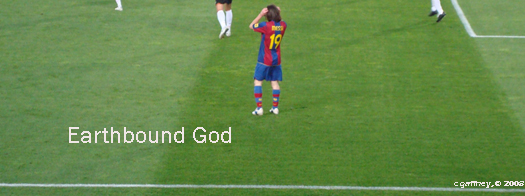
@ Camp Nou, May 2008

The second goal showed the danger of not effectively controlling and compacting defensive space around the box. Messi received the ball from Xavi 35 yards from goal. Park had come too high to defend and left space for Messi to run. He accelerated into the gap between the midfield and central defense and blasted a low shot that curved away from a partially blocked Van der Sar. 2-1.

Messi  started the third goal on the right flank by schooling a world-class defender and cutting into the box. This dragged the United defense goal-ward and as the ball popped around the box, Villa stepped into the void at the top of the box, measured his angle as he set himself and curled, around the lunging defender, an inch perfect shot past 6 foot 6 fingertips into the top corner. 3-1. Champions of Europe.

(United’s goal was excellent if slightly more pedestrian. Rooney paired 1-2s through midfield with Carrick, and into the box with Giggs, slotting home the neat return pass from the greybeard. After their goal, however, it is difficult to remember United doing anything other than chasing the ball. (For fuller tactical analysis click here.) To Manchester’s credit, they are all acknowledging that they were very well beaten).

The players that come through Barcelona’s youth academy are trained from a very young age to think about time, space, and movement in a very particular way. Their collective spatial-ability is changing something about the way football is conceived and played. I see the Barcelona players as constructing new ways of movement and spatial consciousness that are only possible with extreme technical competence. It appears to be unbeatable, with the exception of the occasional team (Inter Milan, Real Madrid) expert in the art of matching Barças non-linear, shifting constellations with the spatial dynamics of a Rubik’s Cube.

How these elements come together to put a smile on my face, I don’t know. But they did. I even managed to forget that all of the candidates in the FIFA elections scheduled for June 1 are under ethics investigations. Thankfully, there’s the Copa do Brasil final on Wednesday to get my mind off of that. 

25 May 2011

Big White Men in Small Black Boxes

This week is the XIV Congress of the National (Brazilian) Association of Urban and Regional Planning. (Link to conference here.) On Tuesday, I attended a session entitled Order/Disorder: violence and the politics of security in the city (Ordem/Desordem: violência e políticas de segurança na cidade). The main attraction was a possible clash between Marcelo Freixo, State Deputy of the PSOL political party (the only remaining progressive party in Brazil) and Rio State Secretary of Social Assistance and Human Rights, Ricardo Henrique.

Freixo was preceded by Julita Lemgruber (fomer head of the Rio State penitentiary system) who talked about the challenges and benefits of the UPP (Police Pacification Units) being installed in select favelas in Rio. While I touched upon many of the same points in my earlier discussions of the UPPs, what follows is what I took away from Professor Lemgruber’s talk.

Benefits of UPPs:
Residents look to resolve their conflicts through legal mechanisms
Stimulation of micro and neighborhood economies
Reduction of lethal violence
The rivalry between Rio’s two major drug factions, the Terceiro Comando and the Comando Vermelho has been eliminated, allowing for more freedom of movement between favelas
Increase in home values
A sense of tranquility

Challenges:
How can the installation of UPPs in favelas result in a consolidation and expansion of territorial control in the city? This is expecially true in the vast areas of Rio that are controlled by milicias (the subject of the Tropa do Elite 2 film).

Is it possible to control the violence and corruption of the police? The police are poorly trained and always have their fingers on the trigger. There is almost no presence of non-lethal weapons in the UPP forces and NO police will consent to move through the favelas unarmed. When will the police cease to fear a re-taking of the hills by drug gangs, even though such an event has never occurred and start non-lethal policing of the favelas?

How is it possible to turn the regime of the UPP into something that is non-authoritarian? The UPP commanders determine what can and cannot occur in the favelas. There is a generalized ban on baile funks, one of the primary source of weekend entertainment and a source of cultural identity.

When will an effective social politics take the place of an effective security politics?

How will the UPPs be used to stimulate the political and administrative roles of community leaders?
How will the police trained and paid to enter the UPP project be convinced that their job is worthwhile? As it stands, 70% of the police think that the UPP project is directly associated with the impending mega-events and that they have become “doormen of the favelas”. There is a distinct lack of esprit de corps among the UPP police and 70% are actively looking for another posting within the MP.

The activity that the MPs most engage in is the revision of suspects. There is a popular saying in Rio that goes something like this: “Young, black and standing: suspect. Young black, and moving: guilty.” The culture of extreme violence that characterizes the Rio State Police is not meted out evenly across the population.  
In talking with several people about the installation of UPPs over the last several days, there is no question that they have brought a generalized sense of tranquility to both the places in which they have been installed and their surrounding areas. However, the generalized feel-good nature of the “change” has not significantly altered the ways in which favela residents (primarily poor and black) are treated by the government. There is a sickening infanitlization of favela residents which suggests that everyone who lives there, if given half the chance, will turn to crime as a way of life and that without the strong hand of the state behind a gun, the chaos and violence will return. The sense of security is limited to those who are not in the way of massive construction projects, who own their own homes, and who are not subject to the spray paint cans of the Municipal Secretary of Housing.

One of the more astounding figures mentioned by Professora Lemgruber was that only 8.5% of MPs working in UPPs have completed high school. 63.5% have completed middle school. With this level of education, how is it possible to begin to address all of the above problems? To make matters worse, the MPs live in sub-human conditions, have little or no orientation about their project, and lack training specific to the job. It’s hard to tell where this UPP project is going but it is far from the unqualified success that the government is portraying (big surprise, I know).

Ok, on to Marcelo Freixo. Friend of Apa Funk, supporter of the ANT, a man with a price on his head for taking on the Western Milícias, Deputado Freixo is one of the most sought after speakers in Rio and has long been a champion of social justice. For those of you who have seen the Tropa I and II movies, the intelligent agitator who goes into the prisons is based on Freixo’s character. Some highlights from his talk:
Two things occurred around the same time in the mid 1990s: Brazil was consolidating as a democracy and becoming hard-wired as a neo-liberal regime of flexible accumulation.  

What does it mean to have a secure city? Freixo drew attention to the fact that 100% of BOPEs actions take place in favelas and that in the new center of operations that is currently under construction in Maré, there will be a “favela scenario” for the most lethal and well-trained urban fighting force in the world to train. In Rio, the question of security is relative and localized and needs to be expanded if effective and coherent public policies are to be developed.

In Rio, dying while resisting arrest, is called an “auto de resistência”. That means, for those of you who have seen the movie Bus 174, cross paths with the cops with no one around and it’s curtains. The data: Under the Anthony Garotinho government (he who was so recently convicted of a slew of charges yet managed to take office), there were 2209 such deaths, or around 550 a year. His wife, Rosinha, was the next governor. Under her watch the body count doubled to 1900 auto-de-resistências per year. The current governor has kept pace with around 4400 deaths while resisting arrest during his first term in office.

Worse are the staggering numbers of homicides and disappeared. Under Rosinha 18.300 people were killed or disappeared in the State of Rio de Janeiro. Under Cabral, 20.600. In eight years, 38.900 people have been killed or disappeared in Rio de Janeiro state. That is more than during the dictatorship in Argentina, in less time. So, the question is, for whom is the city being secured and how?

There is a clear attempt to follow the USAmerican model of incarceration in Brazil. Between 2000-2009, Brazil had an 11% increase in its population and a203% increase in its prison population. Like the USA, a huge percentage of the prison population is wither awaiting trial or stuck there for non-violent offences. For those not familiar with the film Carandiru, there ain’t no cable tv, weight room, or laundry service in Brazilian prisons.

The issue of the UPPs and “security” is very much related to the Olympics and the World Cup. The discussion and discourses surrounding “security” are woefully limited and tend to be dominated by notions of physical security in the face of criminal elements. What most people in Rio (and the wider world) mean by security is the right to private property and personal integrity. This goal has largely been accomplished in the Olympic Ring (O-Ring) of Rio through the installation of UPPs and a public policy of extreme violence exercised against a highly select population. However, the real issues of security and society are unfolding in the West Zone of Rio where the milícias have taken control.

The spectacle of security is very much part of the spectacle of the mega-event. The invasion of the Complexo de Alemão last year was as much a highly coordinated media campaign as a military exercise. The abandonment of the Zona Oeste and the new public housing complexes in Campo Grande and Cosmos to the milicias is a deliberate public policy. As Feixo pointed out, there is not a parallel system of government in the favelas or in the areas controlled by the milicia. Evidence for this was that Sergio Cabral’s candidate took 75% of the votes in the Complexo de Alemão in the 2010 elections. His question to the audience was: who is in charge there? Traficantes or the Governor?

Following in the left-foot-heavy footprints of Freixo was Ricardo Henrique, state secretary of Social Assistance and Human Rights. In beginning his talk about the theoretical roots of the UPP Social program, Henrique drew a line between the “secure city” and the “integrated city”. This division, he suggested, has resulted from the fragmentation of the urban and social fabrics as a result of different practices and politics aimed at different publics and social sectors. The result of these policies has been to reproduce divisions both horizontally and vertically within spheres of government as well as within civil society. Thus, the UPP social project is an attempt to retake the project of developing a republic based on equal rights and accessibility to rights before the law through a more consistent implementation of public policies directed at social development.

Fine. I agree. UPP Social is a necessary but not sufficient condition for reconciling the structural conditions that result in social and spatial fragmentation. What Henrique failed to address in any way, was that at the same time that UPP social is working towards a project of regeneration and de-fragmentation, the rest of the government is working in the opposite direction. While the UPP social programs may be benefitting the 14 favelas in which they are (partilly) implemented, the BRT lines are fragmenting and re-territorializing the rest of the city…FOREVER!

The result: while we can be optimistic that where the UPPs are installed we have seen a sharp decrease in violent crime and a slew of economic and social benefits, there is much work to be done to make these benefits permanent. The lack of long-term planning in Rio’s political system is endemic, systemic, and generalized. There are no guarantees here, only hopes. There are 1.020 favelas in Rio de Janeiro, the UPPs have been installed in 14 of them – the vast majority of which are within the O-Ring and designed to protect Rio’s zones of accumulation and to project the spectacle of security to the world-at-large. The transportation and stadium projects getting crammed into the city are intentionally fragmenting and dividing the city, not attending to effective demand, and benefitting select areas of the city. All of this through the erection of extra-legal forms of government that use the mega-event as a state of emergency to justify extraordinary measures similar to a state of war.

The city government is operating with a heavy, autocratic, and brutal hand as a slew of international media reports have recently shown. Last week the UN commission on housing rights and evictions paid multiple visits to communities that are being brutalized by the city. The tactics are Machiavellian, the results Dickensian. People throughout Rio de Janeiro (and the rest of the World Cup cities) are living in fear and insecurity. When the SMH comes with their spray can, the scarlet letters do not indicate a brighter future but imminent removal at the hands of an authoritarian state whose strings are being pulled by huge white men hidden in small black boxes.


23 May 2011

Problems Continue

Problems continue in Brazil's mega-event world.

Stadia: Yesterday’s edition of Veja, a conservative news weekly, had as its cover a photo of the Maracanã  with the headline – "At the current pace, the Maracanã  will reopen 24 years late". The story behind the front page was not encouraging. None of the 12 Brazilian stadium projects underway are at the same stage of development as were the stadiums in South Africa. Not that it matters. According to Peter Alegi, a top SA 2010 researcher, only one of the ten 2010 WC stadiums is currently in use and the 50,000 capacity Royal Bafokeng Sports Palace drew an impressive 655 fans for a recent league match.

Corruption: The delays and confusion and lack-of-planning and stupidity and incompetence and outright theft and lack of professionalism in the planning for the 2014 World Cup has now been called out by Brazil’s biggest media outlets. This very same media have had their hands forced into a critical posture but never take the next step to calling for a total reorganization of Brazilian football. The CBF is one of the most corrupt and closed institutions in the world. It’s president Ricardo Teixeira was named as one of the greedy gophers selling his votes to Qatar. His father-in-law, João Havelange was also named in the recent corruption scandal.

Transportation: The transportation lines being crammed through Brazilian cities to attend to the short-term demands of mega-events will dislocate millions of people without attending to the real demands of Brazilian metropolitan areas.  The lack of planning in transportation was reported by Agencia Brasil the other day and comes as no surprise. In the above mentioned Veja article, one of the highlights was that the Brazilian government has already declared that 9 of the 12 airport projects will not be ready for the World Cup or Olympics. The Rio Metro saga is playing out poorly as no one can figure out where the new line 4 is going to go.

Forced Evicitions: Last week the UN was in town visiting the thousands of homes that have been partially or totally destroyed by the Rio city government to make way for these ill considered transportation lines. It’s a sad and tragic comedy of Olympian proportions. The hubris and callousness of the Rio city and state government knows no bounds.  According to the Estado do São Paulo newspaper the expectation is that at least 65 thousand Brazilians will lose their homes. The reality is that tens of millions more will be directly and indirectly affected. (Click here for a great story by Tom Phillips).

Transparency: Zero. The Rio 2016 Organizing Committee released the contract that the city signed with the Olympic Committee – 19 months after it was signed. The Brazilian chefão, Carlos Nuzman said that only newspapers would have access to the contract and that the general public would not be able to access what their democratically elected leaders have agreed to do with their money.  The laughable websites www.transparenciaolimpica.com.br and www.cidadeolimpica.com.br continue to function as smokescreens for the funneling of public money into private hands.

Privitization: nota dez. Henrique Mirelles, head of the APO (Public Olympic Authority) and former head of Brazil’s central Bank, has long used coded words to guide his public commentary. His latest was that the Olympics will usher in a new form of public governance.

For the first time I have begun to think that Brazil will not be able to pull these projects together in time for the World Cup. The lack of competency and organization and oversight is staggering and of continental proportions. There are so many moving pieces that have gone unattended for so long that it might be too late to create a functioning mechanism. The government should take over all World Cup operations now, nationalizing the CBF and the World Cup profits. The World Cup was awarded to Brazil in 2007, almost nothing has happened since then. The delays and disorganization serve to increase the cost of everything while necessitating a financial infusion from the state that will invariably be turned into private profit. It is important to remember that the WORKERS’ PARTY (PT) of LULA is behind these developments. Where mega-events are concerned, there is rarely any good news, just talking heads, hollow discourse, and momentary distractions from an increasingly harsh reality. 

12 May 2011

O bicho esta pegando

http://bit.ly/ijkbru

Brick by BRIC: How Global Sport Has Declared War on Brazil's Poor
by Dave Zirin
In Chile, it was called the The Brick. It was the many-thousand page economic manifesto of Dictator Augusto Pinochet, written by "the Chicago Boys" - Chilean exchange students from the University of Chicago. Disciples of the university's conservative, neoliberal economics professor Milton Friedman, they printed The Brick on "the other 9/11" - September 11th, 1973. As Chile's Presidential palace was being bombed, "Companero Presidente" Salvador Allende was being murdered, and General Pinochet was assuming power, The Brick became Pinochet's economic compass. It guided the country through two decades of slash and burn privatisation, displacement, and inequality - all in the name of  "development".

Today Pinochet is reviled and gone, but The Brick has become a default manifesto for much of the globe. Today, it's most ardent sponsors ironically bear its name as an acronym: BRIC. They are Brazil, Russia, India, and China. These ambitious nations have established themselves as the future, not only of global economic growth, but as future centres of international sport. They can offer two things that the decaying, Western powers can no longer provide: massive deficit spending and a state police infrastructure to displace, destroy, or disappear anyone who dares stand in their way.

We are seeing this in particularly dramatic form in Brazil. The country will be hosting both the 2014 World Cup and the 2016 Summer Olympics. In the 21st century, these sporting events require more than stadiums and hotels. The host country must provide a massive security apparatus, a willingness to crush civil liberties, and the will to create the kind of "infrastructure" these games demand. That means not just stadiums, but sparkling new stadiums. That means not just security, but the latest in anti-terrorist technology. That means not just new transportation to and from venues, but hiding unsightly poverty from those travelling to and from the games. That means a willingness to spend billions of dollars in the name of creating a playground for international tourism and multi-national sponsors.

Every day in the favelas, the slums that surround Brazil's major cities, these international athletic festivals are vividly recalling the ways of The Brick. Amnesty International, the United Nations, and even the International Olympic Committee - fearful of the damage to their "brand", are raising concerns. It's understandable why.

This week came a series of troubling tales of the bulldozing and cleansing of the favelas, all in the name of "making Brazil ready for the Games". Hundreds of families from Favela de Metro find themselves living on rubble with nowhere to go after a pitiless housing demolition by Brazilian authorities. By bulldozing homes before families had the chance to find new housing or be "relocated", the government is in flagrant violation of the most basic concepts of human rights.

As the Guardian reported, "Redbrick shacks have been cracked open by earth-diggers. Streets are covered in a thick carpet of rubble, litter and twisted metal. By night, crack addicts squat in abandoned shacks, filling sitting rooms with empty bottles, filthy mattresses and crack pipes improvised from plastic cups. The stench of human excrement hangs in the air."
One favela resident, Eduardo Freitas said, "it looks like you are in Iraq or Libya. I don't have any neighbours left. It's a ghost town".

Freitas doesn't need a masters from the University of Chicago to understand what is happening. "The World Cup is on its way and they want this area. I think it is inhumane," he said.
The Rio housing authority says that this is all in the name of "development" and by refurbishing the area, they are offering the favela dwellers, "dignity".

Maybe something was lost in the translation. Or perhaps a bureaucrat's conception of  "dignity" is becoming homeless so your neighbourhood can became a parking lot for wealthy soccer fans. And there is more "dignity" on the way. According to Julio Cesar Condaque, an activist opposing the levelling of the favelas, "between now and the 2014 World Cup, 1.5million families will be removed from their homes across the whole of Brazil."

I spoke with Christopher Gaffney, Visiting Professor at Universidade Federal Fluminense in Rio de Janeiro and Vice-President of the Associacao Nacional dos Torcedores [National Fans' Association].
"It's like a freefall into a neo-liberal paradise," he said."We are living in cities planned by PR firms and brought into existence by an authoritarian state in conjunction with their corporate partners. These events are giant Trojan horses that leave us shocked and awed by their ability to transform places and people while instilling parallel governments that use public money to generate private profits. Similar to a military invasion, the only way to successfully occupy the country with a mega-event is to bombard people with information, get rid of the undesirables, and launch a media campaign that turns alternative voices into anti-patriotic naysayers who hate sport and 'progress'."

It's a remarkable journey. Pinochet is now a grotesque memory, universally disgraced in death. But The Brick remains, a millstone around the neck of Latin America. Expect a series of protests in Rio as the games approach. And expect them to be dealt with in a way that speaks to the darkest political traditions of the region.

08 May 2011

The Wire, Season 6

At the end of April, three major international organizations visited Rio to deal with Olympic related developments – The IOC, the UN, and Amnesty International. You can probably guess the tone of each of their public statements. I attended the public meeting between the IOC, the Prefeitura, and Rio 2016 which was used as an opportunity to present the new transparency [sic] website Cidade Olímpica (www.cidadeolimpica.com). 

The website presentation was undertaken by the Olympic Parrot, Felipe Goes, and was an embarrassingly shallow testament to the mind-numbing obtuseness of discursive Olympism. The website is slick and paints a picture of “progress” without social, economic, environmental, or structural costs. If you want to sit in an office in Switzerland, São Paulo, or New York and check on the strides that the Cariocas are taking to make you more money, than this is the perfect instrument. If you want to know how and where public funds are being spent, how to interact with the process, or get real information about anything, then just sit back and wait for the bulldozer to come. The website provides 360 degree views of construction sites, tidy videos with carefully crafted interviews, unknown academics talking about Rio’s “transformative” history, and nary a word of opposition or a hint of discord. Everything will happen smoothly, the city will undergo a ‘natural and naturalized’ transformation bringing untold benefits to untold millions. I encourage readers to go through the website to see the projects underway. If you are able to find out any information that goes beyond mere presentation, please let me know so I can have them take it off the website.

The euphemistic void of the new website made me nostalgic for the old black box of www.transparenciaolimpica.com.br. In returning to it after a month away, I was stunned to find that they had reconfigured the site and taken out what little information there was. It’s a joke, an Olim-piada. 

For instance, click on this link and try to get information about the VLT Centro line: http://www.transparenciaolimpica.com.br/projetos2.htm. This brings you to a continual feedback loop which, ironically, functions much like the VLT (Light Rail) line which is projected to circulate only through the Porto Maravilha development project, avoiding connection with the Metro, Rail, and Ferry lines. I shake my head so much in disbelief that I’m developing preternaturally strong neck muscles.

Having read Raquel Rolnk’s UN report denouncing the violations of human rights that are already happening throughout Rio as the government bulldozes homes and building to make way for transportation projects and stadia, I was eager to hear what the Olympian Cerberus had to say about the very strong denunciations.

Geostadia: This has been a very important week for the government and for Rio 2016. Not only is the IOC evaluating developments but the UN and Amnesty International have condemned the government for severe violations of human rights and non-compliance with international treaties to which Brazil is a signatory. I would like to hear how the Prefeitura, Rio 2016, and the IOC are responding to these charges.

Eduard Paes (summary of): I don’t think that the UN is going to need to respond to this question so I’ll just deal with it myself. You have to separate the transportation projects from the Olympic project…

Geostadia (incredulous): But you just presented a whole website link…

Eduardo Paes (irritiated): It will be much easier to get through this if you let me finish.

Carlos Nuzman (bored, thinking about lunch, never looking at the press corps)

Eduardo Paes: As I was saying, these removals have nothing to do with the Olympics because you have to separate the Olympic Facilities from the other infrastructures.

At this point I stopped writing, stopped listening. My head filled with the sound of all of the world’s national anthems being played at once.

As Paes tried to close the door on the subject by asking for another question, Gilbert Felli, head of the IOC delegation took the microphone, answering me directly.

Felli: We don’t want to give the impression that the IOC doesn’t care about these questions. We understand that many of the benefits that the Olympics bring come with consequences and we will be asking Rio de Janeiro for a list of all of the disappropriations being made. We have this problem in all Olympic cities [and how, I thought (two million people in 20 years)], and we are looking to establish more relationships with local and international NGOs in order to deal more effectively with the problem.

There were a couple of other questions regarding the massive flooding that happened around the Maracanã, effectively shutting down the Tijuca region of the city for three days. Of course, but of course, there are project under way to fix this problem, but the reality of the situation is that when it rains in Tijuca and the tide is high, there is nowhere for the water to go and the Maracanã becomes a mud bath.

(I also need to point out that after the official launching of the website, the site didn’t get on air for two days. During the presentation, the Olympic Parrot had to keep pecking at off-line videos to show content. Yet another show at the Rio 2016 amateur hour).

Privatized Mud Bowl
We knew it was coming but have finally had official confirmation. The Maracanã will, after undergoing more than a R$ 1,5 billion of reforms over six years, be given over to a private concession. Sergio Cabral made the announcement here, saying that “a stadium like the Maracanã simply doesn’t fit into the hands of public power”. So, after 60 years, the Maracanã, once the greatest and grandest public space in Rio, Brazil and the Americas, will be fully privatized. As I have been saying in my recent pieces for Brazilian audiences, the Maracanã is dead and we are just entering into stages of denial. The mourning process hasn’t even begun.

Paul McCartney 1 Fla-Flu 0
The Brazilian national championship is going to kick off in two weeks but no games will be played in Rio de Janeiro. Vasco and Botafogo are away and Fla and Flu will have nowhere to play because Paul McCartney is going to be using the Engenhão. With the Maracanã closed to general use until the end of the Paralympics in September of 2016, when big shows come to town three of the big four have to find somewhere else to play. How is it that Rio de Janeiro does not have the capacity to have both Paul McCartney and football occur on the same weekend? No one knows where these games are going to be played yet, which is making it mighty difficult for the Associação Nacional dos Torcedores to organize a protest. Come on CBF, get your s#!@# together so the formgias can take it apart!

Tropa do Elite III
The forced evictions in Rio are accompanied by two major resettlement projects, Morar Carioca and Minha Casa, Minha Vida. The majority of these settlements are in the far, far western suburbs where the presence of milícias is particularly strong. Milícias are the Rio equivalent of 19th century New York ward bosses that control the provision of water, gas, electricity, cable, security, drugs, and transportation for poor neighborhoods. Comprised of off-duty cops and other civil servants, the milícias were the subject of the Tropa do Elite 2 film. They are clearly a major problem and represent a parallel state structure that is completely intertwined with the democratically elected government. Given the more generalized confusions it came as a shock to hear the Municipal Secretary of housing, Jorge Bittar, announce that there is no way to get rid of the milícias operating in the Minha Casa Minha Vida projects. This is an admission that the state has failed in a large geographic area and has allowed that vacuum to be filled by armed gangs who are much more powerful than the drug trafficking factions that have been the target of the UPP installations throughout the city.

Stringer Bell, Marlow Stanfield, Tommy Carcetti, José Maria Beltrame, José Pataro Botelho de Queiroz
Another two pieces of the personality puzzle fell into place over the last ten days. Maria Silvia Bastos Marques will take control of the newly formed Municipal Olympic Authority and Brazil’s top international cop José Ricardo Pataro Botelho de Queiroz will take control of the special security organization. The list of names, players, companies, and institutional arrangements is beginning to fill out. All we need now is for someone to start making a mocumentary like this one about the preparations for the Sydney Olympics:


The Olympic Park Project (OPP)
And finally, the contest to design the Olympic park has begun. This Olim-piada deserves book length treatment. Some highlights:
  • The Olympic Park project is isolated from the city, making an integrated urbanization project nearly impossible
  • There is a 25 meter “environmental zone” around the perimeter, ostensibly to protect the lake, but really, it’s there to eliminate houses in the Vila Autódromo.
  • The majority of the houses in the Vila Autodrómo fall outside the project area, rasing questions about the Prefeitura’s intentions for the community.
  • 40% of the park area must be given over to sporting infrastructure (CTO, Centro de Trinamento Olímpico) and 60% for real-estate speculation. 
  •  The project should not cost more than R$590 million
  •  Only companies that have prior experience with Olympic projects can apply
  •  The material was published on May 5 and the deadline is June 30
  •  All of the proposals will be evaluated and the results published on July 13 (a two week evaluation period for a concusro that will undoubtedly receive scores of proposals from all over the world)
  •  900 pages of information
·         This edital substitutes the previous attempt by Rio 2016 to cram though the Olympic Park project without competition. The IAB (Brazilian Architects Institute) cried foul over a lack of transparency during the initial process in September 2010. It remains to be seen how transparent this process will be as the evaluation committee has yet to be named.

As this process develops over the coming months, Geostadia will be laying a heavy hand on the winning proposal with extreme prejudice. For now, I hope to have given you enough things to chew on for two weeks as I take a little break to work on some other projects. Please keep linking the site to yours and please send comments!  

free counters

Labels

2014 World Cup Rio de Janeiro Maracanã FIFA 2016 Olympics 2016 Summer Olympics Eduardo Paes CBF Copa do Mundo 2014 Rio de Janeiro Olympics Ricardo Texeira World Cup 2014 Vasco da Gama 2010 World Cup White Elephants mega-events APO UPP BRT Brazil football Flamengo Lula Orlando Silva violence ANT Aldeia Maracana Carlos Nuzman Dilma Eike Batista Rio 2016 Sergio Cabral 2007 Pan American Games Campeonato Carioca Corruption IOC Jerome Valcke Novo Maracanã stadiums BOPE BRASIL 2016 Brasil 2014 Engenhao Joao Havelange Maracana Policia Militar Vila Autódromo Aldo Rebelo Botafogo Henrique Meirelles Medida Provisoria Metro Revolta do Vinagre Sao Paulo Sepp Blatter World Cup 2010 forced removal Carnaval Elefantes Brancos Fechadao Marcia Lins Minerao Morumbi Odebrecht Porto Maravilha Rio+20 Romario Security Walls South Africa South Africa 2010 TCU Transoeste protests public money public transportation slavery transparency x-Maracana Andrew Jennings Argentina Audiencia Publica Barcelona Brazil Carvalho Hosken Comitê Popular Confederatons Cup Copa do Brasil 2010 Cost overruns Crisis of Capital Accumulation EMOP FERJ Favela do Metro Fluminense Fluminese Fonte Novo IMX Jose Marin Leonel Messi London 2012 Marcelo Freixo Maré Museu do Indio Olympic Delivery Authority Perimetral Rocinha Soccerex Transcarioca bicycles consumer society debt idiocy militarization transportation 1995 Rugby World Cup 2004 Olympics 2015 Copa America Banco Imobiliario Barcas SA Belo Horizonte Bom Senso F.C. Brasilerao CDURP CONMEBOL Champions League. Mourinho Complexo do Alemão Copa Libertadores Cupula dos Povos ESPN England FiFA Fan Fest Istanbul 2020 Jogos Militares John Carioca Kaka Manaus McDonald's Obama Olympic Village PPP Paralympics Providencia Recife Russia Salvador Soccer City Taksim Square Tatu-bola Urban Social Forum Vidigal Vila Olimpica War World Cup Xaracana attendance figures cities corrupcao drugs estadios football frangueiro futebol mafia planejamento urbano police repression porn privitization reforms shock doctrine taxes 201 2010 Elections 2010 Vancouver Olypmics 2013 2018 World Cup 2030 Argentina / Uruguay ABRAJI AGENCO ANPUR ANT-SP Amazonia Ancelmo Gois Andrade Gutierrez Anthony Garotinho Arena Amazonia Arena Pernambucana Athens Atlético Paranaense Avenida das Americas BID Barra de Tijuca Blatter Brasil x Cote d'Iviore Brasileirão 2013 Brasilia Brasilierao Bruno Souza Bus fares COB COI COMLURB CPI CPO Cabral Caixa Economica Canal do Anil Cantagalo Celio de Barros Cesar Maia Chapeu Mangueira Chile 2015 Choque do Ordem Cidade da Copa Class One Powerboat Racing Clint Dempsey Comite Companhia das Docas Copa do Brasil Corinthians Cuiabá Curitiba Dave Zrin David Harvey Der Spiegel Eastwood Edge of Sports Escola Friendenrich Expo Estadio Expo Urbano FGV Fonte Nova Gamboa Garotinho Geostadia Ghana Globo Greek Debt Crisis Greek Olympics HBO Hipoptopoma IMG IPHAN ISL Iniesta Internatinal Football Arena Invictus Istanbul Itaquerao Jacque Rogge Jefferson John Coates Jose Beltrame Julio Grondona Julio Lopes Julio de Lamare Knights Templar Korea Lei Geral da Copa MAR MEX Manchester United Mangabeira Unger Maracanã. Soccerex Marina da Gloria Mexico Milton Santos Molotov Cocktail Mr.Balls Neymar Nicholas Leoz Nilton Santos Olympic Flag Olympic Park Project Oscar Niemeyer Pacaembu Pan American Games Parque Olimpico Pernambuco Plano Popular Plano Popular do Maracana Plano Popular do Maracanã Play the Game Pope Porto Alegre Porto Olimpico Porto Seguro Portuguesa Praca Tiradentes Preview Projeto Morrinho Putin Qatar Quatar 2022 RSA Realengo Regis Fichtner Roberto Dinamite Russia 2018 SETRANS SMH Santa Teresa Santos Sao Raimundo Sargento Pepper Security Cameras Smart City Sochi 2014 South Korea Stormtroopers São Januário São Paulo Teargas Templars Tokyo 2020 Tropa do Elite II Turkey UFRJ/IPPUR URU USA USA! Unidos da Tijuca United States government Urban Age Conference VVIP Via Binário Victory Team Vila Autodromo Vila Cruzeiro Vila do Pan Vilvadao Vivaldao Volta Alice Wasteland Workers' Party World Cup 2018 Xavi Zurich apartments atrazos barrier beer bio-fuels bonde capacities civil society comite popular copa sudamericana crack crime dengue dictatorship estádios favelalógica feira livre fiador flooding freedom of information furos geral graffiti guarda municipal host city agreement identity infrastructure ipanema istoe labor rape riots schedule school shooting security segregation social movements stadium state of exception supervia tear gas ticket prices torcidas organizadas tourism traffic tragedy trash trem-bala velodromo wikileaks xingar