Chicken Ass on a Stick. Ever had it? Well I hadn´t either until I moved to Taiwan in 1996. If you want to read more about this delicacy, check out the latest issue of XI Quarterly. If you follow this link you´ll get a snippet of the article. Follow this link for an interview I did with the XI Quarterly editors. Sadly, I didn't make their list of best-ever American midfielders abroad.
In Rio, there's no chicken ass on a stick, but there are frangos a-plenty. It is nearly impossible to find a decent game of pick-up football, and extremely difficult to find public transporation that doesn´t kill you or test the limits of human endurance. To solve the former, I am starting a weekly pelada on the Aterro do Flamengo, Campo 1, at 6pm on Wednesdays. To solve the latter, well...there appears to be no hope.
Check out this video (warning, facebook link) to see how the security agents of the Metrô push people into the cars at rush hour. Remember, these are the cars that took two years to get here from China, arrived rusted, and when put on the tracks, were several cm higher than the platforms, making impossible their access by wheelchair.
I suggest that all Cariocas go to work in their swimwear, bring a can of olive oil and grease up before getting on public transport.
The "super-modern BRT system" that the mayor calls a "transportation revolution", turns out to be merely revolting. Less than six months after its hurried inaguration, there are a half-dozen stations that have not been opened, yet have televisions turned on all the time and appear to be functional, the final stretch of the BRT has no exclusive lane putting more buses on the city streets, and along a major part of the line, the buses can no longer run because of the immense potholes. These buses are also already stuffed to capacity. In addition to the poor planning, poor execution and hurried implementation, pieces of the new tunnel have started to fall off. The BRT also can´t operate when it rains too much.
When I last visited the BRT Transoeste in December, I could not buy a ticket at the Salvador Allende station because the ticket booth did not open until 2pm. All of the morning functionaries had been fired - no replacements. The machines for recharging tickets were not working. The security guard, who worked for an outsourced firm, was obliged to open the gates to let everyone on for free. As Woody Allen once said, "It´s a joke of a ruse of a farse of a travesty", but in Rio, it´s business as usual.
Is there another major city in the world that does not have a map of the bus system or in which city buses regularly flip over, run red lights or crash into each other? The buses are expensive, disorganized, uncomfortable, have no schedule and treat their users like animals. The bus drivers, in general, have the ghost of Ayrton Senna in their right foot. The salary for a bus driver is around R$1700 a month. 10 hours a day in Rio's traffic is enough to make anyone furious, but with that salary, ten tons of metal becomes a tool for revenge.
The title of this blog is a useful phrase for visitors and locals alike: tá de brincadeira = you´ve got to be kidding me.
Showing posts with label BRT. Show all posts
Showing posts with label BRT. Show all posts
11 January 2013


18 September 2012
General update
Earlier this
year, after Vasco was judged to have maintained some of their youth players in “conditions
of slavery” at a clandestine training site, I stopped watching football. In Brazil
In some respect,
the only way that Brazilians give any credibility to my indignation and revolt
against Vasco is by me staying away from the game. If I were to follow Vasco closely
after calling them out on the international stage, people would have (and some
did) questioned my “claim to authenticity”. As Vasco continues to disgrace its
history and delude its supporters by trying
to get out from under the judicial decisions that would make them treat
their trainees decently, they are also being sued by Romário for back wages of
R$50 million. The politics of the Vasco directorship continue in the very same,
sad, tired vein as the CBF and Brazilian football in general. Without popular,
judicial, or political pressure to change, nothing ever will. If you’re
satisfied, keep giving your support as you always have. More Bread and Circus
please, hold the bread.
As predicted,
the Paralympic flag did not make the same rounds as the Olympic flag. It
floated on over to a center for the
disabled in Santa Cruz, and that was it. This week, even O Bobo was forced to publish a piece
on the nearly complete inaccessibility of the city for people in wheelchairs. With
four years to the Paralympics, the new metro cars and 40% of the bus fleet are inaccessible.
In more than three years of riding city buses, I have only seen one person try
to get on in a wheelchair. Why? It’s nearly impossible! There is only one crosswalk in all of Rio that has a sound alert for the blind. ONE! As I suggested in my
last post, if we had the Paralympics first, these “problems” would become
priorities.
The BRT
Transoeste has
now claimed five lives and injured many more since its inauguration in June.
On a recent trip along the proposed trajectory of the BRT Transcarioca, it
became clear that the entire region will be sliced in half, with street
crossings limited to stop lights and pedestrian overpasses. Talk about making
things difficult for the disabled and elderly! There is no indication that all the
overpasses will have elevators, and even if they were to have them, would they
be used? Cariocas are masters of finding the shortest trajectory across busy
streets, even if those streets are packed with high speed buses. If no one will
go an extra 30 meters to use a crosswalk or an underpass, why will they begin
to climb with their bags in the heat of the day? Unfortunately, the
Transcarioca will kill as readily as the Transoeste.
26 July 2012
Velodromo Rio
The continual refrain from the organizers of mega-events in Brazil is that the hosting of the 2007 Pan American Games gave the city's event boosters credibility in the eyes of international sports federations. These very same organizers admit that there was "no substantial legacy" from the Pan, other than going 10x over budget, militarizing the city, and gaining experience in running a major event. To their credit, apparently the Pan was well organized as an event unto itself (ticketing and sports competitions), but the innumerable projects that have been left over to rot in the tropical sun defy full description.
Among the innumerable absurdities is the Velodromo (cycling track). Built for R$14 million, there is continual talk of destroying the existing structure and building a new one. This is what the president of the Municipal Olympic Authority had to say:
“Laudos oficiais mostram que a pista atual não permite a quebra de recordes. E ainda há duas pilastras atrapalhando a visão geral. A capacidade é bem menor do que a exigida (1.500 contra cinco mil lugares). O edital de licitação abre duas possibilidades: tanto para a reforma abrangente quanto para a construção de um novo velódromo. O governo federal estuda também remontar o velódromo atual em outra cidade.”
"The official reports say that the track won't permit records to be broken and there are still two support posts that are blocking the general view.The capacity is smaller than required (1500 vs 5000). The (new) licencing process will open two possibilities: one is to reform the current stadium and the other is to build a new velodromo. The federal government is studying the possibility of moving the velodromo to another city."
If we project that a new Velodromo will cost at least double the 2007 version, we can figure an investment around (and conservatively) $28 million for a sport that is not practiced with much frequency in Brazil. However, people do (or would) use their bikes to get to work, so let's look at the budgeting for bike lanes.
There is a project called Rio: capital of bikes, which this site suggests has a budget of nearly R$67 million. However, in looking at the ACTUAL money spent by the city government on this project in 2011 and 2012, we find the following:
2011: R$1,542,890.49
2012: R$1,542,890.49
Ok, great. The city government has invested more than R$3 million on this project, but what does the project entail?
One company, Sinape Sinalizacao Viaria Limitada, received R$ 644,228.83 in 2012. What do they do? Signage. Thus, 41% of the bike project budget is dedicated to signage. I haven't seen a new sign on a bike path in years. How many signs can one put up on 150 km of bike path anyway? Something fishy here...
The point is this: we are spending tens of millions again and again on monumental projects that have no use, are poorly projected, and will fill the pants of the public debt for years to come. In the meantime, the bombast about potentially useful public works projects, like Rio - Captial de bicicleta, has no basis in reality once we start looking at how much money is spent and where. Rio de Janeiro has some bike paths, but they are really inadequate, poorly connected, and when you leave them to try to get from one to another, you run the risk of death. The recently implanted Transoeste BRT line is being used as a bike path, causing some obvious problems between high speed buses and bike commuters. Why are people using the BRT lanes? Because there is no bike path. Why is there no bike path? Because there is no planning and no creative intelligence at work to ends that don't have to do with selling the city to the highest bidder.
The Velodromo farce is but one element in a larger joke that is taking on cosmic dimensions. But perhaps we won't make the mistake of hoisting the South Korean flag when the North Koreans take the field, as happened on the opening day of the women's football tournament. Nice one LOCOG.
Among the innumerable absurdities is the Velodromo (cycling track). Built for R$14 million, there is continual talk of destroying the existing structure and building a new one. This is what the president of the Municipal Olympic Authority had to say:
“Laudos oficiais mostram que a pista atual não permite a quebra de recordes. E ainda há duas pilastras atrapalhando a visão geral. A capacidade é bem menor do que a exigida (1.500 contra cinco mil lugares). O edital de licitação abre duas possibilidades: tanto para a reforma abrangente quanto para a construção de um novo velódromo. O governo federal estuda também remontar o velódromo atual em outra cidade.”
"The official reports say that the track won't permit records to be broken and there are still two support posts that are blocking the general view.The capacity is smaller than required (1500 vs 5000). The (new) licencing process will open two possibilities: one is to reform the current stadium and the other is to build a new velodromo. The federal government is studying the possibility of moving the velodromo to another city."
If we project that a new Velodromo will cost at least double the 2007 version, we can figure an investment around (and conservatively) $28 million for a sport that is not practiced with much frequency in Brazil. However, people do (or would) use their bikes to get to work, so let's look at the budgeting for bike lanes.
There is a project called Rio: capital of bikes, which this site suggests has a budget of nearly R$67 million. However, in looking at the ACTUAL money spent by the city government on this project in 2011 and 2012, we find the following:
2011: R$1,542,890.49
2012: R$1,542,890.49
Ok, great. The city government has invested more than R$3 million on this project, but what does the project entail?
One company, Sinape Sinalizacao Viaria Limitada, received R$ 644,228.83 in 2012. What do they do? Signage. Thus, 41% of the bike project budget is dedicated to signage. I haven't seen a new sign on a bike path in years. How many signs can one put up on 150 km of bike path anyway? Something fishy here...
The point is this: we are spending tens of millions again and again on monumental projects that have no use, are poorly projected, and will fill the pants of the public debt for years to come. In the meantime, the bombast about potentially useful public works projects, like Rio - Captial de bicicleta, has no basis in reality once we start looking at how much money is spent and where. Rio de Janeiro has some bike paths, but they are really inadequate, poorly connected, and when you leave them to try to get from one to another, you run the risk of death. The recently implanted Transoeste BRT line is being used as a bike path, causing some obvious problems between high speed buses and bike commuters. Why are people using the BRT lanes? Because there is no bike path. Why is there no bike path? Because there is no planning and no creative intelligence at work to ends that don't have to do with selling the city to the highest bidder.
The Velodromo farce is but one element in a larger joke that is taking on cosmic dimensions. But perhaps we won't make the mistake of hoisting the South Korean flag when the North Koreans take the field, as happened on the opening day of the women's football tournament. Nice one LOCOG.
27 June 2012
Change of pace
Something different to keep you happy for the next few weeks while I run to yet another international conference, making sure that my carbon footprint matches my electronic. Pick 'em up and put 'em down, I say.

The above scene is kind of like a forest before being flooded by a hydroelectric plant. The Transcarioca BRT will slice down the middle of this street, sending high speed buses between the international airport and Barra de Tijuca. The street will be widened to 30 meters, and the sidewalk diminished to 1.5 meters on either side. These informal crossings will become even more dangerous. If the BRt is to even approximate its projected capacity, a bus will have to pass in each direction every 30 seconds. There will be no bike lane and the BRT stations are not projected to have bike racks. The BRT will cut this neighborhood in two, forever. No one in the region has much information about the timeframe for implementation and it seems unlikely that the city government will be offering much clarity.
 On the same street, Vincente Carvalho, a group of houses was destroyed to make way for the Transcarioca. The city left the rubble in front of the remaining houses and kind of built a barrier to demarcate the limit of the disappropriation. One resident here was fairly livid about the process as she is a renter and had to complete the wall with her own money. In the background to the righ tof the guy on the phone is a sign that reads: ATTENTION: Please don't throw trash. Just beyond him are a series of buildings that will also be destroyed to make way for the BRT, but negotiaions with the business owners have not yet begun.
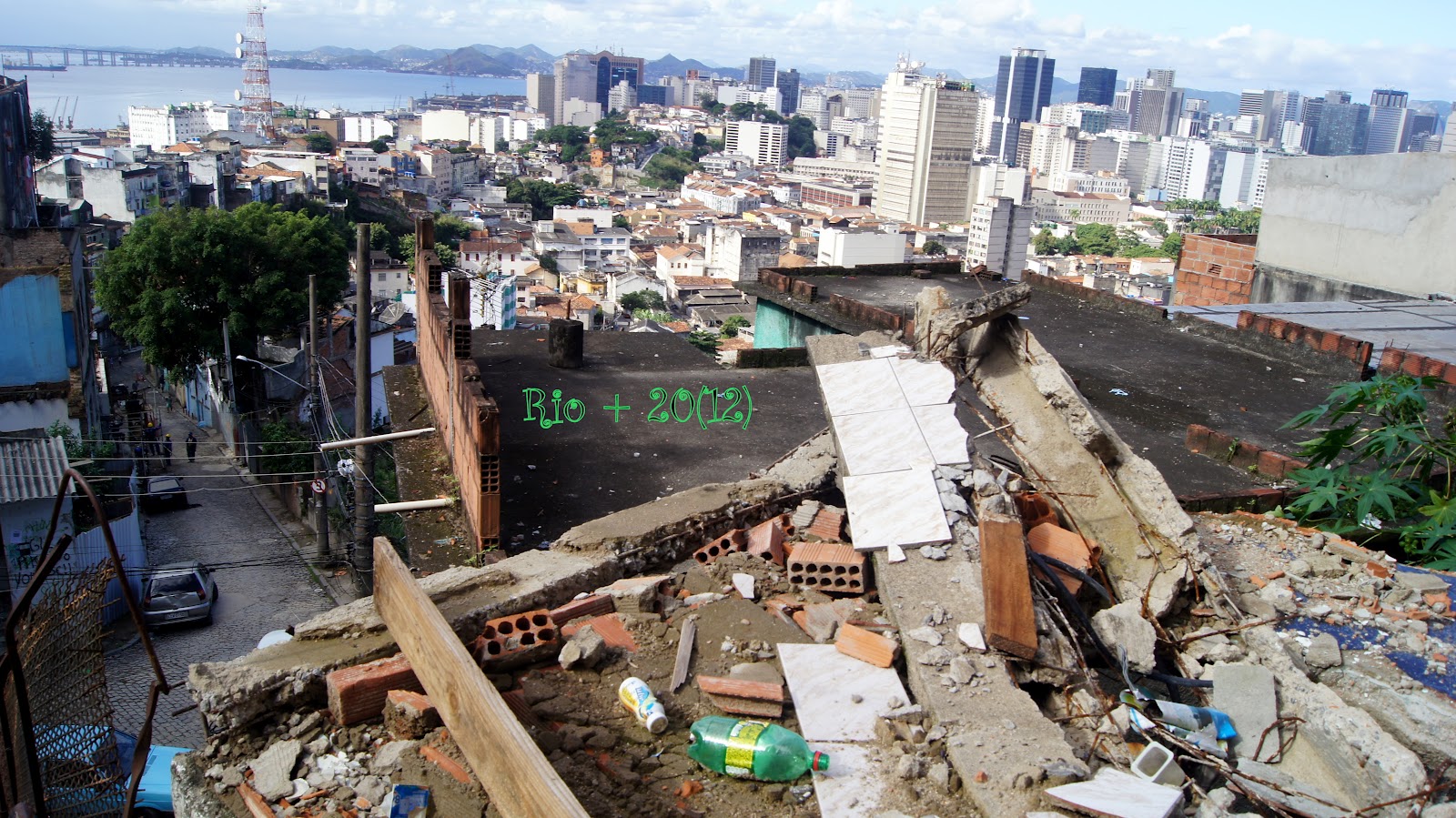
 Morro da Providencia, Zona Portuária. Though difficult to see, the blue bins belong to the Consorcio Porto Novo, the group responsible for the 5 million square meter gentrification project known as the Porto Maravilha. This trash collection point has been made worse by the installation of a tram line that will link Providencia with the Central rail terminal. According to residents, COMLURB trucks used to make regular collections here but their trucks can no longer access the morro because the street has been blocked by the "public works" teleférico project - a project that never had any community involvement.

Forced removal on the Morro da Providencia. This rubble was left behind by a housing demolition that occurred after Providencia was occupied by the Military Police. UPPs all over Rio have unleashed a series of polemics ranging from controversial "thinning" projects, massive real-estate speculation, the elimination of popular culture (funk parties), and the opening of relatively closed social and physical spaces to aggressive forces of capital accumulation. The benefits and drawbacks depend on who you ask and which topic you want to treat. The discourse of UPP occupied favelas as being safe and interesting places for tourists to still experience "authenticity" in Rio is given a good run at Rioonwatch while others have been less reflective about the naked advertising of occupied favelas for foreign visitors.

The above scene is kind of like a forest before being flooded by a hydroelectric plant. The Transcarioca BRT will slice down the middle of this street, sending high speed buses between the international airport and Barra de Tijuca. The street will be widened to 30 meters, and the sidewalk diminished to 1.5 meters on either side. These informal crossings will become even more dangerous. If the BRt is to even approximate its projected capacity, a bus will have to pass in each direction every 30 seconds. There will be no bike lane and the BRT stations are not projected to have bike racks. The BRT will cut this neighborhood in two, forever. No one in the region has much information about the timeframe for implementation and it seems unlikely that the city government will be offering much clarity.


 |
| finally, yet another very cool example of Rio's amazing street art |
10 October 2011
Banal idiocy on a bike
The banal occurrences of daily life in Rio flit between the poles of the annoying and ridiculous. If it were almost any other city in the world, Rio de Janeiro would be completely impossible to aguentar (deal with), but because it’s so staggeringly beautiful, we accept and even encourage the magnificently wrongheaded race to the bottom that qualifies as public policy and urban planning. Comparable to an airbrushed super-model, Rio looks great and is seductively pouty but it’s a fragile image that belies serious eating disorders, exploitation, macho blinkeredness, and complicit consumers who fail to question a system that sends millions of women to the gym to reduce their bodies while their male counterparts get their vanity muscles inflated to cartoonish proportions.
An example, if I may. The ferry that crosses Guanabara Bay is run by a private company via a concession given by the State Government. This is also known as privatization. Recently, the same idiot who was responsible for the bonde disaster in Santa Teresa (State Secretary of Transportation Júlio Lopes) allowed Barcas S.A. to eliminate night-time service because the company was not making enough money. There is virtually no bus service after mid-night so if you’re caught on the wrong side of the bay, the only practical solution is taxi: R$40 – 50. In this instance, the idiocy is allowing the incompetent state secretary of transportation to act on behalf of the private company.
Last week, I attempted to go by bicycle from Rio to Niterói. Arriving at Praça XV was a challenge because there is no bike path that links anything in the center of town to anything else. One has to brave the inferno of Rua Primeiro de Março where there is an excellent chance of becoming another statistic: one cyclist is killed every ten days in Rio de Janeiro. Once to the ferry, in addition to the R$2.80 passenger fee, the intrepid cyclist must pay an additional R$4.70 for the bike! R$15 for a two way passage. Ridiculous and illegal according to a judgment handed down in June.
To make the ridiculous something else, in order to take one’s bike onto the ferry I was told I had to roll through the disembarkation where I fought against a literal human tide in order to put my bike on the waiting platform. After parting the crowd, I arrived on the platform and handed my baggage ticket to security. Just then, the bell signaling immediate departure tolled, but not for me. I had my boarding ticket in hand and wanted to take my bike and enter the ferry. In an amazing leap of logistics, I proffered said ticket to the security guard but in an equally stunning leap backwards he told me that I had to leave my bike with him, return to the front of the terminal, pass through the turnstiles, go back to where I was at that very moment, hand over my ticket stub, and then take my bike onto the ferry. I argued. The Napoleonic supervisor arrived, chest inflated with absolute rules to follow, absolutely. I huffed and puffed while the boat left without me.
Is there a greater dis-stimulus to riding a bike in this city than charging more than twice as much to bring a bike across the bay? To make matters worse, riding a bike in Niterói is far more dangerous than it is in Rio . As I was formally complaining to Barcas S.A., I was told that this dance-around-the-turnstile practice was formalized after some idiot decided to ride his bike onto the ferry and ended up hurting someone. This is the problem: the policies and rules of most public spaces and entities in Brazil
Idiotic transportation practice #2: the new BRT lines will have no bicycle lanes. Even though the Glorious Prince of Rio de Janeiro likes to show off on his bike and skateboard from time to time, there is no safe, functional way of getting around this city on a bike, nor will there be, even though it is in practice much faster to go between most of Rio’s Zona Sul neighborhoods by bike than it is by bus, metro, or car. The OGloBobo reports about the city being “disposed” to bike traffic only showed pictures from the bike path in Botafogo and Flamengo. They must take us for idiots, which I suppose we are. The only days that you can put a bike on the Metro are Sundays and feriados and there is no bus in the city that has the capacity for bikes, nor will there be. This idiotic lack, combined with the increasingly insane and maddening traffic situation in the city, will eventually clog the city so tightly that not even Dick Cheney’s heart surgeon will be able to fix the problem.
Next up: more idiocy from RIOTOUR, the FERJ pigs at the trough, Orlando Silva in the crosshairs.
12 June 2011
Festa Juninho (Pernambucano)
Here’s a big post to give everyone something to chew on for a couple of weeks. I will be giving talks at: Duke University in Durham, NC on June 22 (@ the Haiti Laboratory, Franklin Humanities Institute, Bay 4 Smith Warehouse, noon), The Brazilian Association of Investigative Journalism in São Paulo on July 2, and Intel in Santa Clara, CA on July 11. Details forthcoming.
Starting from the top down in classic mega-event style:
Leonardo Martins in Jornal do Brasil wrote, “As UPPs são, antes de tudo, um projeto de poder, de controle de um espaço tradicionalmente submetido à opressão. Os novos Capitães, que comandam as UPPs são os novos “donos do pedaço”, em substituição aos traficantes que ali se encontravam. Autorizam bailes, mandam baixar o som dos moradores, escolhem as músicas que os moradores podem escutar, determinam horário e condutas pessoais, intimam e intimidam àqueles que tem uma opinião mais crítica acerca da função da polícia, como por exemplo o fechamento da rádio comunitária do Andaraí, pela Polícia Federal, sobre o pretexto de rádio pirata e atrapalhar o tráfego aéreo."
“The UPPs are, above all, a projection of Power, for control of a space that has traditionally been oppressed. The new Captains that command the UPPs are the “owners of the land”, substituting the drug traffickers that were there before. They authorize dances, tell the residents to turn their music down, choose the music that the residents can listen to, determine the coming and going and conduct of people, intimate and intimidate those who have a more critical opinion of the police function, as for example the closing of the closing of the community radio station in Andaraí by the Federal Police on the pretext that it was a pirate radio station and it interfered with air traffic.”
I haven’t been back to visit and UPPeed communities in awhile, so I don’t have much more to contribute to the debate than I had a few weeks ago. I hear adolescents around town say “UPP é o caralho” and have seen that succinct and poignant phrase scribbled on walls.
Mayor alert! EP twisted his ankle in a political minefield, but don’t worry, he’s going to be ok. O Principe’s attempts to manipulate the infrastructure of the Olympic machine didn’t sit too well with people more powerful and experienced than he. In trying to limit the powers of the APO, EP threw a few one-liners into the City’s Olympic act that he then had to beg some legislators to erase and pretend to everyone else that he wasn’t trying to maintain as much power for himself as possible. The story is much longer than that, of course, but takes a doctoral thesis to sort though. Fortunately, those are available.
According to sources buried deep within the international press corps, The IOC has had all of their questions answered in regard to forced removals for Rio’s BRT lines. The Trans-Oeste BRT (Blown Right Through) is moving people out of the way faster than a turd in a hot tub. The results are shit.
 |
| Picture of housing demolitions carried out by Rio's Housing Secretary along the Trans-Oeste BRT line, April 2011. Nelma Gusmão de Oliveira foto. |
 |
| Last one standing, Zona Oeste Rio de Janeiro. Nelma Gusmão de Oliveira foto |
Mayor alert! O Principe tried to stick the Olympic golf course in a closed condominium complex where the cheapest condo goes for R$2.1 million. Unfortunately, the land that he wanted to put the course on has been stuck in the judicial system. Apparently the news took the condo residents by surprise. The is the kind of “planning” is happening on a metropolitan level, not just with the Olympic golf course.
According to the Union of Externally Controlled Federal Auditors (AUDITAR), “the new model of contracting banked by the base of Dilma Rousseff’s government in the house of deputies is going to make the public works for the World Cup and Olympics much more expensive.” This is not at all surprising given that the new laws are designed to “flexibilize” normal contracting processes.
Compounding the problem is that those who frequent stadiums end up paying for them three times. Once for construction. Twice for higher ticket prices. Third for world-class maintenance costs. Even our illustrious Federal Deputy Romário is calling the stadium budgets into question.
The CBF brought their team back to Brazil for the first time in a long time to prepare for the Copa America in Argentina. The ticket prices were staggering and the games were seen as test venue for the CBF to employ private security guards (as will be the case during the World Cup). The Prossegur rent-a-cops did not take kindly to the unfurling of a banner by the ANT-GO crew and gave them some rough treatment for unfurling this lovely banner. Congrats to these brave formigas!!!
 |
| Ricardo Ali Baba Teixeira, OUT! For decades Brazilian football has been in the hands of incompetent and corrupt officials, we demand the democratization of decisions related to Brazilian football with the participation of fans! Neither FIFA, or the CBF, or Football is of the People! National Fans Association |
Here are the attendances and financial details from those matches:
Game | Paying Public | Gate Receipts | Average Ticket | Free tickets |
BRA (0) x HOL (0) | 36.449 | R$3.120.625 | R$85.81 | 7.000? |
BRA (1) x ROM (0) | 30.059 | R$4.357.705 | R$144.90 | 9.000? |
66.508 | R$7.478.330 | R$112.44 | pqp |
It’s impossible to tell how many tickets the CBF gave away to itself and to its sponsors. Interestingly and stupidly, the first match in Goiânia, resulted in Ricardo Teixeira (Mr. Jowls) promising a Copa America 2015 match to that city, even though they are not hosting any World Cup matches. In Rio, tickets for Copa Libertadores matches in 2010-2011 started at R$75. In three hours of football, the CBF made off with R$7.5 million and scored one goal. How expensive will tickets to the World Cup be? How expensive will the stadiums be? This is a link to a professor from the Fundação Getúlio Vargas who is criticizing the Maracanã budgeting process. We have seen a 170% increase in construction costs since 2009. This is without multiple labor shifts, without increased raw material and labor costs, without counting the subsidy for imports, without counting the no-bid conracts, without the time crunch, etc.
But, this will give Brazil (and Rio in particular) the MOST MODERN STADIUMS IN THE WORLD!!!!!!
What does it mean to have the most “modern “ stadium in the world? The continual search for and production of the modern in Brazil has had very mixed urban, social, and environmental results. When the Maracanã was constructed, it was the most modern stadium in the world, was it not? Will not the host of the 2016 European Championships have the most modern football stadiums in the world? Why bother calling it the most modern stadium in the world? It’s a stupid and completely relative question.
Modern could mean functional but certainly means secure and comfortable and bougie, but in the context of Brazil’s mega-events “modern” has become more associated with overspending on monumental mistakes that are guaranteed to bring diminishing economic returns in an attempt to appear modern for and to foreigners. The stadium, as such, does not have to be submitted exclusively to economic metrics as a measure of its value. In addition to agreeing to build economic black holes, the cultural costs have not been calculated in the production of the twelve stadiums for the World Cup. The Mané Garrincha Stadium in Brasilia had bleachers so well-made that it took three attempts to demolish them with explosives. They are installing an expensive house of cards in his place.
FIFA has chosen Rio de Janeiro as the host of the International Broadcast Center for the World Cup. It will, of course, be in Barra de Tijuca at the Rio Centro complex. This is interesting (though not surprising) for a couple of reasons. One is that it will develop further Barra’s emergent position as the high-tech and media production center of Rio de Janeiro and Brazil. Why? Because in order to install something as sophisticated and grandiose as an IBC millions if not billions of fiber optic cables need to be stuck into the region, creating an information infrastructure that augments already profound structural inequalities within the city.
Secondly, the increasing and repetitive investment in communications infrastructure in Rio de Janeiro (and São Paulo) is consolidating the position of those cities in the hugely unbalanced urban hierarchy of Brazil. The choice of Rio will guarantee that it grows its media and communications industry at the expense of Belo Horizonte, Salvador, Porto Alegre, etc. Of course, wherever this kind of investment happens there are knock on geographic effects. However, the overwhelming Federal investment in Rio de Janeiro (at least R$100 billion between 2010-2016) is going to have long term consequences for a more balanced urban system. The FIFA media release is worth a read.
The Secretary of the Fazenda of Rio de Janeiro is trying to find ways to raise R$4 billion to finance public works for mega-events. His primary obstacle, according to Oh, Globo is the Law of Fiscal Responsibility (LRF), which prevents cities from emitting bonds while they are in debt. O Principe is still waiting for his R$ 2.5 billion loan to come in from the World Bank and until that happens, Rio is prohibited from borrowing more money. The strategy therefore is to wait until Henrique Mirelles (O Neo-Libertador) finally gets into power and then they’ll talk about how much debt they can saddle Rio with. This quote I found rather touching: Do ponto de vista político é muito delicado (mexer na LRF), mas do ponto de vista econômico, faria sentido", ressaltou a secretária. (From the political point of view it’s very delicate [to mess with the LRF) but from the economic point of view it makes sense). Head, shoulders, knees, and toes! Get flexible people!
 |
| Dilma and the PT get to work on the law |
Did you know that trees are as flexible as stadia? Well, the revisions to the Forest Code that are getting crammed though the senate is going to surprise you, or not. The Amazon is being picked apart by agri-business, timber, and mining interests and the Worker’s Party is doing everything it can to hand the country over to capitalists. The passing of the mutilated Forest Code and the mega-event flex-laws are the priority of the new Minister of Institutional Relations. If Dilma’s government were any more flexible they’d call the county Shavasana.
25 March 2011
The impossibility of everything
The impossibility of keeping up with EVERYTHING that is happening in Rio de Janeiro is increasingly clear. Today I drove with Fabricia Herdy as my grad-student co-pilota along the trajectory of the Trans-Carioca BRT line (also known as the T5) that will supposedly link the international airport (Galeão) with the Autódromo. This is the link to the official and brutally crisp video. http://oglobo.globo.com/rio/video/2011/22724/
I have many impressions after driving these streets. In sum: Nooooosssssaahhhh Senhora. The project appears to be moving, or rather, the city government has started putting up big blue signs. There are mergulhões to be sunk, houses and businesses to be bulldozed, viaducts to be shot into the air, voids to be bridged, tunnels to be dug and an unimaginably complex project to be carried off in four and a half years. Officially mid-wifed this week by O Principe do Rio, the Trans-Carioca is budgeted at R$1,5 billion and will consume at least 3,200 buildings. It is a massive urban transportation project and will DEFINITELY change things along its 39km trajectory. (In the Grandes Projetos Urbanos (GPDU) laboratory in the Graduate School of Architecture and Urbanism at the Universiade Federal Fluminense, we are working on a project that will analyse these transformations. We’ll present our preliminary results at LASA 2012 in San Fransisco. If you want abstract, send me an email).
But wait, there are three more BRT lines planned. One is blasting its way across swamplands and through mountains to connect Barra da Tijuca and Santa Cruz, and another is headed, lock-step from Barra to the military compound in Deodoro. The third, and least likely to leap off paper is the Trans-Brasil that will link Santa-Cruz and Caju. These are all supposed physically manifest before the 2016 Olympics? The T-5 alone is going to demand an incredible amount of equipment. Are there enough qualified laborers in Greater Rio to build all of these things? What about all of the other things under construction? If I were a skilled road-man, fore-man, or oil-man with a mouthful of Portuguese, I would get myself to Rio asap.
Eduardo Paes calls the T-5 “An urban revolution”. He’s right. There’s a half a billion set aside to pay people for the homes the project will destroy. The Minha Casa Minha Vida housing program for the whole country is only R$7,6 billion (just cut back from R$12,7). So, to build one BRT line, one in every 15 reales of public housing money will go to destroy housing stock. If they manage to connect all of these segments before the opening day of the Olympics, I will be well and truly impressed. It will take years to untangle what is being rolled into these BRT projects. Caution and three sheets to the wind boys!
Politically, the bicho esta pegando também. For Portuguese readers, the following is a link to a great description by Nelma Gusmão de Oliveira of the lack of change in the basic form, function, and force of the APO (Public Olympic Authority). There was some shuffling of papers and a few hundred public functionaries fell into the dustbin of the future, reducing the budget of the APO by a few million a year. In a budget that begins at R$29 billion, that’s nothing. But never fear! The former head of Brazil’s Central Bank (all 8 years under Lula), is taking charge, damnit. Bankers are honest and know how to manage many billions of your money! There's not too much noise coming from opposition, but there are a few snarky figures lingering about. Don’t tremble because the Rio Military Police is there too…
 |
| Rio police spray little kids in Niteroi, nice work fellas. Oglobo foto. |
Let’s hope that the MP doesn’t start turning its attention to the Social Movements mobilizing to fight the World Cup and Olympic Project the way they’ve been treating the Obama protestors and the people from Morro da Bumba in Niterói that have yet to move into permanent housing following last April’s mudslides.
Oh, FIFA. Oh, CBF. Oh, the Copa. You know it has to be bad if a headline in OGlobo about the 2014 World Cup is: White Elephant of the Forest. This refers to the absolute and complete lack of utility for the Arena Amanônia after the World Cup. It’s a pity that they destroyed a functional and elegant stadium in the process. Much like the HSBC Arena in Rio (built for the 2007 Pan-Am. Games), the 47,000 seat R$593 million stadium will probably only be used for shows. Air Supply in Manaus anyone? Get your tickets now. We knew this was going to happen. It was planned this way. There was never any doubt about the result. But it didn’t have to happen this way, and no one is going to do a thing to prevent it from happening again or hold officials responsible for their pig-hgeaded, short-sightedness. Or are they?
In a refreshing switch on its coverage of favelas being the main source of pollution for the lakes of the Olympic Development Region, OGlobo has finally started reporting on the saw sewage and waste that condominiums are pouring into the waterways. There have also been occasional reports about the pollution caused by the various chemical and pharmaceutical plants in the region. Nothing, of course, about how the changes to the city’s master plan which will allow for more and denser condominium development, more cars, more consumption, more sewage, and more waste will affect the regions already stressed water system. That’s for IBAMA and Imanjá to deal with.
I started off this column by reflecting on how it was difficult to keep up with everything that is going on in Rio. This is true everywhere, but at times, Rio de Janeiro seems to be moving so quickly and in so many directions that it’s difficult to know where to sit and watch it. This is part of the challenge of finding an apartment in Rio: to find a place that is quiet but close to transportation, on a side street but with a view, close to entertainment, restaurants, parks, plazas. Someplace to work, play, eat, study, sleep, feel comfortable. Too much to ask? There are great streets in crappy neighborhoods and crappy apartments on great streets. Some are too far, some are too low, the buildings from the 60s and 70s and 80s are cramped, the new buildings without personality and the roomy apartments in older, elegant buildings from the 30s, 40s, and 50s are too expensive. There is a general sense of urgency and scarcity that is clapped on the ear with the open palm of bureaucracy. Most of the apartments I have seen have had between 4 and 12 other people looking at them at the same time. Looking to rent an apartment in Rio? Here’s a word you need to know: fiador.
Your fiador will be someone who owns at least one property in the city of Rio de Janeiro and who is willing to provide you with all of their original personal documents, including the value of their apartment, how much money they make, etc. This person will act as the guarantor of your rent for your 30 month contract. You flee the country, or move to the interior of the interior, the rent is on them. The problem, in addition to what I feel is a tremendous invasion of privacy and the commensurate need for a long-standing friendship (or family relation) to even ask someone to be a fiador, is that it takes a lot of running back and forth, here and there, copies, orginals, stamps, signatures, proof of residence, bank accounts, getting everything together, and the first person (of the 10 of you standing in line to see the over-priced apartment where you will never speak to or meet the person who owns it), the first person to deliver all of their documentation will be the one who gets the apartment. So, get your fiadores lined up now, or be prepared to pay Porto Seguro the equivalent of one month’s rent per year for two and a half years. You will never see this money again. This word you already know and it needs no italics: mafia.
09 February 2011
Que transparência é essa?
21 December 2010
BRTs, forced removals and end of year terror
The forced, violent removal of people and homes in preparation for the crashing wave of mega-events has begun. In addition to the 119 favelas marked for removal by the city government last year, there are many thousands more homes, businesses, and temples that will be eliminated to make way for the soon-to-be-infamous BRT lines. A bit of explanation:
BRT = Bus Rapid Transit. BRT lines are dedicated bus lines that function like rail lines in that they have fewer stops and only permit one kind of vehicle in a designated space. In Brazil Rio de Janeiro
These are the principal problems with the construction of BRT lines in Rio :
- Forced removal of at least 10,000 homes, businesses, and public spaces
- The continued dependence on the internal combustion engine and “things on rubber wheels” for mobility
- The solution for 21st century transportation problems in a city of 13 million is the same as a 1970s solution for a city of 1.5 million
- BRTs require dedicated concrete sluices that will divide communities in the same way as elevated highways (like the Linha Amarela)
- BRTs deliver only 30% of the passenger capacity as light rail
- All of the BRT lines will have their terminal points in Barra de Tijuca. There will be no linking of the city from East-West, nor will there be connections between the Baixada Fluminense and the City of
- This will augment, not reduce, the influence of the
- The three BRT lines will alter urban space forever, further fragmenting the city along class and geographic lines
- The three BRT projects are being constructed with public money yet will be run by private concessionaries. These projects will consume tens of billions of reales and have not been sufficiently discussed in public forums before being implemented.
There has already been significant resistance to the forced removals. The city government is attacking homes in the night with bulldozers, continuing a long tradition of the SMH (City housing authority) of violence against those who don’t get out of their way immediately. The BRT projects are part of a larger Olympic building initative that is targeting favelas for removal before 2012. I will be presenting a paper at the ANPUR conference in Rio in May about the BRTs of Rio de Janeiro. My paper abstract (in Portuguese) is below. For more information about the terrorist actions of the city government in the Vila Harmonia and Vila Recreio II favelas, see the Newsletternomade.
As linhas BRT do Rio de Janeiro – fragmentação através de integração
Uma peça fundamental do projeto olímpico do Rio de Janeiro é a instalação de três linhas de BRT, Bus Rapid Transit. A prefeitura do Rio, em parceria com o Comitê Olímpico Brasileiro, projetou as linhas sem qualquer discussão em audiências públicas, justificando o investimento nesse tipo de transporte como necessário para a maior integração do “anel olímpico” – uma invenção retórico-geográfica que disfarça as carências de transporte na cidade.
O presente trabalho está baseado na perspectiva de que as linhas de BRT compõem parte de uma estratégia de fragmentação sócio-espacial do município. Ao invés de atender as necessidades atuais do transporte metropolitano, tomando-se em conta o fluxo de veículos e seu uso, as BRTs se limitarão a atender as exigências das classes dominantes. O resultado será desastroso para o transporte público, afetando negativamente a mobilidade da maioria da população e fragmentando barrios e comunidades. Tendo em vista que essas intervenções determinarão a estrutura de transporte na cidade pelos próximos cem anos, elas demandam uma discussão urgente e mais ampla, baseada no pensamento crítico.
Combinando mapas e dados obtidos junto à prefeitura do Rio sobre as trajetórias das BRTs e visitas aos locais onde serão implantadas (com milhares de desapropriações), e comparando a experiência recente da instalação de uma BRT em Johanesburgo durante a Copa do Mundo 2010, este trabalho mostrará que as três linhas de BRT na capital fluminense irão agravar a fragmentação e a segmentação da cidade, privilegiando zonas já favorecidas com altos índices de investimento público. A pesquisa alerta para a possibilidade da criação intencional de uma metrópole na qual a classe operária se vê isolada e impedida de locomover-se com facilidade dentro das regiões que ocupa – pois o transporte de massa está disponível apenas para levá-la às zonas mais ricas, para trabalhar. A falta de integração entre as zonas menos favorecidas limitará as possibilidades de desenvolvimento econômico local e fortalecerá as divisões sócio-geográficas já existentes na cidade.
Subscribe to:
Posts (Atom)