Showing posts with label EMOP. Show all posts

07 November 2012

The Perverse Priorities of Power (PPP)


The Maracanã privatization scheme (Public Private Partnership) is both emblematic and symptomatic of the way that the Rio State and City governments relate to the public. For those not familiar with the story, the Maracanã has undergone a series of crippling reforms since 2005 when the state threw R$430 million at the complex to “prepare” it for the Pan American Games. The promise at the time was that these reforms, which included upgrades to the Maracanazinho gymnasium, the Celio de Barros running track and the Julio de Lamare aquatic center, would meet the demands of international sports federations (IOC, FIFA) so that one day Rio could bask in the temporary glory of being the center of the universe. Overseeing the reforms for the Pan was the current mayor, Eddie P., then the state secretary of sports. In his words at the time, “the privatization of the Maracanã is inconceivable.”

Foto from inside EMOP showing the permanence of the Maracana complex 
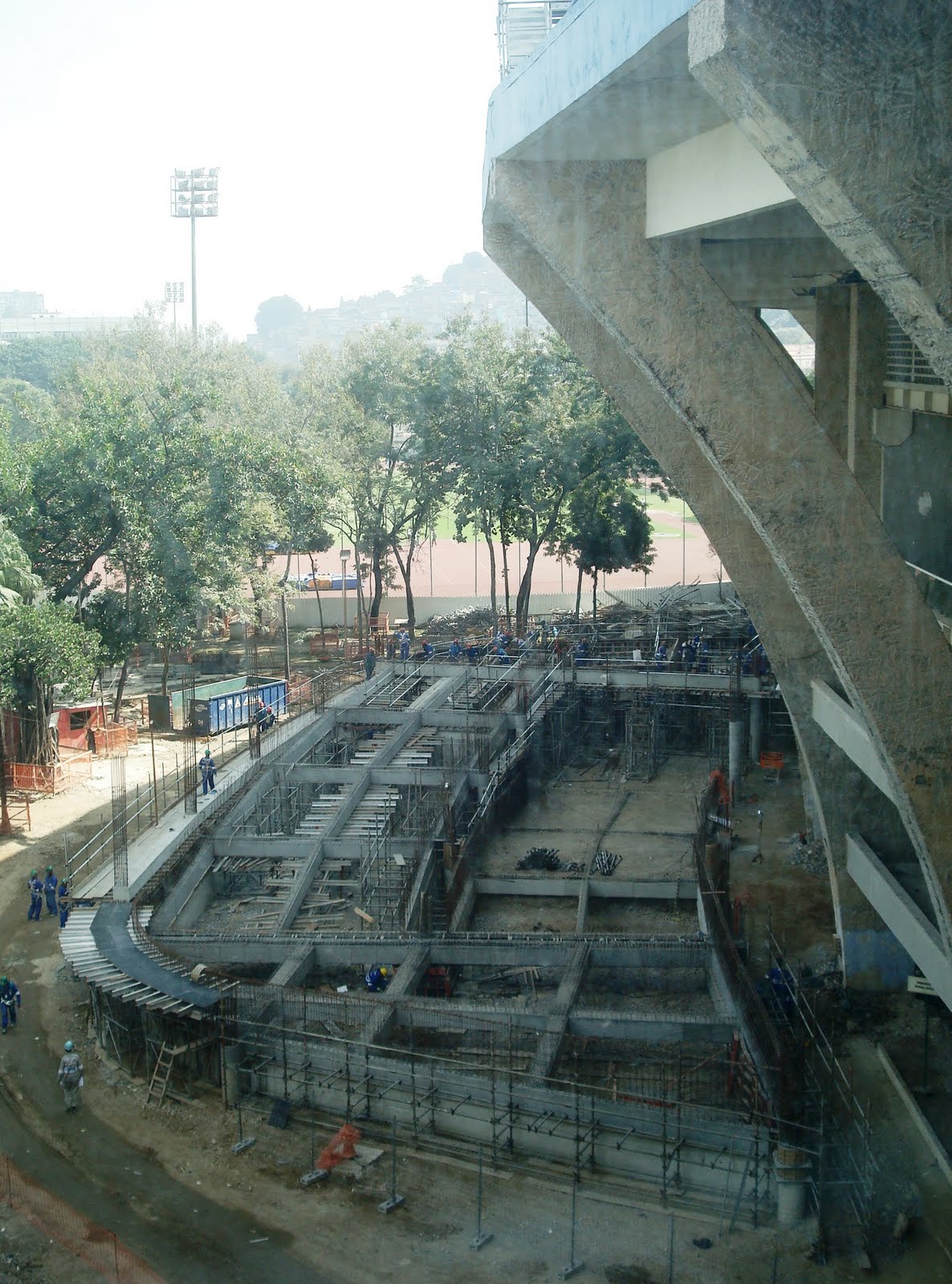
After tearing apart the reforms of the Pan, the Maracanã has been ripped to shreds with a price tag that is approaching R$1 billion. The football stadium has been closed four of the last eight years, but the aquatic park and athletics facilities have functioned well, serving a diverse constituency of neighborhood residents, athletic athletes and public schools. Two weeks ago, these facilities were put at risk through the opening of proposals to privatize the complex. Ícaro Moreno, the head of EMOP (state public works), said last week that these installations are being moved across the train tracks, but there’s no project for that at all. In fact the photos of the Maracanã complex on the walls of EMOP show these facilities being preserved in situ. No one has consulted any of the users of the Maracanã: football fans, elderly, parents of school children, athletes, coaches, journalists.

The ONLY time the public interest will be “consulted” will happen tomorrow night in what is being erroneously called an audiência pública. The government will present the project they have developed behind closed doors, open the floor for a few comments, perhaps register that they have somehow engaged in a democratic process and tchau. Following the audiência, the script reads, Batista’s IMX company will submit its privatization proposal, which will be accepted, and poof – no more public influence over one of Brazil’s greatest architectural icons and public spaces, no more public school, no more athletic track, no more swimming complex, no more Museu do Índio. The projected return on public investment (without inflation or interest on loans) over the 35 year concession will be around 26%. After 30 years, these cookie cutter “world-class” stadiums all a face lift anyway, so IMX will likely re-negotiate after the public pours money into the New Novo Maracanã.  This is a direct public investment in private welfare.

The perverse associations between Eike Batista and the state government are little discussed, even amongst the politically conscious. The perverse conception of democracy as one in which the public can comment on but not participate in the formulation of the public interest is totally blasé. The extension and expansion of democratic rights to the population isn’t high on the mayor’s or governor’s or Eike’s to-do list.  The expenditure of public money on public works to be handed to private interests that involves the destruction of a top-performing public school, a century-old indigenous heritage site, and two Olympic quality training facilities in order to generate even more profit for Brazil’s richest man, is a perversity that boggles the imagination. 

The future of the Maracanã must be discussed more broadly with those who use it. An audiência pública to discuss a pre-determined project is merely farcical theatre.

If you didn't have enough to gag on today, take a look inside the host city agreements: http://www.prefeitura.sp.gov.br/cidade/secretarias/copa/documentos/index.php?p=47152


12 August 2011

FIFA comes to Rio, not all is well


FIFA descended upon Rio de Janeiro for the 2014 World Cup Qualifying Draw during the last week of July. The city government shelled out R$30 million to Geo Eventos, whose parent company is O Globo, to host the party.  FIFA demanded that the Santos Dumont airport be shut down for hours and the Very Important People arrived at Eike Batista’s (Brazil’s richest person) Marina da Gloria in limousines escorted by police motorcycles. The normal, pathetic media frenzy ensued: no answers of substance were given to questions of weight and interminable platitudes met the inevitable softballs. Pelé showed up at the behest of President Rouseff but did not cross paths or exchange knowing glances with Ricardo Teixeira. Yawn.

Out on the streets were a thousand protestors flanked by riot police. The Comitê Popular da Copa e Olimpíada spent months organizing the protest and was able to gather a sizeable and vocal group that, among other things, was demanding the head of Teixeira. This head controls the CBF and Brasil 2014 and has been under increasing media and government scrutiny, including a highly revealing article in Piauí. This was the largest, earliest anti-FIFA movement in the history of the World Cup and was a very encouraging sign that not everyone in Brazil is going to passively accept the autocratic implementation of legalized robbery.

Just before the events of July 30, the Ministério Público RJ held the first Audiência Pública (Public Hearing) to discuss the Maracanã construction process. That this was the first  public hearing about the stadium’s fate speaks volumes about how the World Cup is being carried off. That the Maracanã underwent R$320 million in reforms in 2006-2007 to prepare it to host the World Cup screams for massive judicial inquiries into the management of Rio’s public facilities. These reforms, as I have shown here on various occasions, have dis-characterized the stadium, transforming it from an iconic public space of cultural production into a sanitized space of consumption. The Audiencia Publica did nothing to discourage this view.

The discussants were Professora Sonia Rabelo, Professor Carlos Lessa, the head of EMOP (Public works for the state of Rio) Icaro Moreno Junior, the president of IPHAN Luiz Fernando de Almeida, and the procurador from the MPF Mauricio Andreiuolo Rodrigues. The debate circulated around the idea that the construction project should be stopped because what is being destroyed has been protected by IPHAN as a cultural patrimony and that the Novo Maracanã project will completely change the stadium’s character. On the side of the people were the professors, on FIFA’s side EMOP and IPHAN.

The most disturbing element of the discussion came from the IPHAN president. After asserting that the only criteria being used to evaluate the project was the preservation of the ethnographic character of the stadium, the 100+ people in the audience were treated to a spotty video of the new stadium. It showed what could have been the inside of a shopping mall or a closed condominium complex. I asked the IPHAN president whether or not he agreed that we were being shown an ethnographic film that pertained to the upper classes and if this was consistent with the character of the Maracanã. He responded by saying that for him, the preservation of the ethnographic character was “ to host the World Cup in the Maracanã” and that “if you want to have a FIFA World Cup one has to abide by what FIFA demands”. In short, IPHAN has sold out, bowed to pressure, showed no spine or integrity in relation to the Maracanã  - forever altering the character of the stadium and saying, basically, that if we don’t like what has been done to the stadium after the World Cup (especially the roof, which was the center of the debate), we can demand that it be restored. I’ll let the reader decide if this makes any damn sense at all.

Following the Audiência there was rumor that the legal system had intervened to stop the project but this was just rumor. It appears that the project, whatever it is, will continue apace and that the Maracanã in 2013 will, as the EMOP president recently stated, “be recognizable as the Maracanã by those who see it from a distance”. Great. Well done lads! 

Here are some photos of what has been lost. 


21 July 2011

Tupi Ruins found at the Maracanã!!!

It had been awhile since I had ventured into the hole of sadness that was the Maracanã. Though hope does still exist that the final project can be altered from its current course, the continued devastation of this cultural patrimony continues to depress and amaze. I say that there is hope because the Comitê Popular da Copa e Olim-piadas has scheduled a meeting with the Ministerio Publico Federal (MPF - a federal legal agency) for the 28th of July at 14 hrs in downtown Rio (Ninlho Pecahna 31, 6a andar). There, the public will be able to present legal and personal depositions in an attempt to get the construction project altered. Unfortnately, the title of the public hearing is "Maracanã, Present and Future", a clear attempt to forget the previous 61 years of the stadium's history. What follows are some photos from today's experience, which involved an aborted attempt to see Cyprus play Qatar in volleyball in the World Military Games (aborted because they wouldn't let me in with something sticking out of my backpack).

Losing the color. In order to test the concrete of the supporting structure, the sky-blue paint of the stadium has been stripped away. This is part of the larger plan to return the Maracana to its "original" color, white. There is some question as to whether or not the stadium was ever painted white as it was not completed in time for the opening game of the 1950 World Cup. The story that I choose to believe (due to multiple interviews in 2004) and that I wrote about extensively in Temples is that the organizers of the '50 Cup were so confident that Brazil would win the tournament that they offered to paint the stadium in the colors of the winning team. Uruguay won, silencing 200,000 Brazilians and the Maracanã has borne the stain ever since. If only SUDERJ would open the archives se we could get at the maintenance records of the stadium to determine the exact moment in which the stadium was painted, and repainted, and repainted in the colors of los hermanitos we could put this debate to rest. In the foreground is the mis-conceived 2014 project and a banner for the World Military Games. R$705 million of public investment does not begin to approximate what the final cost of the project will be.


Souviner's shop. Snack's Bar. Fala serio. I know that Brazilians are very liberal in their use of the apostrophe, but this kind of grammar howler pervades tourist-orientated signage. The sign explaining the Jules Rimet trophy says in its final paragraph, "In 1966 it was stolen in England, recovered and once again stolen, this time in Brazil where it was melt and sold." Are we to understand that that the thieves melted the trophy before they sold it? They should also put a footnote in the sign that Brazilian thieves stole it before selling it to an Argentine who melted it and pressed it into gold bars (or bar's).


The "museum". Not only is there no useful information, but on display is a bycicle used by workers to get around the job site. How innovative, I guess it's how they got by in 1950. In the back of the room there is a desk used by a functionary, very good, but on top of that desk there is a suitcase that was "used to carry cash and tickets." You don't say? In the era of Eduardo Viana, the decseased Caixa d'Agua, who ran the Rio State Football Federation as his personal fiefdom, the carrying of game reciepts home in such a suitcase was far from uncommon. This very bag should have FIFA's name on it, though it is definitely not big enough to carry the billions they are going to put on the plane to Switzerland.

General view of the Maracanã from the tourists' perch. This is one of the saddest sights in the history of modern sport. The current projects calls for the reduction of the capacity from 86,000 to 76,000 as well as the shrinking of the monumental pitch from 78 x 110 yds to 68 x 105. This will change forever the kind of place the Maracanã is as well as the kind of football played there. The physical space of the goal mouths that have been the thresholds of joy and despair for millions over decades will disappear. Games played here will become ping-pong matches characterized by long-balls and packed-in defenses, styles of play that will violate the basic characteristics of Brazilian football.

The old moat that separated the geral from the field can be seen in the back of this photo. Now used as a ramp to bring heavy equipment onto what was the field, this defining characteristic of the Maracanã will also disappear. In the foreground, the first of the 60 large concrete supports that held the elegant, monumental roof hits the deck.

As I was watching the roof come apart I was wondering what they were going to do with these massive supports.  As if on cue, in comes the hammer, reducing to rubble a legally protected part of Rio de Janeiro's cultural heritage. No one standing around the massive dust cloud appeared to be wearing any kind of respiratory device. I'm sure that aspirating 61 year old concrete will have a salubious effect on EMOPs labor force.


On the left, one of four new ramps being installed for access to the lower level of the stadium. On the right, the remnants of the old ramp with the entrance to the Maracanãzinho gym in the bckground. This photo was taken from what, in 2000, was supposed to have been the FIFA International Football Hall of Fame. They only managed to construct a huge (gl)ass appendage to the Maracanã and the museum never left paper. During today's visit the down escalators were not functioning.

Museu do Índio, not very well
preserved. 
Tupi Ruins in the Maracanã!!!!
Last week, workers digging under the field found 11th century Tupi ruins. This was either a burial ground, an observatory, a collective kitchen, a platform for religous ceremonies, or just a pile of dirt that kids used to play on. Archeologists are mystified.  This discovery will further complicate the city government's attempts to disappropriate the Museu do Índio to turn it into a parking lot. They were apparently here first, but who knew that they were playing in midfield the whole time? The people working at Snack's Bar said that this was part of the re-cycling of the old field and that this dirt will be used for the new pitch, but they clearly hadn't read Charles Mann's 1491.

Finally, a 45 second video panorama of the work in progress.


Thanks to Caira Conner for the photographic assistance, her master's research (NYU) looking at "social development" though sporting initiatives associated with mega-events  can be found here.
free counters

Labels

2014 World Cup Rio de Janeiro Maracanã FIFA 2016 Olympics 2016 Summer Olympics Eduardo Paes CBF Copa do Mundo 2014 Rio de Janeiro Olympics Ricardo Texeira World Cup 2014 Vasco da Gama 2010 World Cup White Elephants mega-events APO UPP BRT Brazil football Flamengo Lula Orlando Silva violence ANT Aldeia Maracana Carlos Nuzman Dilma Eike Batista Rio 2016 Sergio Cabral 2007 Pan American Games Campeonato Carioca Corruption IOC Jerome Valcke Novo Maracanã stadiums BOPE BRASIL 2016 Brasil 2014 Engenhao Joao Havelange Maracana Policia Militar Vila Autódromo Aldo Rebelo Botafogo Henrique Meirelles Medida Provisoria Metro Revolta do Vinagre Sao Paulo Sepp Blatter World Cup 2010 forced removal Carnaval Elefantes Brancos Fechadao Marcia Lins Minerao Morumbi Odebrecht Porto Maravilha Rio+20 Romario Security Walls South Africa South Africa 2010 TCU Transoeste protests public money public transportation slavery transparency x-Maracana Andrew Jennings Argentina Audiencia Publica Barcelona Brazil Carvalho Hosken Comitê Popular Confederatons Cup Copa do Brasil 2010 Cost overruns Crisis of Capital Accumulation EMOP FERJ Favela do Metro Fluminense Fluminese Fonte Novo IMX Jose Marin Leonel Messi London 2012 Marcelo Freixo Maré Museu do Indio Olympic Delivery Authority Perimetral Rocinha Soccerex Transcarioca bicycles consumer society debt idiocy militarization transportation 1995 Rugby World Cup 2004 Olympics 2015 Copa America Banco Imobiliario Barcas SA Belo Horizonte Bom Senso F.C. Brasilerao CDURP CONMEBOL Champions League. Mourinho Complexo do Alemão Copa Libertadores Cupula dos Povos ESPN England FiFA Fan Fest Istanbul 2020 Jogos Militares John Carioca Kaka Manaus McDonald's Obama Olympic Village PPP Paralympics Providencia Recife Russia Salvador Soccer City Taksim Square Tatu-bola Urban Social Forum Vidigal Vila Olimpica War World Cup Xaracana attendance figures cities corrupcao drugs estadios football frangueiro futebol mafia planejamento urbano police repression porn privitization reforms shock doctrine taxes 201 2010 Elections 2010 Vancouver Olypmics 2013 2018 World Cup 2030 Argentina / Uruguay ABRAJI AGENCO ANPUR ANT-SP Amazonia Ancelmo Gois Andrade Gutierrez Anthony Garotinho Arena Amazonia Arena Pernambucana Athens Atlético Paranaense Avenida das Americas BID Barra de Tijuca Blatter Brasil x Cote d'Iviore Brasileirão 2013 Brasilia Brasilierao Bruno Souza Bus fares COB COI COMLURB CPI CPO Cabral Caixa Economica Canal do Anil Cantagalo Celio de Barros Cesar Maia Chapeu Mangueira Chile 2015 Choque do Ordem Cidade da Copa Class One Powerboat Racing Clint Dempsey Comite Companhia das Docas Copa do Brasil Corinthians Cuiabá Curitiba Dave Zrin David Harvey Der Spiegel Eastwood Edge of Sports Escola Friendenrich Expo Estadio Expo Urbano FGV Fonte Nova Gamboa Garotinho Geostadia Ghana Globo Greek Debt Crisis Greek Olympics HBO Hipoptopoma IMG IPHAN ISL Iniesta Internatinal Football Arena Invictus Istanbul Itaquerao Jacque Rogge Jefferson John Coates Jose Beltrame Julio Grondona Julio Lopes Julio de Lamare Knights Templar Korea Lei Geral da Copa MAR MEX Manchester United Mangabeira Unger Maracanã. Soccerex Marina da Gloria Mexico Milton Santos Molotov Cocktail Mr.Balls Neymar Nicholas Leoz Nilton Santos Olympic Flag Olympic Park Project Oscar Niemeyer Pacaembu Pan American Games Parque Olimpico Pernambuco Plano Popular Plano Popular do Maracana Plano Popular do Maracanã Play the Game Pope Porto Alegre Porto Olimpico Porto Seguro Portuguesa Praca Tiradentes Preview Projeto Morrinho Putin Qatar Quatar 2022 RSA Realengo Regis Fichtner Roberto Dinamite Russia 2018 SETRANS SMH Santa Teresa Santos Sao Raimundo Sargento Pepper Security Cameras Smart City Sochi 2014 South Korea Stormtroopers São Januário São Paulo Teargas Templars Tokyo 2020 Tropa do Elite II Turkey UFRJ/IPPUR URU USA USA! Unidos da Tijuca United States government Urban Age Conference VVIP Via Binário Victory Team Vila Autodromo Vila Cruzeiro Vila do Pan Vilvadao Vivaldao Volta Alice Wasteland Workers' Party World Cup 2018 Xavi Zurich apartments atrazos barrier beer bio-fuels bonde capacities civil society comite popular copa sudamericana crack crime dengue dictatorship estádios favelalógica feira livre fiador flooding freedom of information furos geral graffiti guarda municipal host city agreement identity infrastructure ipanema istoe labor rape riots schedule school shooting security segregation social movements stadium state of exception supervia tear gas ticket prices torcidas organizadas tourism traffic tragedy trash trem-bala velodromo wikileaks xingar