The continual refrain from the organizers of mega-events in Brazil is that the hosting of the 2007 Pan American Games gave the city's event boosters credibility in the eyes of international sports federations. These very same organizers admit that there was "no substantial legacy" from the Pan, other than going 10x over budget, militarizing the city, and gaining experience in running a major event. To their credit, apparently the Pan was well organized as an event unto itself (ticketing and sports competitions), but the innumerable projects that have been left over to rot in the tropical sun defy full description.
Among the innumerable absurdities is the Velodromo (cycling track). Built for R$14 million, there is continual talk of destroying the existing structure and building a new one. This is what the president of the Municipal Olympic Authority had to say:
“Laudos oficiais mostram que a pista atual não permite a quebra de recordes. E ainda há duas pilastras atrapalhando a visão geral. A capacidade é bem menor do que a exigida (1.500 contra cinco mil lugares). O edital de licitação abre duas possibilidades: tanto para a reforma abrangente quanto para a construção de um novo velódromo. O governo federal estuda também remontar o velódromo atual em outra cidade.”
"The official reports say that the track won't permit records to be broken and there are still two support posts that are blocking the general view.The capacity is smaller than required (1500 vs 5000). The (new) licencing process will open two possibilities: one is to reform the current stadium and the other is to build a new velodromo. The federal government is studying the possibility of moving the velodromo to another city."
If we project that a new Velodromo will cost at least double the 2007 version, we can figure an investment around (and conservatively) $28 million for a sport that is not practiced with much frequency in Brazil. However, people do (or would) use their bikes to get to work, so let's look at the budgeting for bike lanes.
There is a project called Rio: capital of bikes, which this site suggests has a budget of nearly R$67 million. However, in looking at the ACTUAL money spent by the city government on this project in 2011 and 2012, we find the following:
2011: R$1,542,890.49
2012: R$1,542,890.49
Ok, great. The city government has invested more than R$3 million on this project, but what does the project entail?
One company, Sinape Sinalizacao Viaria Limitada, received R$ 644,228.83 in 2012. What do they do? Signage. Thus, 41% of the bike project budget is dedicated to signage. I haven't seen a new sign on a bike path in years. How many signs can one put up on 150 km of bike path anyway? Something fishy here...
The point is this: we are spending tens of millions again and again on monumental projects that have no use, are poorly projected, and will fill the pants of the public debt for years to come. In the meantime, the bombast about potentially useful public works projects, like Rio - Captial de bicicleta, has no basis in reality once we start looking at how much money is spent and where. Rio de Janeiro has some bike paths, but they are really inadequate, poorly connected, and when you leave them to try to get from one to another, you run the risk of death. The recently implanted Transoeste BRT line is being used as a bike path, causing some obvious problems between high speed buses and bike commuters. Why are people using the BRT lanes? Because there is no bike path. Why is there no bike path? Because there is no planning and no creative intelligence at work to ends that don't have to do with selling the city to the highest bidder.
The Velodromo farce is but one element in a larger joke that is taking on cosmic dimensions. But perhaps we won't make the mistake of hoisting the South Korean flag when the North Koreans take the field, as happened on the opening day of the women's football tournament. Nice one LOCOG.
Showing posts with label Rio de Janeiro Olympics. Show all posts
Showing posts with label Rio de Janeiro Olympics. Show all posts
26 July 2012


25 October 2011
Rotten to the Core
Ok, so no one liked or got the Gangrene Cup pun. The 2014 World Cup is supposed to be the Copa Verde, playing on an erroneous perception of Brazil as a "natural paradise" while greenwashing the environmental destruction that more than two million km of air travel will wreak. So, perhaps a Shakespeare reference to get us going today, albeit an obvious one.
There is something rotten in the State of the Copa. Not only is the government forced to create a state of exception to allow the Trojan horses of FIFA and the IOC into the country, but the people who are opening the gates are as incompetent and corrupt as the fazenderos themselves.
Orlando Silva, who I have long criticized as an incompetent hack and an embarrassment to millions of communists both dead and alive, is struggling to keep his head above the turbulent political waters in which he suddenly finds himself. Last week, Veja (which is not so much a magazine as a blunt political instrument), published an exposé on the good minister and his shady relations with a Military Police officer that also ran some sport’s outfit sponsored by the Ministry of Sport’s Segundo Tempo program. Silva is not doing himself any favors by quoting Pablo Neruda in order to proclaim his “invincibility”, but at least he’s got a sense of humor (or is giving us a good laugh at his expense).
One of the reasons for this attack is that opposition parties are trying to get their hands on the Ministry of Sport’s top spot. The MoS has seen its budget increase by 63% in the last year, a greater percentage than any other ministry, reaching R$2,5 billion in 2011. This is likely to keep increasing as the mega-events go super nova and the state starts paying the orchestra to play even louder to drown out the screams coming from the stinking ship.
Another reason for the attack from Veja could be that Editora Abril, which publishes the rag, is an official sponsor of the 2014 World Cup. There has been open warfare between FIFA and the CBF against Silva who has failed to deliver on his promise to get World Cup legislation passed fast enough and with enough goodies for the Swiss-based gang’s pleasure. By undermining Silva’s already tenuous credibility, Veja has stimulated investigations into allegations of corruption and taken him out of FIFA’s hair. Dilma has responded by taking away Silva’s role as the primary interlocutor between the federal government and FIFA but has for the moment left him at the head of the MoS.
One of the main bones of contention between the Brazilian federal government and FIFA is so absurd as to be laughable, if it weren’t so pathetically base. In Brazil
This is happening at the same moment that a federal inquisition is installing a commission to investigate Ricardo (Dr. Jowls) Texeira and the CBFdp. This investigation was given some propulsion by the news that FIFA is going to give access to long-entombed Swiss court documents that will likely name Texeira and the godfather João Havelange as recipients of bribes from the FIFA/ISL scandal in the 1990s. As Andrew Jennings has long said, this is an international, organized crime family that should be treated with all of the respect and deference given to common criminals. Jennings is headed to Brasilia
No one is sure how these events are being structured. A few weeks ago at a presentation given by the Rio 2016 organizing [sic] committee a vague and confusing diagram showed international journalists just how transparent things are going to be. Carlos Nuzman, in addition to heading up the Brazilian Olympic Committee is also the president of Rio 2016, and is also the head of the Rio 2016 Executive Committee and the General Assembly. Nuzman is also trying to get the IOC age-limit rules changed so he can remain in the circles of power past his 70th birthday, the legal retirement age from IOC posts.
Sports mega-events cram Trojan Horses full of Black boxes, violating national sovereignty in order to turn public money into private profit within increasingly militarized and fragmented cities planned by public relations firms and directed by intentionally opaque and un-responsive parallel governance structures that act in the service of capital and at the expense of the citizenry. I sincerely hope that I will, one day, find evidence to the contrary. For now, that sentence sums it up.
22 September 2011
Here we go again, de novo
Olympics, Olympics, Olympics. Copa, Copa, Copa. Rio 2016, Brazil 2014, Olimpiada, Brazil 2014, 2014 Brasil, World Cup FIFA,Mundial da FIFA, FIFA, FI-FA-FO-DA, FeeFã, Olympics, Olympics, ParaOlympics. O-limp-ics. Shout it from the rooftops, sing it in a taxi, whisper it while making love because EVERYTHING for now and forever is about the bloody mega-events: economy, politics, city planning [sic], health care, transparency, security[sic], media, and the pqp. But, if you happen to be whispering these sweet nothings into the hairy ears of Carlos Nuzman, Ricardo Teixeira, Jerome Valcke or their lawyers you are subject to criminal proceedings for copyright violation (and bad taste).
The “Law of the Cup” (LdC) emerged from its black box into the light of day this week, irritating everyone except the ruling party panderers. There are a number of items that are particularly noxious:
Chapter 2, Section 1 of the LdC deals with the protection and exploration of commercial rights for the Confederations’ and World Cup. The National Institute of Industrial Property (INPI) is the target of the law as their existing statutes have to be bent over to FeeFã's whispering will.
In Article 5.1.1, the INPI will not require that FeeFã prove that a given item is associated with their events. This will allow just about any visual or textual reference to come under the aegis of copyright protection statutes, thereby eliminating the possibility of non-associated businesses and vendors to make money. Thus, using the “Brazil 2014” in any context could be considered a violation. Imagine a tourist agency’s ad: “Come to Brazil
Section 2 dealing with “areas of restricted commerce and access routes” is the shortest and perhaps most worrying. All levels of Brazilian government will assure that FIFA is granted the exclusive right to sell everything in the “official event locations, their immediacies, and in the principal access routes.” Hmm. Let’s suppose that some lefty anarchist wants to take the Metrô instead of driving to the Maracanã to see a World Cup match. That means that every road leading to all of the Metrô stations in the city becomes a principal access route and that FeeFã could tell the city to police all of those routes for non-official commerce. What would happen to you if you decided to set up a t-shirt stand? Section 4 details your fate: three months to one year in prison or a fine. This is nothing short of the privatization of public space that is intended to maximize profits for FeeFã and their FeeFiliates.
So far, so bad, but nothing terribly surprising.
One of the elements that got Romário, yes Romário of the 1994 world cup winning side and now a federal deputy, up in a huff was the inclusion of a clause that would allow all levels of government to declare holidays during game days. The Rio de Janeiro Ukraine and Cameroon Brazil
The freebies of the LdC are extensive. We know that the stadiums are all built with public money and that they get handed over to FeeFã for months. But FeeFã will also get free secutiry, health and medical services (read: termas), vigilância sanitaria (whatever that is), and will also slide through customs and immigration.
Article 8 describes in the most minimal details the development of a separate court system to process FIFA’s legal needs. Similar to the military tribunals in Guantanamo or Iraq
Chapter Three, Article 26, XI gives possible good news for those who decide to leave your conscience at home, overcome the global financial downturn and spend ten thousand dollars on a two week trip: “spectators who posses tickets…and individuals who can demonstrate official involvement with the events…considering a valid passport sufficient for the visa” will “have a visa issued without any restriction to nationality, race or creed.” This could mean that some visa fees will be waved, or not, I’m not sure and neither is anyone else.
Enough about the LdC. It’s more or less what we expected and somewhat less than FeeFã wanted. Next up, the strikes, increases in costs, and organizational nightmares for the Oh-limp-ics.
05 September 2011
Mobility, Death, Stadiums, Strikes: Normalcy
GEOSTADIA MILESTONE: 25,000 HITS!!!! 120 Countries!!! Thanks everyone!
After strikes at the Maracanã and Minerão, threats of striking in Cuiabá, there is now the possibility of a strike at the Fonte Nova inSalvador
Good news first – there is a plan to extend the Metrô across the bay to Niterói and São Gonçalo. The linha 3 project video link is here and is a much, much, much needed improvement in metropolitan mobility. No timeline has been set, but at least the state government has recognized the impossibility of transporting tens of thousands of people across a narrow bridge. There will even be a stop at the Universidade Federal Fluminense. Holding one’s breath for this project to be completed is not recommended.
Bad news. Really bad news. The quaint and picturesque bonde that shuttles people around Santa Teresa has had yet another accident. Remember that last year a bonde collided with a bus, crushing a woman to death. Last month a French tourist fell to his death off the aqueduct in Lapa. Ten days ago, five people died instantly and more than fifty were injured when the bonde brakes failed on its way down the hill. In most places in the world a major transportation line killing a handful of people and critically injuring others would be a major and permanent scandal – especially when the secretary of transportation blames the dead conductor instead accepting any kind of responsibility when only 7% of the maintenance budget had been spent. Apparently, instead of using nuts and bolts to secure the brakes, something else was used as a temporary fix. Rumor has it that instead of replacing the wheels of the trams with the same size, used wheels from the SuperVia trains were put on and these were perhaps too large for the bonde tracks. Who knows? What we do know is that the total disregard for public safety inevitably led to the evitable deaths of five people. There are some criticisms being launched in the proper directions but no real outrage, no one demanding the Governor’s head on a platter. The Transportation Secretary retained his post despite massive evidence of incompetence.
That there was a disaster waiting to happen is evidenced in this video that shows the bonde heading downhill against traffic.
More ridiculous news coming out of the Ministério do Esporte. The MoS, responsible for the governance of all sport in Brazil Rio de Janeiro Brazil
Not surprisingly, and as I predicted here, there is a shortage of qualified labor for the 2016 Olympic projects. It is a very good time to be a civil engineer in Brazil
The general strike at the Maracanã continues! There was a brief resolution last week, but all work has stopped again and the Consorcio Maracanã (Odebrecht, Delta and Carioca) is making no attempt to re-start negotiations with the union. One of the major complaints of the workers is that they were being served rotten food and that even after the last round of negotiations, the food provider was not changed. There are likely two sides to this story, maybe even three, but serving rotten food to one’s workers is certainly not in the best interests of the nation. Come on Dilma, get your petit-bourgeois party back to the left it left ten years ago!
After strikes at the Maracanã and Minerão, threats of striking in Cuiabá, there is now the possibility of a strike at the Fonte Nova in
In case you thought that no one in the government was watching what is going on with these insanely inflated budgets, the Tribunal das Contas Da União (TCU) identified some price inflation in the Maracanã project. The official cost is now around R$859 million, or R$11.300 per seat. By contrast, the new privately financed Grêmio stadium in Porto Alegre will only cost R$6.600 per seat and Palmerias’ Palestra Italia stadium in São Paulo
27 June 2011
Back in Action
After nearly two weeks away, much has changed in Rio but everything continues along the same trajectory.
A new UPP was installed in the Mangueira favela, closing the “security belt” around the Maracanã . Many communities are clamoring for the installation of UPPs, but some places are more critical than others to mega-event security and those receive military occupation first. Even O Globo can be heard to clamor for more rapid investment in urbanization and social programs to accompany the changing of one form of martial law for another.
 |
| Did you understand what our world cup symbol means? They're going to steal public money? Eiii! Whose hand is this without a finger? |
The Federal Government is trying to hide the real costs of mega-event construction at the same time that the tight relationships between Rio governor Deputy Dog Cabral, Eike Batista (the richest man in Brazil) and Delta Construction (recipient of more than a billion in tate contracts in the last 3 years) were revealed because of a helicopter crash that killed the girlfriend of Cabral’s son on the way to a private party in Bahia state. Batista gave R$750,000 to Cabral’s re-election campaign in 2010. Delta is part of nearly all public works projects in Rio de Janeiro. These insider relationships and the closing off of mega-event budgets to public scrutiny because they are considered “state secrets” has not done much to improve public opinion about how, where, why, and how the tens of billions of public R$ are being spent.
 On the good side, there is an increasingly coordinated public movement against the autocratic turn in Brazilian politics. On Tuesday (tomorrow) there is a rally in front of the Municipal Government to call for a CPI (Parliamentary Inquisition Commission) to investigate the forced removal of thousands of homes and the destruction of communities and livelihoods that have been the subject of so much national and international media attention. As ever, Eliomar Coelho is at the front of this movement and is struggling to get a few more city council people to get on board. The majority of the city council is in the pocket of El Principe (mayor Eduardo Paes) and are undoubtedly making tons of money.
 The international NGO Witness was in Rio a few weeks ago and produced this video about the removals in the Favela do Metrô, which is being destroyed to make way for a parking lot for the Maracanã. There are a series of videos about other communities in Rio that can be linked to from this youtube clip.
08 May 2011
The Wire, Season 6
At the end of April, three major international organizations visited Rio to deal with Olympic related developments – The IOC, the UN, and Amnesty International. You can probably guess the tone of each of their public statements. I attended the public meeting between the IOC, the Prefeitura, and Rio 2016 which was used as an opportunity to present the new transparency [sic] website Cidade Olímpica (www.cidadeolimpica.com).
The website presentation was undertaken by the Olympic Parrot, Felipe Goes, and was an embarrassingly shallow testament to the mind-numbing obtuseness of discursive Olympism. The website is slick and paints a picture of “progress” without social, economic, environmental, or structural costs. If you want to sit in an office in Switzerland, São Paulo, or New York and check on the strides that the Cariocas are taking to make you more money, than this is the perfect instrument. If you want to know how and where public funds are being spent, how to interact with the process, or get real information about anything, then just sit back and wait for the bulldozer to come. The website provides 360 degree views of construction sites, tidy videos with carefully crafted interviews, unknown academics talking about Rio’s “transformative” history, and nary a word of opposition or a hint of discord. Everything will happen smoothly, the city will undergo a ‘natural and naturalized’ transformation bringing untold benefits to untold millions. I encourage readers to go through the website to see the projects underway. If you are able to find out any information that goes beyond mere presentation, please let me know so I can have them take it off the website.
The euphemistic void of the new website made me nostalgic for the old black box of www.transparenciaolimpica.com.br. In returning to it after a month away, I was stunned to find that they had reconfigured the site and taken out what little information there was. It’s a joke, an Olim-piada.
For instance, click on this link and try to get information about the VLT Centro line: http://www.transparenciaolimpica.com.br/projetos2.htm. This brings you to a continual feedback loop which, ironically, functions much like the VLT (Light Rail) line which is projected to circulate only through the Porto Maravilha development project, avoiding connection with the Metro, Rail, and Ferry lines. I shake my head so much in disbelief that I’m developing preternaturally strong neck muscles.
Having read Raquel Rolnk’s UN report denouncing the violations of human rights that are already happening throughout Rio as the government bulldozes homes and building to make way for transportation projects and stadia, I was eager to hear what the Olympian Cerberus had to say about the very strong denunciations.
Geostadia: This has been a very important week for the government and for Rio 2016. Not only is the IOC evaluating developments but the UN and Amnesty International have condemned the government for severe violations of human rights and non-compliance with international treaties to which Brazil is a signatory. I would like to hear how the Prefeitura, Rio 2016, and the IOC are responding to these charges.
Eduard Paes (summary of): I don’t think that the UN is going to need to respond to this question so I’ll just deal with it myself. You have to separate the transportation projects from the Olympic project…
Geostadia (incredulous): But you just presented a whole website link…
Eduardo Paes (irritiated): It will be much easier to get through this if you let me finish.
Carlos Nuzman (bored, thinking about lunch, never looking at the press corps)
Eduardo Paes: As I was saying, these removals have nothing to do with the Olympics because you have to separate the Olympic Facilities from the other infrastructures.
At this point I stopped writing, stopped listening. My head filled with the sound of all of the world’s national anthems being played at once.
As Paes tried to close the door on the subject by asking for another question, Gilbert Felli, head of the IOC delegation took the microphone, answering me directly.
Felli: We don’t want to give the impression that the IOC doesn’t care about these questions. We understand that many of the benefits that the Olympics bring come with consequences and we will be asking Rio de Janeiro for a list of all of the disappropriations being made. We have this problem in all Olympic cities [and how, I thought (two million people in 20 years)], and we are looking to establish more relationships with local and international NGOs in order to deal more effectively with the problem.
There were a couple of other questions regarding the massive flooding that happened around the Maracanã, effectively shutting down the Tijuca region of the city for three days. Of course, but of course, there are project under way to fix this problem, but the reality of the situation is that when it rains in Tijuca and the tide is high, there is nowhere for the water to go and the Maracanã becomes a mud bath.
(I also need to point out that after the official launching of the website, the site didn’t get on air for two days. During the presentation, the Olympic Parrot had to keep pecking at off-line videos to show content. Yet another show at the Rio 2016 amateur hour).
Privatized Mud Bowl
We knew it was coming but have finally had official confirmation. The Maracanã will, after undergoing more than a R$ 1,5 billion of reforms over six years, be given over to a private concession. Sergio Cabral made the announcement here, saying that “a stadium like the Maracanã simply doesn’t fit into the hands of public power”. So, after 60 years, the Maracanã, once the greatest and grandest public space in Rio, Brazil and the Americas, will be fully privatized. As I have been saying in my recent pieces for Brazilian audiences, the Maracanã is dead and we are just entering into stages of denial. The mourning process hasn’t even begun.
Paul McCartney 1 Fla-Flu 0
The Brazilian national championship is going to kick off in two weeks but no games will be played in Rio de Janeiro. Vasco and Botafogo are away and Fla and Flu will have nowhere to play because Paul McCartney is going to be using the Engenhão. With the Maracanã closed to general use until the end of the Paralympics in September of 2016, when big shows come to town three of the big four have to find somewhere else to play. How is it that Rio de Janeiro does not have the capacity to have both Paul McCartney and football occur on the same weekend? No one knows where these games are going to be played yet, which is making it mighty difficult for the Associação Nacional dos Torcedores to organize a protest. Come on CBF, get your s#!@# together so the formgias can take it apart!
Tropa do Elite III
The forced evictions in Rio are accompanied by two major resettlement projects, Morar Carioca and Minha Casa, Minha Vida. The majority of these settlements are in the far, far western suburbs where the presence of milícias is particularly strong. Milícias are the Rio equivalent of 19th century New York ward bosses that control the provision of water, gas, electricity, cable, security, drugs, and transportation for poor neighborhoods. Comprised of off-duty cops and other civil servants, the milícias were the subject of the Tropa do Elite 2 film. They are clearly a major problem and represent a parallel state structure that is completely intertwined with the democratically elected government. Given the more generalized confusions it came as a shock to hear the Municipal Secretary of housing, Jorge Bittar, announce that there is no way to get rid of the milícias operating in the Minha Casa Minha Vida projects. This is an admission that the state has failed in a large geographic area and has allowed that vacuum to be filled by armed gangs who are much more powerful than the drug trafficking factions that have been the target of the UPP installations throughout the city.
Stringer Bell, Marlow Stanfield, Tommy Carcetti, José Maria Beltrame, José Pataro Botelho de Queiroz
Another two pieces of the personality puzzle fell into place over the last ten days. Maria Silvia Bastos Marques will take control of the newly formed Municipal Olympic Authority and Brazil’s top international cop José Ricardo Pataro Botelho de Queiroz will take control of the special security organization. The list of names, players, companies, and institutional arrangements is beginning to fill out. All we need now is for someone to start making a mocumentary like this one about the preparations for the Sydney Olympics:
The Olympic Park Project (OPP)
And finally, the contest to design the Olympic park has begun. This Olim-piada deserves book length treatment. Some highlights:
- The Olympic Park project is isolated from the city, making an integrated urbanization project nearly impossible
- There is a 25 meter “environmental zone” around the perimeter, ostensibly to protect the lake, but really, it’s there to eliminate houses in the Vila Autódromo.
- The majority of the houses in the Vila Autodrómo fall outside the project area, rasing questions about the Prefeitura’s intentions for the community.
- 40% of the park area must be given over to sporting infrastructure (CTO, Centro de Trinamento Olímpico) and 60% for real-estate speculation.
- The project should not cost more than R$590 million
- Only companies that have prior experience with Olympic projects can apply
- The material was published on May 5 and the deadline is June 30
- All of the proposals will be evaluated and the results published on July 13 (a two week evaluation period for a concusro that will undoubtedly receive scores of proposals from all over the world)
- 900 pages of information
· This edital substitutes the previous attempt by Rio 2016 to cram though the Olympic Park project without competition. The IAB (Brazilian Architects Institute) cried foul over a lack of transparency during the initial process in September 2010. It remains to be seen how transparent this process will be as the evaluation committee has yet to be named.
As this process develops over the coming months, Geostadia will be laying a heavy hand on the winning proposal with extreme prejudice. For now, I hope to have given you enough things to chew on for two weeks as I take a little break to work on some other projects. Please keep linking the site to yours and please send comments!
09 April 2011
A Chacina do Realango (The massacre in Realengo)
One of the most frequent questions I receive from foreign journalists or from people following the ongoing comedy-drama of the 2014 World Cup and 2016 Olympics is, “Will Brazil be prepared to host?”
My stock answer is that this is the wrong question to be asking. In the light of the Columbine-esque shooting that took place in Realengo yesterday, the questions surrounding mega-event production seem even more insensate and mis-directed than normal.
One of the first things that people here comment on is that the school massacre is “another import from the United States”. OGlobo, in its best imitation of Fox News, announced that there was no evidence that the murderer was Islamic. Rather, this deeply disturbed 23 year old served the angry god of the Old Testament.
Brazil already has more than 7 million illegal arms with 60% of them coming from the USA. So not only was the act itself an imitation of Columbine, but the weapons likely carried the MADE IN USA stamp. I mentioned the other day that 40,000 PMs are now permitted to take their guns home for safe-keeping. Having more guns in private hands is not the answer here. This is a massive problem that might be able to be solved with money. How much money would it take to buy up all of the illegal arms? Let’s calculate.
A new .357 Magnum costs R$700. Let’s say that’s cheap and that the average cost of a gun is R$1600, or US$1000. 7 million x 1000 = 7 Billion. So for the price of the World Cup stadiums (give or take) the state could buy all of the illegal arms in Brazil (of course, it’s not this simple, nor possible, but I’m making a point here, I hope).
There are simply certain maladies that are going to become an increasing part of life in Brazil if it continues along the developmental path followed by the United States. When I explain to Brazilians that I came to Brazil for work, as a professor, they have a hard time believing that the higher education system in the United States is in such a sorry state. The idea that everything in the United States is better is still a very strong one in Brazil. Even when people acknowledge problems, it is a much longer conversation to get people (in a “developing” country[sic]) to recognize that constructing a consumer society in which one’s place within the social system, one’s ability to access basic human rights, is determined by one’s ability to pay for those rights is fundamentally flawed. This is increasingly the case in the United States and the idea that human freedom is now inexorably tied to the ability to fit within market systems is a palpable reality in Brazil. This is a tragic state of affairs and on occasions like yesterday it becomes poignantly so.
The discussion about this event in Brazil will be about increasing security. However, the bandwidth of that debate will be limited to the provision of physical security. Until civil society, individuals, reporters, academics, sei lá Joe Carioca, understand security as a broader concept we will continue to limit ourselves to ramping up instead of toning down the number of weapons on the streets.
Security means having access to clean water, a functional health system, quality public education, affordable and efficient transportation, transparency in government, stable infrastructure, access to food, clean air, soil, etc. These “securities” are as important as one’s bodily integrity and we should be able to take it FOR GRANTED that our children are going to come home alive when we send them off to school. In the absence of these other securities for the general population, the necessity for armed protection (for some more than others) is apparently paramount. This is an old story in Brazil and one that is going to get a huge boost with the installation of mega-events.
For instance, the 36,000 private security guards that are going to be hired by the Brazilian state to “secure” FIFA-space during their 5 week orgy in 2014, are all going to have guns. Is there a plan for those guns after the World Cup? Multiply those 36,000 x whatever Obama came here to sell and you get the general idea of the militarization of urban space that is “necessary” to “secure” the World Cup.
The sickening events in Realengo make the World Cup and Olympics seem small and stupid and petty. We know that football brings joy to millions and that the Olympics bring forth and compresses nearly, nearly the entire range of human emotions. What we never think about when we watch the games are the dead bodies and broken lives that sustain them. These are the hidden people, disappeared from stadia, wiped from the streets, cleaned or isolated into oblivion. There are people losing their homes and livelihoods to make way for stadium parking lots. Neighborhoods are being slashed and torn asunder to make way for Olympic transportation. There are kids getting executed in the city’s schools. Mega-events can only be installed through fear and terror – ironically, emotions that sport doesn’t, or shouldn't, provide.
The question, therefore, is not, cannot, and will not be “Will Brazil be ready?” But rather, why, how, for whom, and at what cost? Today, that cost was the lives of twelve middle school students.
05 April 2011
The Revolution will be televised in HD and 3D
Where does one get news that doesn’t come from news outlets? One basically has to do independent research or be a journalist one’s self, or take what you get from the journalists out there and piece together the narrative, reading between the thousands of lines and connecting dots to weave together a narrative. That`s what I`ve been trying to do with this blog for the past years. However, there is always the risk of anticipating what the picture is going to look like and then finding articles and directing one’s interpretations along lines and dots that don`t necessarily exist. Clearly, my interpretation of the production of Rio as a mega-event city is much different than that of O Principe, or Seu Sergio (Cabral), or those Brazilians who take their vacations in Miami and Orlando in order to “escape” from places like Barra da Tijuca which look, feel, and function in the same way as Miami and Orlando (sans Disney).
I was part of a conversation this weekend in which a wealthy Brazilian lawyer postulated that all of the problems in Brazil would begin to be solved if people acted with “Mais Deus no coração” (More god in their hearts). Tudo bem, you can fill that empty signifier with whatever you want. Of course, whenever someone launches into a discourse like that I wait patiently for the other shoe to drop, and it wasn’t long in coming. My interlocutor then said that Brazil was never able to overcome the problems left by a legacy of colonialism because they had “never spilt blood’ as the United States had during the Civil War or the European nations during the World Wars. The problems of Brazil, he suggested, would only be solved by a bloody revolution. This was a person that had just told me about the ten days he had spent shopping in Miami, the house he was thinking of buying there, and was sitting in a lovely garden drinking his fill in a gated, isolated condominium high above Belo Horizonte. If blood isn’t being spilt in Brazil, daily, in the defense of this man and his property then I am John Carioca. If there is going to be (more, fresher) blood in the streets, to solve Brazil’s problems, then who will be those who are “revolution-ized”? Surely this man wasn’t suggesting that I kill him on the spot?
The point here is that the revolution has already happened, and this man has won with the turning of the page. Contrary to the assertions and discourses of “developmentalism” this has been a bloody revolution, and is armed and ready to pull the trigger to consolidate its gains. From the installation of UPPs to the multi-billion dollar investments in security apparatuses for mega-events, this revolution is slowly turning Brazil in to a realm of unfettered capital accumulation. The freedom to participate in this revolution depends on one’s ability or capacity or desire to enter the market as an entrepreneur or provider of services. Or you can work in the defense of the revolution, as will the 36,000 private security forces that will be contracted for the World Cup. That’s right, a private FIFA army of 36,000. This in addition to the expanding Military Police, which in a move of strategic irony, gave permission to all 40,000 of its members in Rio to take their weapons home to prevent them from being stolen from the armory!
This is the democracy of a consumer society, where the rights and privileges of movement, freedom of expression, access to information, and basic human rights are entirely predicated upon one’s position within a global hierarchy of consumption reflected in the old class and race divisions of Brazil. The Brazilian revolution has been installed piece by piece over many years, hollowing out the state while at the same time filling it with employees and draining the public coffers. Brazil’s external debt is exploding as fast as its consumer debt. The Rio state government has opted to trade the martial law of the drug traffickers for the martial law of the state, dislocating the problems of violence to other, less visible, parts of the Rio metropolitan region. The service economy is trying to boom but at the same time the provision of basic services is astoundingly poor. The airports are in a shocking state, the streets of Copacabana have man-hole covers that explode with astounding frequency and the Metrô works most of the time.
The newsy discourse is all about how things are happening in preparation for 2014 and 2016, but these dates only tend to re-enforce the idea that the mega-events are the most important things to ever happen to Rio de Janeiro and Brazil. They are merely symptoms of a larger socio-economic-political trajectory. They are important, yes. We should understand why the state government is going to spend a billion dollars to reform the Maracanã. We should hold these people accountable. They should have their feet collectively held to a very hot fire until the money falls from their pockets and the vergonha actually creeps into their powdered faces. To get a sense of how pathetically fragile this call for transparency is, try to get some information out of http://transparenciaolimpica.com.br/ Careful you don’t involuntarily spit all over your screen when you check out the Legadômetro.
But everything is good! Be happy, you consumers, you Floridians who over mortgaged yourselves, you lawyers who want to spill the blood of your compatriots! This week the Real is trading at US$1,60. It’s time to buy some greenbacks and plane tickets to Miami F.L.A.
20 March 2011
A visita d'O'Bama
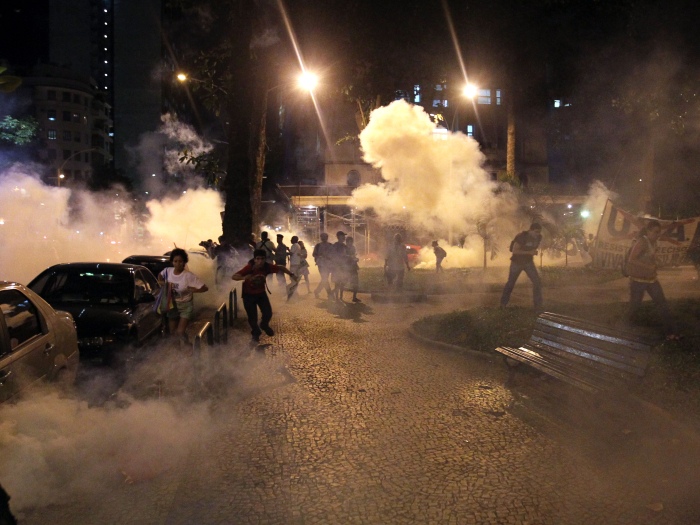 |
| Not eveyone is happy about Obama's visit to Rio de Janeiro http://noticias.r7.com/rio-de-janeiro/fotos/manifestantes-protestam-conta-visita-de-obama-20110318.html |
Mr. President woke most of the Zona Sul up this morning with his helicopters flying about. There has probably never been anyone in history that has a larger security footprint than Obama. The airports were shut down, the Brazilian Navy parked off of Copacabana, and more than 2000 Brazilian troops occupied the already occupied Cidade de Deus so that the big O could pay a visit. Where Obama goes, or plans on going, many thousands clear tens of thousands of others out of the way. There has been a media frenzy, of course, with everyone wanting to get a USAmerican on record for something (this artilce has momentarily put me in front of Frank Gaffney, from the dark side of the force in a google search for Gaffney Obama).
It’s a shame that NPR hasn’t made their more qualified reporters permanent staff in Brazil. That way those of you in North America could perhaps avoid the flaccid, banner waving drivel that came out before the Obamas descended on Brazil. On Friday, “Brazilians welcome Obama as their own” took on special meaning for football fans, organized labor, and people living in UPP favelas as protestors threw Molotov cocktails at the USA consulate downtown. The general reaction in the news was to ignore this massive protest, but the reaction amongst many Brazilians was that the protestors “estão de parabéns” – they should be congratulated. There were, on various listserves, calls for more protests of this sort, though I imagine that when faced with the FBI, Secret Service, BOPE, and the Brazilian Military, syndicalists, student organizers, and those with a memory that extends beyond 1985 figured that caution was the better part of valor.
After talking to Brazilian business interests and past presidents (with the exception of Lula who felt slighted because he was not asked to the official state dinner personally by Dilma and went to his son’s birthday churrasco instead), Obama gave a speech at the Teatro Municipal (full text here). I’ll pick on some easy things, because it’s Sunday and Obama woke me up this morning.
You play an important role in the global institutions that protect our common security and promote our common prosperity. And you will welcome the world to your shores when the World Cup and the Olympic games come to Rio de Janeiro.
We all know that the World Cup and Olympics have nothing to do with common prosperity, but the prosperity of big civil engineering firms, multi-national corporations, and corrupt sporting oligarchies. Our “common security” is one in which the banks get trillions from the government, R$33 billion gets poured into the World Cup, R$29 billion into the Olympics, and the minimum wage in Brazil is stuck at R$545 a month (US$328 x 12= US$3989 year).
We need world-class infrastructure -- which is why American companies want to help you build and prepare this city for Olympic success
Read: Brazilian money going to pay for USAmerican military and surveillance technology. The FBI has already been working with Brazilian police to install new modes of discipline in Brazilian stadiums.
Together we can also promote energy security and protect our beautiful planet. As two nations that are committed to greener economies, we know that the ultimate solution to our energy challenges lies in clean and renewable power. And that's why half the vehicles in this country can run on biofuels, and most of your electricity comes from hydropower. That's also why, in the United States, we've jumpstarted a new clean energy industry. And that's why the United States and Brazil are creating new energy partnerships -- to share technologies, create new jobs, and leave our children a world that is cleaner and safer than we found it.
There is nothing “clean” about biofuels. They require a massive, underpaid labor force and relegate unimaginably large swaths of the Brazilian northeast to mono-cropping. Brazil and the United States pollute, pollute, and pollute some more while eliminating environmental restrictions in the name of economic competition. The Brazilian Amazon has been re-territorialized so that it can be eviscerated (thanks Lula and Mangabeira Unger!). The “Brazilian dream” is to live in a condo, have at least two cars, and go to Orlando every year. (I’m only being slightly unfair here). Even if a car runs on biofuel, what about the resources needed to bring it into production? Does everyone have to have a car, Mr. President? In southeastern Brazil, the answer is yes, we can, and we bloody well will.
And as two countries that have been greatly enriched by our African heritage, it's absolutely vital that we are working with the continent of Africa to help lift it up.
When in Brasilia, Obama ordered an attack on Libya. Let’s keep the vapid paternalism flowing, that’ll make us feel good about what we’re doing while keeping Africa’s natural resources flowing in a Westerly
direction (and not to China).
The millions in this country who have climbed from poverty into the middle class, they could not do so in a closed economy controlled by the state. You're prospering as a free people with open markets and a government that answers to its citizens. You're proving that the goal of social justice and social inclusion can be best achieved through freedom -- that democracy is the greatest partner of human progress.
“Freedom” is just another word for open markets. In this sense, this is basically the same speech that W. would have given. “Democracy” is the greatest partner of increased profits and ever-expanding economies. In the speech he gave to the bidness folk in Brasilia, Obama said “When we look South towards Brazil, we see 200 million consumers.”
So hopefully once NPR gets some people who don’t just report about what they would like to believe to be true in that soft-spoken NPR world, those of you who are not living in Brazil will get a more complete picture of the perspectives and attitudes towards the USA here. There is massive ambivalence, admiration, disgust, mistrust, sympathy, and historically rooted perceptions that are not going to be overturned by Obama’s visit. People remember well the USA’s long-standing support of the military dictatorship here (and Chile, Argentina, Peru, Uruguay, Paraguay). Lula’s leftish militancy against the imperium was about as hollow as is Chavez’s. They keep their popularity by talking a big game, but in the details they hand everything over to the capitalists, developers, and USA-trained economists.
Obama has disappointed and deceived in many of the same ways as Lula. After much hope for change, he has implemented even more of the neo-liberal tools of governance to further the class-project that received such a tremendous boost under w. No one here is asking Obama how Brazilians are treated in Immigration detention centers. No one here wants to know what has gone so wrong with the “American dream”, as Brazilians are embarking upon a “development project” that is leading to a continental-scale consumer society modeled on the USA . There is no way to be green about this, much in the same way that it is impossible to have a green World Cup or Olympics, principally because there are part and parcel of the same socio-historical trajectory. It will take many, many more Molotov cocktails to alter this path.
22 February 2011
Oh no, more APO...
Today, the Brazilian lower house is taking up the possibility of reforming Provisional Measure 503/2010 (MP 503/2010) that may or may not create a new state agency to run the 2016 Olympic Games. Rio's mayor, Eduardo Paes, has been expressing his dissatisfaction with the measure which will take much of the power over Olympic construction out of his hands and put more powerful and qualified people than him in positions of power. According to today's small column in OGlobo, there does not appear to be much chance of changing MP 503/2010 as it has to be voted on before March 1. If the vote is delayed, the MP will die and Rio's Olympic project will be delayed for another few months (not necessarily a bad thing).
Apparently Dilma, Paes, and Rio state govenor Sergio Cabral are willing to let the measure die rather than create the new state agency. The creation of the Public Olympic Authority and the Brasil Sport Legacy [sic] Company (or BRASIL 2016), was a fundamental piece of Rio 2016's bid. It has been nearly a year and a half since Rio won the Olympic auction. While I agree that MP 503/2010 needs to be radically reformed, there has been no public discussion of the MP in Rio and there will be no mechanisms for civil society to participate in the decisions taken regarding the city's future. There are R$30 billion hidden agendas in this process, but if MP 503/2010 does not get voted upon, it may be just the opporutnity that Rio's social movements and public defenders need to get insert themselves into the hurricane of creative destruction that is making its way to South America.
The TCU report from last week didn't have any immediate or noticable effect on the CBF or the organization of the World Cup. Today I published a o a slightly revised version of last week's article regarding the TCU's findings about Brazil's 2014 World Cup preparations at The Shin Guardian, one of the leading footy websites in the USA:
http://theshinguardian.com/2011/02/22/brazil-stadiums-budgets-that-border-on-complete-fiction/
Coming soon: photos from a Paulista clássico, Santos (1) x Corinthians (3)
Apparently Dilma, Paes, and Rio state govenor Sergio Cabral are willing to let the measure die rather than create the new state agency. The creation of the Public Olympic Authority and the Brasil Sport Legacy [sic] Company (or BRASIL 2016), was a fundamental piece of Rio 2016's bid. It has been nearly a year and a half since Rio won the Olympic auction. While I agree that MP 503/2010 needs to be radically reformed, there has been no public discussion of the MP in Rio and there will be no mechanisms for civil society to participate in the decisions taken regarding the city's future. There are R$30 billion hidden agendas in this process, but if MP 503/2010 does not get voted upon, it may be just the opporutnity that Rio's social movements and public defenders need to get insert themselves into the hurricane of creative destruction that is making its way to South America.
The TCU report from last week didn't have any immediate or noticable effect on the CBF or the organization of the World Cup. Today I published a o a slightly revised version of last week's article regarding the TCU's findings about Brazil's 2014 World Cup preparations at The Shin Guardian, one of the leading footy websites in the USA:
http://theshinguardian.com/2011/02/22/brazil-stadiums-budgets-that-border-on-complete-fiction/
Coming soon: photos from a Paulista clássico, Santos (1) x Corinthians (3)
21 December 2010
The APO doesn't exist! Rio 2016 and the failure to deliver authority
One of the most confusing and potentially harmful elements of hosting an Olympic Games is the creation of a legal authority created to "deliver" them. In the case of London Iraq
On March 14 of 2010, the slippery Minister of Sport gave an extensive explanation about how the Autoridade Público Olímpico (APO – Rio’s version of London APO and was put in the position of describing it without, perhaps, knowing exactly how it was going to work.
Things have changed since the elections.
Now, the PCdoB (Communist Party of Brasil) wants to keep Silva at the head of the Sports Ministry for the Rousseff government. Dilma agreed. This may explain why just the other day, Silva was pretending not to know anything about the existence of the APO , saying “this thing is an idea, a concept, an organization that doesn’t exist.” This, despite the fact that Lula went to some trouble to approve a Medida Provisória (MP ) brining it into existence. However, the APO requires the approval of all three levels of government and Eduardo Paes, the little prince of Rio, has begun to grumble about the extraordinary authority given over to the APO . Without the approval (or involvement) of Paes in the APO it is unlikely that his cabal of city council members will approve the MP, leaving the 2016 Olympics without an organizing structure. I am not against the disappearance of the APO , as it appeared to be an institution designed to deliver money to the contractor friends of the governor and mayor. But the IOC must really be wondering what the hell is going on with the organization of the 2016 Games, as 15 months after awarding them to Rio, there is no clear direction being taken for their implementation.
There has been rumor that the Dilma government will create an independent ministry to organize the Olympics. This is exactly what Brazil
It is clear that no one really knows what is going on. On the front page of the Rio 2016 website is a Maracanã project that is not being planned (according to the SUDERJ and Brazil 2014 descriptions). The main news that is being spammed to the media outlets is about the countdown to the launching of the Rio 2016 brand on New Year’s Eve (oh, so exciting). The city government is launching aggressive and violent campaigns to kick people out of their homes so that huge concrete sluices can carry buses back and forth to the Olympic Zone in Barra de Tijuca. City, State, and Federal troops are occupying hills throughout the city.
Is this surprising? No. Why not? The same people who were in charge of the Pan American Games are directing the Olympics. The “legacy” benefits of that event were ZERO. Orlando Silva cited the event that he helped to direct as a failure (I heard him say this personally). Silva went so far as to blame the bloody defeat of Cesar Maia (former Rio mayor) in his bid for State Senator on the failures of the Pan. Ten years from now, who will we blame for the housing crisis, the lack of functional transportation, the poor air and water quality, the lack of decent jobs in the city, the absence of legacy benefits from the 2016 Olympics?
06 December 2010
A partial response to a question unanswered
Of the many elements of my question that Lula did not respond to, the notion of changing federal, state, and local laws in order to host mega-events is one of the most important and insidious. In Brazil
One of the methods used by the Brazilian executive branch to dribble democratic processes is known as a MP (Medida Provisória), similar to the kind executive order used by George W. to invade Iraq
In July 2010, President Lula signed MP 496/10 that allows cities that will host the World Cup to extend their debt levels above their level of revenue, violating a federal law that requires cities to maintain balanced budgets. This MP opens the path for excessive public spending. According to lawyers and economists, this will encourage reckless public spending under “emergency conditions”, creating a situation similar to the 2007 Pan American Games which was ten times over budget, was able to sidestep well-established contracting procedures, left behind useless and decaying structures, and resulted in multiple lawsuits against the organizers.
Lula held the contrary view, saying that “this is important so that we don’t repeat the errors of the Pan. We tried to construct a pact to figure out who was responsible for what and it didn’t work”. “Acho que isso é muito importante para a gente não repetir os [erros dos] Jogos Pan-americanos. A gente tentou construiu um pacto para saber qual a responsabilidade do governo federal, estadual e municipal. Não deu certo”, lembrou.
Not satisfied with the indebtedness of cities, it is also necessary to open the nation’s frontiers to any and all materials imported to construct, amplify, or reform buidings for the World Cup and Olympics. MP 497/10 creates a free trade zone that is equivalent to a massive public subsidy for foreign firms to do business in Brazil
Last week, the city government of Rio de Janeiro
We’ve seen over the last weeks the ways in which the state has been violently intervening in Rio de Janeiro
(I’m not sure if any one has undertaken a larger sociological examination of the role that “inviting the world to Rio ” is going to have on Carioca society. Cariocas’ are generally reluctant to invite people into their homes, preferring to meet in public spaces, bars, street corners, etc. The airing of dirty laundry in the face of the world’s press, which will undoubtedly be going through the metaphorical closets, might be rather embarrassing and can be considered one of the risks of hosting mega-events).
Lula, of course, is in favor of the World Cup and Olympics as they represent significant gains in Brazil
There is no evidence to support the notion that cities, states, or nations ever recuperate their investment in mega-events. The short and medium term consequences for what I would consider necessary social spending (housing, education, transportation, health) are dire. In the case of Rio de Janeiro
This is nothing new, but it is interesting to hear how the “leftist” president of Brazil
Lula is justifiably proud of many of the accomplishments of his government, but the idea of eliminating or lowering tariffs on foreign companies and altering laws so that FIFA and the IOC can come in and contribute to the explosive growth of a consumer society (of which the recent invasions are meant to “secure”) is abusive, short-sighted, and un-democratic. The proof is in the alteration of laws which will stimulate short term gains for a few, which the cities and their residents will live with the debt and alterations to urban space for the next generations.
Lula’s closing comments at the collective interview provide deep insight into the way he (and the incoming president, Dilma) view the role of government.
“If you look at the world today, among the largest hydroelectric dams under construction, the three largest are being built in Brazil Brazil Brazil : norte-sul, de 1.530 km, nordestino that will link Ceará and Pernambuco passing for Piauí, 1.900 km, and the East-West that will link Bahia with Belém. So we have three of the biggest rail lines in the world under construction. If you look at what we are doing, you will see that we are also building for of the biggest refineries in the world, Comperj in Rio de Janeiro Brazil Brazil
This is the new look of the Worker’s Party in Brazil
What Lula doesn’t say, and refused to answer, was that he has signed laws and is working to create cities that will encourage private urban governance and the spectacularization of consumption and leisure in the form of blinged-out stadiums, fancy waterfront restaurants, and exclusive shopping districts.
Get your authenticity packaged up by staying in a 2 star boutique hotel in the Complexo de Alemão, or Pavão-Pavãozinho, where just last year drug traffickers ruled! Don’t worry, it’s occupied by shock troops, nothing to fear (anymore). Come to Rio, your safe, yet legally justified, debt-laden haven for unlimited capital accumulation where things will look just like Barcelona
Subscribe to:
Posts (Atom)