Showing posts with label Transcarioca. Show all posts

26 February 2013

Passando dos Limites / Going too far

The monthly salary for a public school teacher is around R$1600. I do not know people who work harder with fewer resources to do society`s most important and least valorized work. I can only imagine the complete indignation and revolt of public school professionals when the announcement came that the city government spent more than a million reais (US$500,000) to buy 20,000 copies of a board game to be distributed to the city`s schools. The game, presumably, will become an obligatory element of the curriculum. The game is called Banco Imobiliário Cidade Olimpica, or Olympic City Monopoly.

What are the UPPs about again?
It is difficult to know where to begin criticizing the idea that schoolchildren be indoctrinated with the ideology that the public places and spaces of the city be treated as mere commodities used to accrue personal wealth and power. We could begin with the fact that only the current administration`s projects are highlighted in the game, giving the impression that the mayor, governor and their cronies have produced the urban landscape since taking office. We could also highlight the fact that arbitrary monetary values are assigned to public places, eliminating any and all conception of use value for those that have paid for these things (the public) and transforming every element of the urban into something that can be traded on the open, deregulated market. How about the “sorte” (luck) card that says: “the value of your home increases after the favela in your neighborhood was pacified, receive R$75,000”. Paulo Freire is turning like a rotisserie chicken in his grave.

Just when I was starting to lose the hard edge of permanent pessimism, the perverse pedagogy and poor taste of the mayor took physical form in the public space of Copacabana Fort. In the fort, which is a federal property, a private club has opened to attend to the beautiful people [sic] of Rio`s Zona Sul who can no longer tolerate the hoi polloi and undifferentiated tourist mass of Ipanema and established a clubby off world inside the fort. Veja`s coverage was nauseatingly apologetic: “Club attracts high class clients in search of vip treatment and the experience of sharing the beach with people of the same profile”. A mere R$250 gets you into the club that has a pool, discreet waiters, blaring electronica, hot tub, R$5000 bottles of campaign, R$80 face towels and a lax security force that ignores the clouds of pot smoke drifting off the dance floor. If you are surprised that rich, white Brazilians are able to smoke weed bought in favelas inside a military fort while the favelas themselves are occupied by the military, then you clearly haven`t spent enough time playing Banco Imobiliário.

A few weeks ago I reported on the judicial victory of the Aldeia Maracanã. During the negotiations the government had offered to work with the Aldeia in some regard in order to maintain the site as a part of Brazil`s indigenous heritage. Incredibly, but unsurprisingly (another of Rio`s characteristics is that you are not surprised at being shocked), the brain trust of Rio 2106 and the State Government announced that the indigenous people would be expelled and the site transformed into an Olympic museum with all profits acruing to the IOC! Huh? This is the same set of intellectual heroes that have programmed the destruction of an Olympic swimming pool and an Olympic training center in order to prepare the city for the Olympics. It is a sadly transparent attempt to turn a judicial defeat into a victory. 

These paradigms of competency in public planning have also determined that the facilities constructed for the 2007 Pan American Games are almost completely inadequate. You know the situation is dire when OGlobo starts criticizing the R$1.6 billion that will have to be spent on the 2007 facilities to make them viable for 2016. To wit: the velodrome is being destroyed, the aquatics center will only host water polo while a temporary diving center will be built at the Copacabana Fort (someone better get rid of the rich potheads first), the basketball arena will only be used for gymnastics and every other installation will have to undergo massive upgrades. Of course, there is still no budget for the 2016 Games, and even if there were why should the public pay any more attention to it than the Games organizers themselves? 

A series of fires have occured in the Autodromo de Jacarepagua, site of the future Olympic Park. These are not ordinary fires but massive conflagrations of discarded tires. The toxic smoke has infiltrated the Vila Autodromo over the past weeks, creating a health and environmental hazard. This could be another manifestation of the pressure tactics used by the government to encourage people to leave their homes or at least to reconsider their negotiating position. When there is not grave incompetence in public administration there is likely malice and vice versa. Somtimes it is both. 

Evidence to support this last statement came from the Largo do Tanque this week where a series of forced removals occurred as the municipal government races to complete the Transcarioca BRT before the World Cup. The reports from Tanque are as disturbing as they are tragic. There is evidence that agents of the municipal government are negotiating the price of homes with the residents as the bulldozers circle the house. This is not the “key for key” policy dictated by Brazilian law and international statutes but rather an underhanded and divisive approach to eliminating social resistance to the invented needs of massive urban interventions. A few years ago there were a series of signs along Flamengo Beach that spelled out the Universal Declaration of Human Rights. Those signs, along with the rights, have disappeared in the Cidade Maravilhosamente Especulativa.

The involuntary interment of crack addicts and homeless people continues throughout the eastern and southern parts of Rio. Rio`s program of forced interment is widely criticized by health care professionals as doing nothing to solve problems of mental health, physical addiction or the social conditions that produce such large numbers of homeless in Rio. There have been few investigations into the conditions of the internment centers, no data released on how long people are kept, what happens to them upon release or the efficacy of the program in decreasing crack use. Though it might be a stretch, the BRTs are no more a solution to Rio`s mobility problems than is the involuntary internment program a solution to drug addiction and homeless. In both cases human rights are violated while being sold as necessary for the betterment of the city.

The General Osorio metro station opened in 2010, bringing the Metro to Ipanema 35 years after its inauguration. Last week the General closed his doors for 10 months so the extension to the one and only metro line in the state can start. Just to be clear, two years ago the line was extended to Ipanema with the full knowledge that it would have to be further extended for the Olympic transportation project. Instead of planning for that extension without needing to close the station the top-notch intellects at Rio Metro closed the tunnel system and therefore have to pick up where they left off in 2010. In addition to the inconvenience of the closure, the astronomical sums of money and urban disruptions of the Linha 4 [sic] are causing protests and revolt among even the stodgy lovers of the status quo in Leblon.

And finally, the call for proposals for the privatization of the Maracanã was launched on Monday. The companies that are bidding for the 35 year “concession”, IMX and LusoArenas, will have one month to submit their proposals and then a committee comprised of ONE PERSON will rule in favor of one or the other. As IMX was the external consultant that devised the economic feasibility study it looks as if Eike Batista will be able to add another of Rio de Janeiro`s iconic spaces to his Banco Imobiliário. The billionaire with the ten dollar toupee has not been having much luck financially lately, but was recently granted his long-time wish to build a nine-story convention center in the Marina da Glória. The agency responsible for protecting Rio de Janeiro`s architectural and cultural heritage, IPHAN, has once again surfed the wave of privatization. There are likely no cards in the Banco Imobiliário game that represent IPHAN or IBAMA or INEA (environmental regulatory agencies), much less something that would make one pay for an impact study or have to spend money and time consulting the public about the future use of public space.

This Thursday, 28.2.13, the Comitê Popular da Copa e das Olimpiadas is sponsoring a seminar that will treat the Maracanã in all of its symbolic, historical, political and cultural complexity. The seminar will begin at 2pm in the auditorium of the the Associação Brasileira de Imprensa, on Rua Araujo Porto Alegre, 71. More details can be found on the Comite`s site: www.comitepopularrio.wordpress.com

18 September 2012

General update


Earlier this year, after Vasco was judged to have maintained some of their youth players in “conditions of slavery” at a clandestine training site, I stopped watching football. In Brazil, it’s impossible not to pay attention to novellas of some kind, but I have found that my decision to drop my active support for Vasco (though I’m still Vasco) has freed me to do other things. It’s actually quite a relief not to suffer the difficulties of fighting for a place in the Copa [your name here] Libertadores, or to get upset when we lose 4-0 at home and the very popular, very good manager is forced to resign. The more one knows about the way Brazilian football works, the more revolting it becomes. Quem conheça a cozinha não come mais.

In some respect, the only way that Brazilians give any credibility to my indignation and revolt against Vasco is by me staying away from the game. If I were to follow Vasco closely after calling them out on the international stage, people would have (and some did) questioned my “claim to authenticity”. As Vasco continues to disgrace its history and delude its supporters by trying to get out from under the judicial decisions that would make them treat their trainees decently, they are also being sued by Romário for back wages of R$50 million. The politics of the Vasco directorship continue in the very same, sad, tired vein as the CBF and Brazilian football in general. Without popular, judicial, or political pressure to change, nothing ever will. If you’re satisfied, keep giving your support as you always have. More Bread and Circus please, hold the bread.

As predicted, the Paralympic flag did not make the same rounds as the Olympic flag. It floated on over to a center for the disabled in Santa Cruz, and that was it. This week, even O Bobo was forced to publish a piece on the nearly complete inaccessibility of the city for people in wheelchairs. With four years to the Paralympics, the new metro cars and 40% of the bus fleet are inaccessible. In more than three years of riding city buses, I have only seen one person try to get on in a wheelchair. Why? It’s nearly impossible! There is only one crosswalk in all of Rio that has a sound alert for the blind. ONE! As I suggested in my last post, if we had the Paralympics first, these “problems” would become priorities.

The BRT Transoeste has now claimed five lives and injured many more since its inauguration in June. On a recent trip along the proposed trajectory of the BRT Transcarioca, it became clear that the entire region will be sliced in half, with street crossings limited to stop lights and pedestrian overpasses. Talk about making things difficult for the disabled and elderly! There is no indication that all the overpasses will have elevators, and even if they were to have them, would they be used? Cariocas are masters of finding the shortest trajectory across busy streets, even if those streets are packed with high speed buses. If no one will go an extra 30 meters to use a crosswalk or an underpass, why will they begin to climb with their bags in the heat of the day? Unfortunately, the Transcarioca will kill as readily as the Transoeste. 

27 June 2012

Change of pace

Something different to keep you happy for the next few weeks while I run to yet another international conference, making sure that my carbon footprint matches my electronic. Pick 'em up and put 'em down, I say.


The above scene is kind of like a forest before being flooded by a hydroelectric plant. The Transcarioca BRT will slice down the middle of this street, sending high speed buses between the international airport and Barra de Tijuca. The street will be widened to 30 meters, and the sidewalk diminished to 1.5 meters on either side. These informal crossings will become even more dangerous. If the BRt is to even approximate its projected capacity, a bus will have to pass in each direction every 30 seconds. There will be no bike lane and the BRT stations are not projected to have bike racks. The BRT will cut this neighborhood in two, forever. No one in the region has much information about the timeframe for implementation and it seems unlikely that the city government will be offering much clarity.

On the same street, Vincente Carvalho, a group of houses was destroyed to make way for the Transcarioca. The city left the rubble in front of the remaining houses and kind of built a barrier to demarcate the limit of the disappropriation. One resident here was fairly livid about the process as she is a renter and had to complete the wall with her own money. In the background to the righ tof the guy on the phone is a sign that reads: ATTENTION: Please don't throw trash. Just beyond him are a series of buildings that will also be destroyed to make way for the BRT, but negotiaions with the business owners have not yet begun.

 Morro da Providencia, Zona Portuária. Though difficult to see, the blue bins belong to the Consorcio Porto Novo, the group responsible for the 5 million square meter gentrification project known as the Porto Maravilha. This trash collection point has been made worse by the installation of a tram line that will link Providencia with the Central rail terminal. According to residents, COMLURB trucks used to make regular collections here but their trucks can no longer access the morro because the street has been blocked by the "public works" teleférico project  - a project that never had any community involvement.


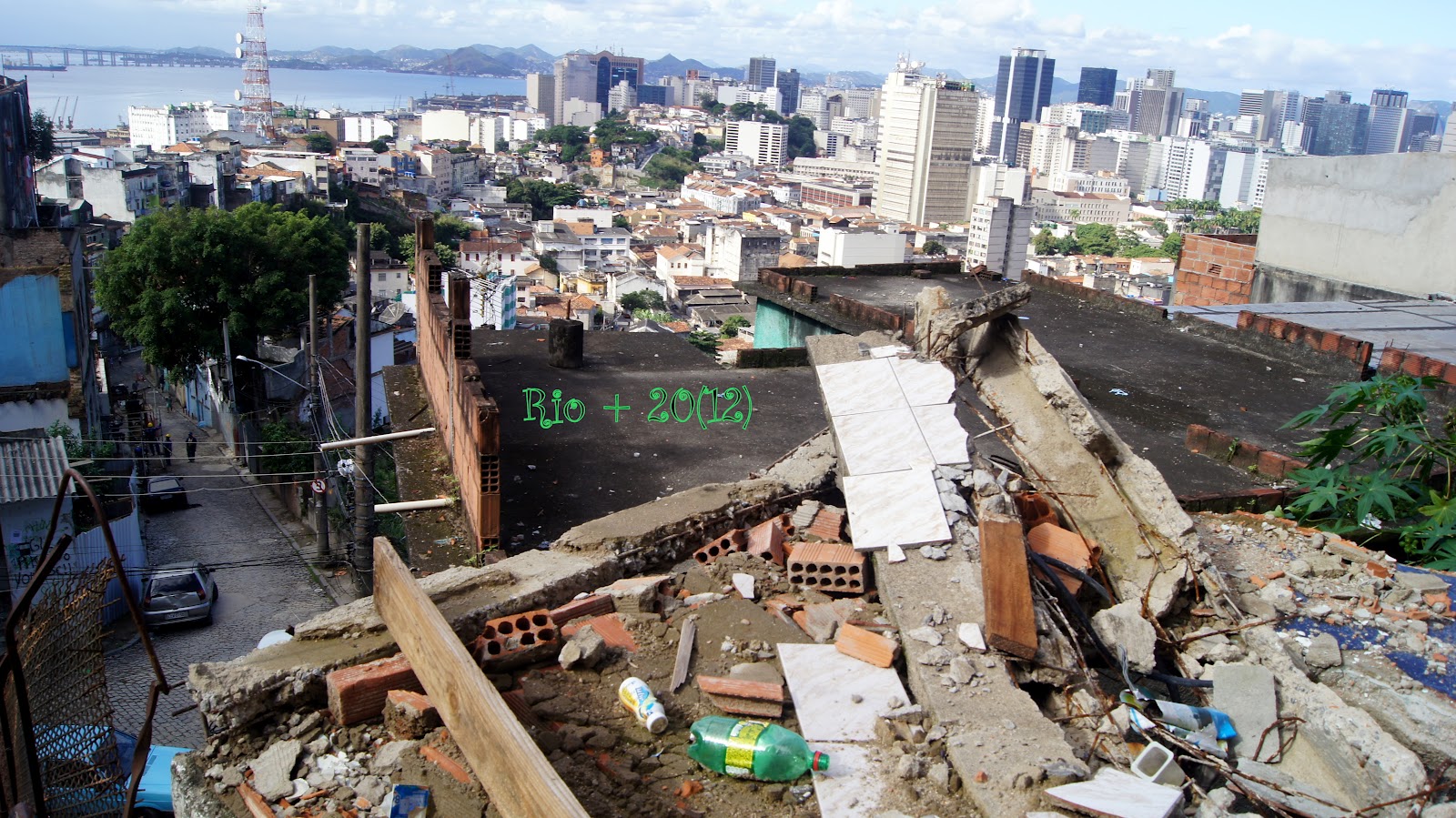
Forced removal on the Morro da Providencia. This rubble was left behind by a housing demolition that occurred after Providencia was occupied by the Military Police. UPPs all over Rio have unleashed a series of polemics ranging from controversial "thinning" projects, massive real-estate speculation, the elimination of popular culture (funk parties), and the opening of relatively closed social and physical spaces to aggressive forces of capital accumulation. The benefits and drawbacks depend on who you ask and which topic you want to treat. The discourse of UPP occupied favelas as being safe and interesting places for tourists to still experience "authenticity" in Rio is given a good run at Rioonwatch while others have been less reflective about the naked advertising of occupied favelas for foreign visitors.

finally, yet another very cool example of Rio's amazing street art

free counters

Labels

2014 World Cup Rio de Janeiro Maracanã FIFA 2016 Olympics 2016 Summer Olympics Eduardo Paes CBF Copa do Mundo 2014 Rio de Janeiro Olympics Ricardo Texeira World Cup 2014 Vasco da Gama 2010 World Cup White Elephants mega-events APO UPP BRT Brazil football Flamengo Lula Orlando Silva violence ANT Aldeia Maracana Carlos Nuzman Dilma Eike Batista Rio 2016 Sergio Cabral 2007 Pan American Games Campeonato Carioca Corruption IOC Jerome Valcke Novo Maracanã stadiums BOPE BRASIL 2016 Brasil 2014 Engenhao Joao Havelange Maracana Policia Militar Vila Autódromo Aldo Rebelo Botafogo Henrique Meirelles Medida Provisoria Metro Revolta do Vinagre Sao Paulo Sepp Blatter World Cup 2010 forced removal Carnaval Elefantes Brancos Fechadao Marcia Lins Minerao Morumbi Odebrecht Porto Maravilha Rio+20 Romario Security Walls South Africa South Africa 2010 TCU Transoeste protests public money public transportation slavery transparency x-Maracana Andrew Jennings Argentina Audiencia Publica Barcelona Brazil Carvalho Hosken Comitê Popular Confederatons Cup Copa do Brasil 2010 Cost overruns Crisis of Capital Accumulation EMOP FERJ Favela do Metro Fluminense Fluminese Fonte Novo IMX Jose Marin Leonel Messi London 2012 Marcelo Freixo Maré Museu do Indio Olympic Delivery Authority Perimetral Rocinha Soccerex Transcarioca bicycles consumer society debt idiocy militarization transportation 1995 Rugby World Cup 2004 Olympics 2015 Copa America Banco Imobiliario Barcas SA Belo Horizonte Bom Senso F.C. Brasilerao CDURP CONMEBOL Champions League. Mourinho Complexo do Alemão Copa Libertadores Cupula dos Povos ESPN England FiFA Fan Fest Istanbul 2020 Jogos Militares John Carioca Kaka Manaus McDonald's Obama Olympic Village PPP Paralympics Providencia Recife Russia Salvador Soccer City Taksim Square Tatu-bola Urban Social Forum Vidigal Vila Olimpica War World Cup Xaracana attendance figures cities corrupcao drugs estadios football frangueiro futebol mafia planejamento urbano police repression porn privitization reforms shock doctrine taxes 201 2010 Elections 2010 Vancouver Olypmics 2013 2018 World Cup 2030 Argentina / Uruguay ABRAJI AGENCO ANPUR ANT-SP Amazonia Ancelmo Gois Andrade Gutierrez Anthony Garotinho Arena Amazonia Arena Pernambucana Athens Atlético Paranaense Avenida das Americas BID Barra de Tijuca Blatter Brasil x Cote d'Iviore Brasileirão 2013 Brasilia Brasilierao Bruno Souza Bus fares COB COI COMLURB CPI CPO Cabral Caixa Economica Canal do Anil Cantagalo Celio de Barros Cesar Maia Chapeu Mangueira Chile 2015 Choque do Ordem Cidade da Copa Class One Powerboat Racing Clint Dempsey Comite Companhia das Docas Copa do Brasil Corinthians Cuiabá Curitiba Dave Zrin David Harvey Der Spiegel Eastwood Edge of Sports Escola Friendenrich Expo Estadio Expo Urbano FGV Fonte Nova Gamboa Garotinho Geostadia Ghana Globo Greek Debt Crisis Greek Olympics HBO Hipoptopoma IMG IPHAN ISL Iniesta Internatinal Football Arena Invictus Istanbul Itaquerao Jacque Rogge Jefferson John Coates Jose Beltrame Julio Grondona Julio Lopes Julio de Lamare Knights Templar Korea Lei Geral da Copa MAR MEX Manchester United Mangabeira Unger Maracanã. Soccerex Marina da Gloria Mexico Milton Santos Molotov Cocktail Mr.Balls Neymar Nicholas Leoz Nilton Santos Olympic Flag Olympic Park Project Oscar Niemeyer Pacaembu Pan American Games Parque Olimpico Pernambuco Plano Popular Plano Popular do Maracana Plano Popular do Maracanã Play the Game Pope Porto Alegre Porto Olimpico Porto Seguro Portuguesa Praca Tiradentes Preview Projeto Morrinho Putin Qatar Quatar 2022 RSA Realengo Regis Fichtner Roberto Dinamite Russia 2018 SETRANS SMH Santa Teresa Santos Sao Raimundo Sargento Pepper Security Cameras Smart City Sochi 2014 South Korea Stormtroopers São Januário São Paulo Teargas Templars Tokyo 2020 Tropa do Elite II Turkey UFRJ/IPPUR URU USA USA! Unidos da Tijuca United States government Urban Age Conference VVIP Via Binário Victory Team Vila Autodromo Vila Cruzeiro Vila do Pan Vilvadao Vivaldao Volta Alice Wasteland Workers' Party World Cup 2018 Xavi Zurich apartments atrazos barrier beer bio-fuels bonde capacities civil society comite popular copa sudamericana crack crime dengue dictatorship estádios favelalógica feira livre fiador flooding freedom of information furos geral graffiti guarda municipal host city agreement identity infrastructure ipanema istoe labor rape riots schedule school shooting security segregation social movements stadium state of exception supervia tear gas ticket prices torcidas organizadas tourism traffic tragedy trash trem-bala velodromo wikileaks xingar